Explore our insights
Asset class
Formats

Education

Education
Investors are exploring new ways to diversify their portfolios in pursuit of potentially higher returns, lower volatility, and more effective risk management. An increasingly popular way to do so is by incorporating private-market investments and other alternative assets that aren’t always easy to access. But these investors also need to balance their desire for higher returns and lower volatility with their periodic limited liquidity needs. As a result, there continues to be growing interest in interval funds — a vehicle that sits at the intersection of traditional mutual funds and ETFs, which are broadly available to individual investors, and private funds, which are typically restricted to institutional and other qualified investors. In this article, we break down:
Understanding interval fund structure
To understand interval funds, it’s important to recognize how they differ from other investment vehicles. Traditional mutual funds let investors buy and sell shares daily at net asset value (NAV). With ETFs, blocks of shares, called creation units, are sold to broker-dealers at NAV, then investors buy and sell shares on secondary markets (exchanges), where their price may move above or below NAV based on market demand. Traditional closed-end funds issue a fixed number of shares once during an initial public offering. After that, their shares can trade on exchanges in the same way that ETF shares do.
Interval funds are a distinct type of closed-end fund that blend features of both open- and closed-end structures. Shares of an interval fund are offered continuously, like shares of mutual funds and ETFs. However, unlike mutual funds and ETFs, which can sell their shares on a daily basis, investors can only sell their interval fund shares back to the fund at specific times (known as “intervals,” which are typically every 3, 6, or 12 months) laid out in the fund’s prospectus. Interval funds can only accept redemption requests during these particular windows, which may be a few weeks long, or possibly shorter. These limited redemption opportunities give managers flexibility to invest in less liquid assets that may offer higher return potential.
As with open- and closed-end funds, interval funds can be available to any investors capable of meeting the investment minimums, and they can serve as the underlying vehicle for a wide range of investment strategies, each with different goals and potential outcomes. Notably, this makes interval funds broadly more accessible than private funds, which have similar capabilities to invest in less liquid assets, but are only available to qualified investors.
Interval funds are also a more flexible option than private funds because they have set redemption opportunities, while private funds tend to have longer lockup periods. Because they fall somewhere in the middle of the spectrum between traditional vehicles and private funds, interval funds may be a useful choice for investors seeking to strike a balance between liquidity and return/diversification goals. Please note that an interval fund will only accept requests for redemptions during a particular window within a calendar quarter, which may be a few weeks long or possibly shorter.
Figure 1 below compares key interval fund characteristics to other investment vehicles, such as traditional closed-end funds, open-end mutual funds and ETFs, and private funds.
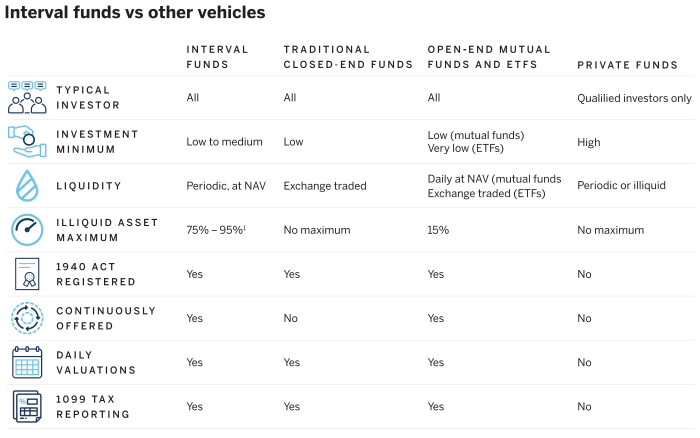

One of the most significant advantages of interval funds is their ability to access a broader set of investment opportunities. Given their ability to invest in less liquid assets like private loans, real estate, or private equity, they may offer higher return potential, often referred to as an “illiquidity premium.” By investing in assets with low correlations to traditional stocks and bonds, interval funds can help diversify a portfolio and seek to deliver a more resilient return profile over time.

As noted, interval funds offer a way to access less liquid investments while still maintaining some level of liquidity. Their redemption windows are limited in time and subject to caps, but they can offer more flexibility than private fund structures.1

Interval funds have the same 1099 tax treatment as open- and closed-end funds, while private funds are often subject to more complicated tax reporting.
Of course, just as interval funds may have some relative advantage over other vehicles, they have relative disadvantages in some cases, as illustrated in the Figure 1 above. Interval funds may have higher investment minimums than standard open- or closed-end mutual funds. Additionally, while they can offer better limited periodic liquidity terms than private funds, there are liquidity constraints relative to open-end mutual funds and ETFs, making them more suitable for investors with longer time horizons.
Who should consider interval funds?
Interval funds may be a compelling choice for investors who have a longer-term time horizon to seek the potentially higher returns and diversification benefits illiquid securities can offer, and who want to do so with a degree of flexibility. They may be beneficial for investors seeking to diversify their portfolios through transparent products with relatively simple tax reporting. Individual investment goals, time horizon, and risk tolerance are all important considerations, but for many investors, interval funds may offer an accessible avenue to illiquid investments.
1Typical illiquidity maximum during pendency of repurchase offer is 75%-95%. Limited liquidity is available to interval fund shareholders only through a given fund’s offers to repurchase between 5% and 25% of its outstanding shares at net asset value.
IMPORTANT DISCLOSURE
For financial advisor and institutional use only. Not for use with the public. All investing involves risk. Diversification and active investment do not ensure profit or protection against losses. This is for educational and informational purposes only. Nothing herein constitutes investment advice or a recommendation and should not be relied upon as a basis for making an investment decision. This document does not constitute an offer to sell, or a solicitation of an offer to buy, any security or instrument, or a solicitation of interest in any Wellington vehicle, account, or strategy. Opinions expressed reflect the opinions of the author(s) as of the date indicated and are based on the author's opinions of the current market conditions, which is subject to change. Past events and trends are not necessarily indicative of future events or results. Forward-looking statements should not be considered as guarantees or predictions of future events. While any third-party data used is considered reliable, its accuracy is not guaranteed. This material and/or its contents are current at the time of writing and may not be reproduced or distributed in whole or in part, for any purpose, without the express written consent of Wellington Management.
PAST RESULTS DO NOT PREDICT FUTURE RETURNS.
Disclosures:
Interval Funds are complex based on the structure, the potential to have cash locked up for far longer than investors might want, and the much higher costs than liquid mutual funds tend to have. Liquidity risk may be greater in interval funds. Interval funds make periodic offers to repurchase a portion of outstanding shares, therefore investors cannot sell their shares at any given time. An investor can only exit the fund at the designated intervals as described in the fund’s prospectus.
An investment in an interval fund is not suitable for investors who need certainty about their ability to access all of the money they invest in the short term. Before investing in an interval fund, investors should be knowledgeable to the risks associated with the investment vehicle, including the liquidity risks discussed herein, and the risk that the fund’s ability to be fully invested and achieve its investment objective.
Interval funds make periodic offers to repurchase a portion of outstanding shares, therefore investors cannot sell their shares at any given time. An investor can only exit the fund at the designated intervals as described in the fund’s prospectus.
Diversification neither assures a profit nor guarantees against loss in a declining market which may allow the interval funds to be less correlated to other traditional stock and bond investments, potentially helping mitigate aggregate volatility in a portfolio.
There can be no guarantee that any strategy (risk management or otherwise) will be successful. All investing involves risk, including potential loss of principal.
What Is an Interval Fund?
Is a closed-end mutual fund that doesn’t trade on an exchange and only allows investors to redeem shares periodically in limited quantities. These funds can own illiquid investments that ordinary mutual funds cannot.
What Is an Exchange-Traded Fund (ETF)?
An exchange-traded fund (ETF) is an investment fund that holds multiple underlying assets. It can be bought and sold on an exchange, much like an individual stock. ETFs can be structured to track anything from the price of a commodity to a large and diverse collection of stocks—even specific investment strategies.
What Is an Open-End Fund?
An open-end fund allows investors to contribute money into a shared, professionally managed portfolio of securities, with the fund creating new shares as needed to match demand. The fund sponsor sells shares directly to investors and redeems them as well. These shares are priced daily based on their net asset value (NAV).
What Is a Closed-End Fund?
A closed-end fund sells a set number of shares once through an initial public offering (IPO) to raise investment capital. These shares are then traded on a stock exchange, with no new shares being issued or new money added to the fund.
What Is a Private Investment Fund?
A private investment fund is an investment company that does not solicit capital from retail investors or the general public. Members of a private investment company typically have deep knowledge of the industry as well as investments elsewhere.
Continue learning











URL References
Related Insights