


- Fixed Income Portfolio Manager
- Boston
United States, Institutional
Change
The views expressed are those of the author at the time of writing. Other teams may hold different views and make different investment decisions. The value of your investment may become worth more or less than at the time of original investment. While any third-party data used is considered reliable, its accuracy is not guaranteed. For professional, institutional, or accredited investors only.
As discussed in our 2022 credit sector outlook piece, Break with tradition in 2022, we see opportunities in a few nontraditional credit sectors that stand out to us as having a higher probability of generating excess returns in the months ahead (Figure 1):
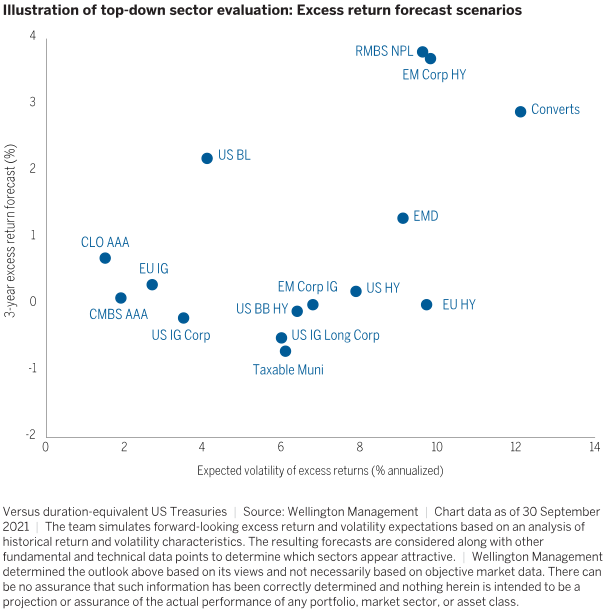
Reductions in fixed income portfolio risk may be warranted in the months ahead, especially if valuations remain tight or compress further. However, we also think investors should remain nimble if, for example, bouts of increased volatility lead to greater idiosyncratic dispersions or inefficiencies across fixed income markets.
In this still-uncertain market environment, a “barbelled” approach, consisting of larger allocations to higher-quality, liquid assets like cash and developed market government bonds, may make sense. For greater return potential, where appropriate, leaning further into those select, nontraditional sectors highlighted above may be an effective strategy in 2022.
Please read our full 2022 credit sector outlook piece, Break with tradition in 2022, for a deeper dive. And for related content, be sure to check out A credit strategy designed for all seasons, authored by several of our fixed income and multi-asset colleagues.


Rapid fire questions with Jeremy Butterworth on 2026 credit markets
Continue readingResilient growth, rising risks: Investing through the energy shock
Continue readingHigh asset prices, not low interest rates, are driving inflation
Continue readingBy
URL References
Related Insights

Weekly Market Update
What do you need to know about the markets this week? Tune in to Paul Skinner's weekly market update for the lowdown on where the markets are and what investors should keep their eye on this week.

Rapid fire questions with Jeremy Butterworth on 2026 credit markets
Investment Strategist Jeremy Butterworth discusses why credit markets have remained resilient despite shifting rate expectations, where dispersion is creating opportunities for active investors, and why Asia continues to offer a compelling credit opportunity set.

Resilient growth, rising risks: Investing through the energy shock
Macro Strategist Eoin O’Callaghan explores the drivers of resilient growth amid the continued energy shock and discusses why investors need to keep a close eye on evolving macro conditions.

European high yield: time for selectivity
Portfolio Managers Konstantin Leidman and Thomas Kelly, and Investment Director Jennifer Martin discuss how European high-yield investors should rethink their approach in response to historically tight spreads.

September FOMC: Doves capitulate
For the first time in over three years, the Fed raised the target rate range to 3.75%-4.00% in September. Our team looks at what's driving the shift and what it means going forward.

AI capex and the new credit cycle
Fixed Income Portfolio Managers Alyssa Irving and Liz Kleinerman, and Head of Investment Grade Private Credit Emeka Onukwugha explore the emergence of an AI investment cycle in credit markets.

Band-aids, bazookas, and boomerangs: Equity investing in a volatile US rate regime
With fiscal pressures and Treasury-market fragilities keeping bond yields volatile, Macro Strategist Juhi Dhawan outlines implications for equity investors.
High asset prices, not low interest rates, are driving inflation
Wealth distribution in the US has rendered the Federal Reserve’s usual tools less effective. The Fed will need to address asset prices head-on in creative ways if it is going to return inflation to target.
By
URL References
Related Insights







Monthly Market Review — August 2026
A monthly update on equity, fixed income, currency, and commodity markets.
By