




- Portfolio Manager
United States, Institutional
Change
The views expressed are those of the authors at the time of writing. Other teams may hold different views and make different investment decisions. The value of your investment may become worth more or less than at the time of original investment. While any third-party data used is considered reliable, its accuracy is not guaranteed. For professional, institutional, or accredited investors only.
This year is shaping up to have a macro backdrop very few investors have ever experienced. Most central banks are loosening policy into what we would characterize as historically tight labor markets. The scale and impact of US tariffs will be an ongoing question, and the market will likely continue to oscillate between different macro narratives. Unknowns around the direction of the economic cycle may force investors to consider a wider distribution of cyclical outcomes and policy responses. This sets the stage for:
In light of its recent 25th anniversary, our Opportunistic Fixed Income Team reflects on these challenges and potential opportunities for investors who are able to maintain perspective, flexibility, and a thoughtfully constructed, diverse fixed income portfolio.
When it comes to investing, it’s easy to let inertia inform decision making. If something is working, it’s human nature to believe it will keep working. If something did — or didn’t — work before, you’re likely to think it will — or won’t — again. But history suggests the worst strategic asset-allocation decision is to extrapolate current or past dominant trends to inform future choices.
Today’s winners may not keep winning, and/or they may be overpriced, unable to continue generating compelling returns. Yesterday’s losers might turn it around. So, it’s important to think outside of these terms and focus on what matters.
So, what matters? When it comes to fixed income portfolio management, we contend that overall portfolio construction is arguably more important than credit security selection. In our view, a mindfully constructed portfolio has layers of diversification embedded in its structure. This may mean investing across different sectors, time horizons, geographies, styles, and objectives. A flexible, diverse approach to fixed income can potentially maximize risk-adjusted returns over time (Figure 1).
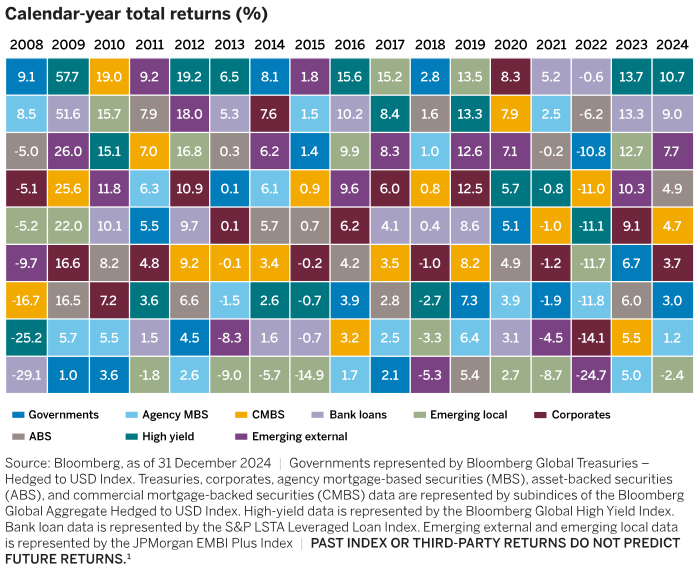
Taking a holistic approach to fixed income may help investors create portfolios capable of both weathering storms and generating attractive returns. This helps minimize the need for “on-the-fly” risk management — a good thing, we think, because unwinding the psychological effects of experiencing a bout of significant risk can be difficult and cost investors opportunities.
This type of mindset may prove beneficial in times of volatility or uncertainty, like these, when it can be necessary to pivot away from even the most comfortable prior plans or maintain long-term optimism in the face of short-term challenges in order to manage risk and seek returns.
1The "S&P LSTA Leveraged Loan Index " is a product of S&P Dow Jones Indices LLC or its affiliates (“SPDJI”) and has been licensed for use by Wellington. Standard & Poor’s® and S&P® are registered trademarks of Standard & Poor’s Financial Services LLC (“S&P”); Dow Jones® is a registered trademark of Dow Jones Trademark Holdings LLC (“Dow Jones”). Wellington’s products are not sponsored, endorsed, sold or promoted by SPDJI, Dow Jones, S&P, or their respective affiliates, and none of such parties make any representation regarding the advisability of investing in such product(s) nor do they have any liability for any errors, omissions, or interruptions of the S&P LSTA Leveraged Loan Index.
Information has been obtained from sources believed to be reliable but J.P. Morgan does not warrant its completeness or accuracy. The index is used with permission. The index may not be copied, used, or distributed without J.P. Morgan’s prior written approval. Copyright 2025, J.P. Morgan Chase & Co. All rights reserved.
Source: Bloomberg Index Services Limited. BLOOMBERG® and the Bloomberg indices listed herein (the “Indices”) are service marks of Bloomberg Finance L.P. and its affiliates, including Bloomberg Index Services Limited (“BISL”), the administrator of the Indices (collectively, “Bloomberg”) and have been licensed for use for certain purposes by the distributor hereof (the “Licensee”). Bloomberg is not affiliated with Licensee, and Bloomberg does not approve, endorse, review, or recommend the financial products named herein (the “Products”). Bloomberg does not guarantee the timeliness, accuracy, or completeness of any data or information relating to the Products.






















Monthly Market Review — September 2026
Continue readingBy