




- Multi-Asset Strategist
Explore our insights
Asset class
Formats
2026 Midyear Investment Outlook

2026 Midyear Investment Outlook
The views expressed are those of the authors at the time of writing. Other teams may hold different views and make different investment decisions. The value of your investment may become worth more or less than at the time of original investment. While any third-party data used is considered reliable, its accuracy is not guaranteed. For professional, institutional or accredited investors only.
Over the last decade, there have been notable shifts in US public pension asset allocations. We believe the pace of change will remain high, and perhaps even accelerate, in the coming years. In this article, we share our latest research on asset allocation trends and what they suggest about plans’ ability to hit their actuarial return on assets (ROA) targets.
We also offer our top 10 investment ideas for putting plans on a better path forward over the next decade:
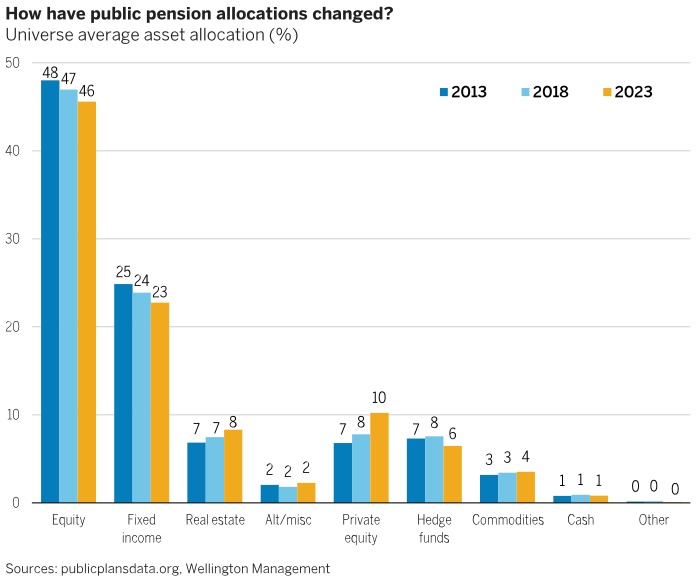
For a broad view of pensions’ portfolio allocations, we drew on the latest available data from publicplansdata.org, a partnership of the Center for Retirement Research at Boston College, the MissionSquare Research Institute, the National Association of State Retirement Administrators, and the Government Finance Officers Association. We found that the average US public pension portfolio remained heavily weighted toward public equities (46%) and fixed income (23%), although allocations to those traditional asset classes came down over the past 10 years (Figure 1). In their place, pensions added to private equity and real estate, which stood at 10% and 8%, respectively. Allocations to hedge funds declined slightly to 6% and allocations to commodities increased slightly to 4%.
The database does not break out allocations to private credit, which may be showing up in other categories (e.g., fixed income or private equity). But based on our discussions with plan sponsors, private credit is a meaningful allocation for many public plans.
Figure 1
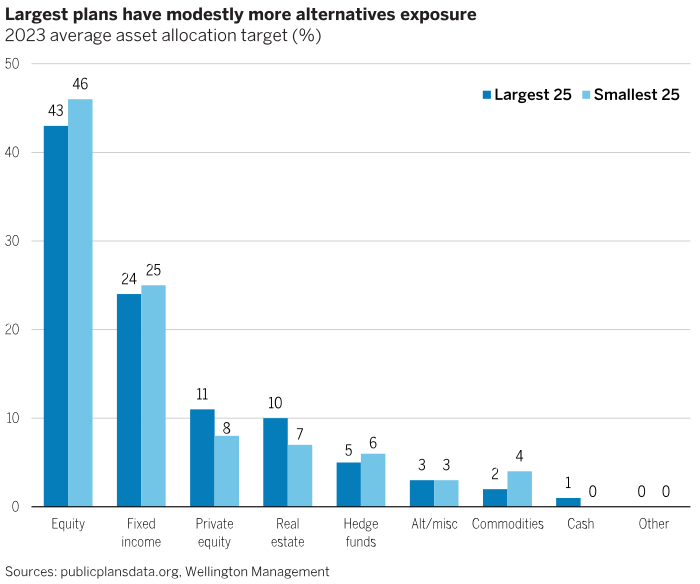
We also compared the allocations of the 25 largest plans and the 25 smallest plans in the database (based on total asset value). As shown in Figure 2, the largest plans (dark-blue bars) allocated less than the smallest plans to public equity and fixed income but more to private equity and real estate. Interestingly, the largest plans allocated slightly less to hedge funds. That may be a result of the challenge large plans face in assembling meaningful alternatives allocations, given the capacity limitations of some strategies and the due diligence required to build a multi-billion-dollar hedge fund portfolio. It may also be that some larger plans use portable alpha structures whereby they port hedge fund alpha on top of the equity portfolio, in which case some of their hedge fund allocations could show up in the equity bucket.
Figure 2
Our research revealed fairly wide dispersion in the target allocations of the largest plans and the changes made in those allocations over time, suggesting that plans are tackling investment challenges in a variety of ways. Among our findings:
We also recently surveyed more than 100 public pension clients about their asset allocation plans for the next decade. The areas in which respondents said they are most likely to add exposure included private credit, private infrastructure, private equity, public fixed income, and international public equity. The areas most likely to be reduced included US public equity, public fixed income, and private equity. Respondents also indicated an inclination to continue reshaping their allocations: 73% said they expect either more or a similar degree of change in their asset mix over the next decade compared with the previous one.
As interesting as it is to review these broad trends, what ultimately matters is whether plans have the right asset allocation for their objectives — and in particular, for the ROA assumption they use to discount their future liabilities. Over the last decade, the average ROA assumption used by public pensions (both the largest plans and the broad universe of plans) has steadily declined from more than 7.5% to 6.9%. (More detail on these assumptions is available in our annual ROA guide.)
Even at this lower level, we believe plans may struggle to achieve their return targets. To determine whether current plan allocations match up well with the average ROA, we drew on Wellington’s 10-year (intermediate) and 30-year (strategic) capital market assumptions (CMAs), shown in Figure 3. These CMAs are generated quarterly and incorporate four core building blocks — the income and growth the asset class is expected to generate, any change in valuation, and the currency impact for a given investor — as well as shared economic drivers, such as GDP and inflation expectations. It’s important to note that our CMAs reflect market beta only. We assume no alpha, with the exception of modest amounts in private equity and hedge funds (based on conservative estimates of average experience and net of management fees).
Figure 3
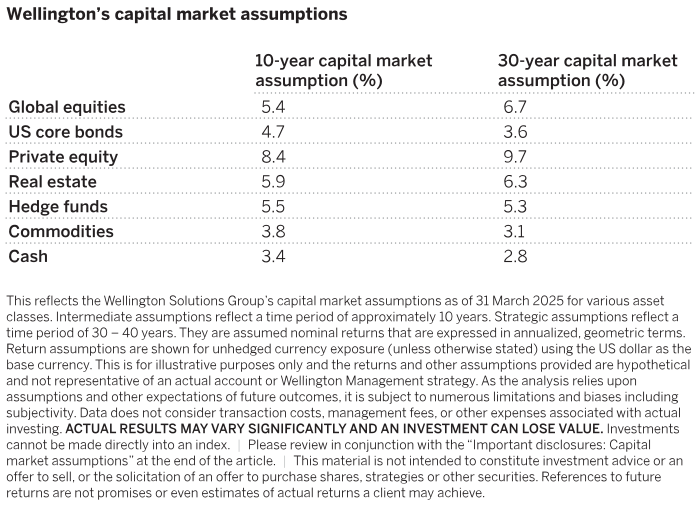
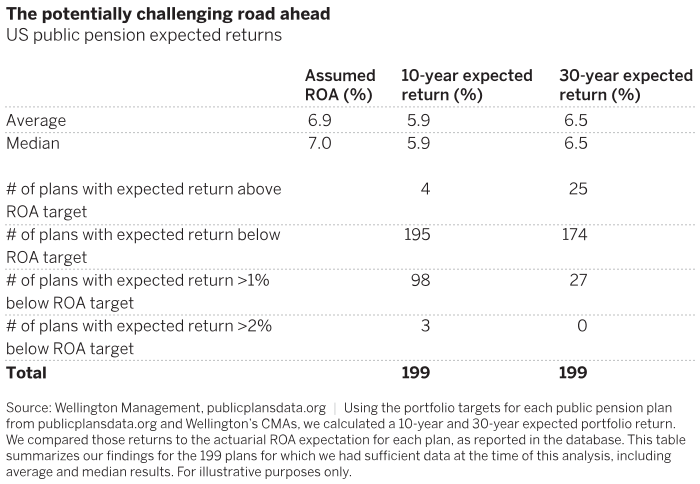
We applied these two sets of expected returns to both the average asset allocations outlined above and the specific allocations of 199 plans with sufficient asset allocation information in the publicplansdata.org database. In both cases, we compared the results to the relevant ROA assumptions. As shown in Figure 4, the 10-year and 30-year expected returns for the average public pension allocation are 5.9% and 6.5%, respectively — both below the average assumed ROA. The bottom section of the table offers more detail. Of the 199 plans studied, we estimated that, based on our 10-year CMAs, 195 would not meet their return target and about half of those would trail by more than 1%. The numbers were a bit more reassuring on a 30-year basis, with 174 plans set to fall short of their return target but only 27 expected to trail by more than 1%. (Remember that these gaps will be smaller if plans are able to add alpha on top of their strategic asset allocation exposures.)
Figure 4
For some plans, these findings may suggest a challenging outlook. To help, we want to share 10 ideas for closing the pension return gap.
1. Prepare for greater economic dispersion and market volatility
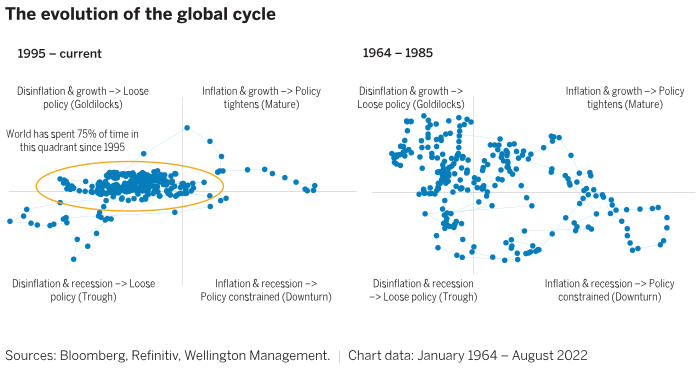
As shown in Figure 5, which comes from Wellington Macro Strategist John Butler, the global economy has spent the better part of the past 30 years in an environment of positive growth and disinflation (upper left quadrant of left-hand chart; each dot represents a calendar quarter). By contrast, from 1964 to 1985, it was much more common for the economy to move through the four stages of the business cycle over time (right-hand chart). As John has argued in recent years, we are likely to see greater cyclicality and dispersion in economic outcomes going forward, thanks to deglobalization, higher inflation, and a range of other factors.
With this in mind, public pensions should ensure their governance process is up to speed and key stakeholders are prepared for a more volatile world. There should be a plan for portfolio rebalancing, which can be a first line of defense against volatile markets. It may also be an opportune time to consider incorporating dynamic strategies within equities and fixed income; top-down dynamism (e.g., tactical asset allocation); and defensive strategies.
Figure 5
2. Deliberately address equity market concentration
The US equity market and, to a lesser extent, the global equity market have been dominated by a relative handful of large stocks in recent years. We think plans should prepare for the possibility this could persist, including considering strategies with the potential to navigate narrow markets. This includes extension (140/40) strategies, hedge funds, and quantitative and factor strategies that can take a more deliberate approach to weighting the largest names in the index.
Plans can also consider incorporating “completion” sleeves in a portfolio — intentionally adding some exposure to the large stocks dominating the market to ensure that the active risk in their portfolio is not dominated by underweights to those names. Read more on addressing market concentration here.
3. Establish a plan for strategies that have lagged recently
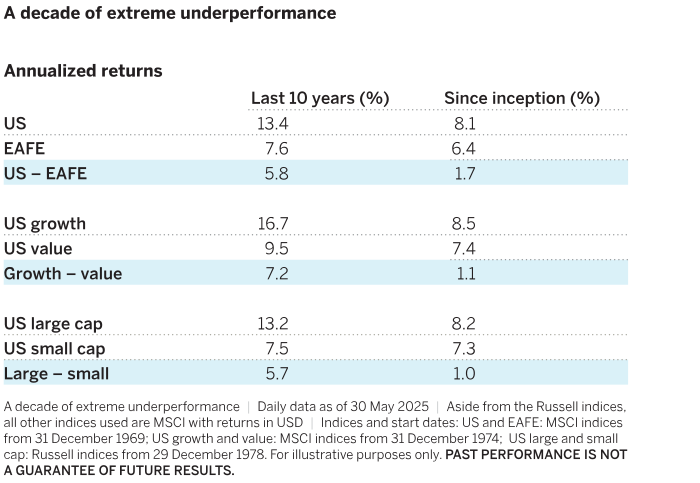
Figure 6 shows how extreme the underperformance of non-US, value, and small-cap stocks has been over the past 10 years relative to the longer term. Growth has had almost a sevenfold advantage in returns over value compared with the since-inception period, for example (second blue row).
How should plans think about these portfolio laggards? We believe it requires gauging one’s confidence that longer-term cycles will revert, but we also think there may be value in deliberately taking a little more risk in one or more of these areas. Governance is important in this decision making, because while we do expect returns to normalize in all three areas eventually, we wouldn’t be surprised to see these historical anomalies persist a bit longer. (Read more on this topic here.)
Figure 6
4. Make fixed income portfolios less benchmark focused
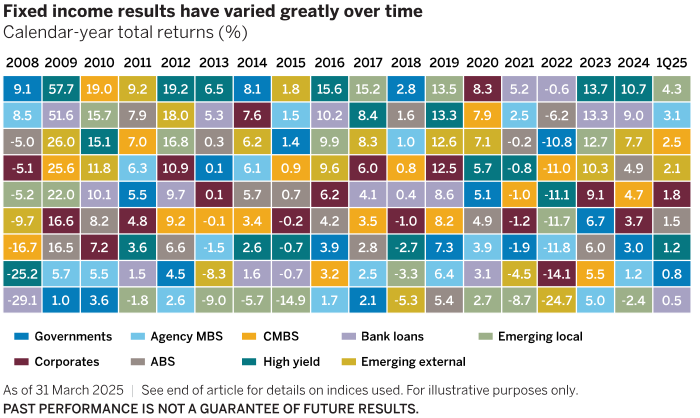
Figure 7 shows the annual performance of different fixed income sectors over time. Fixed income is sometimes considered a “boring” allocation with little opportunity for exceptional returns, but note the enormous dispersion in results in some years (e.g., between the top and bottom performers in 2024) and the variation in results from year to year.
We think plans should consider strategies that may be able to take advantage of this, including total return strategies, multi-sector strategies that seek to add value through sector selection/rotation, opportunistic strategies that focus on out-of-favor sectors due for a recovery, and fixed income hedge funds.
Figure 7
5. Revisit hedge fund exposure
If we are in a more inflationary and volatile backdrop (as noted in idea #1), we may see more periods in which stocks and bonds are positively correlated, as we did in 2022. Said another way, bonds may no longer help a portfolio as much when equities are selling off. However, hedge funds may have the ability to play a diversifying role in periods when fixed income doesn't.
Some investors are understandably skeptical about hedge funds given their unexceptional performance from 2010 to 2020. But we think we’ve entered an environment that may be more fertile for hedge funds, with the potential for higher levels of security dispersion, macro volatility, and interest rates — three factors that have historically played a crucial role in the success of hedge funds, as discussed in our recent paper, “Goldilocks” and the three drivers of hedge fund outperformance.
6. Check on real asset exposure and be ready to ramp it up
We think this is a good moment to review real asset exposure, with numerous potential drivers of higher inflation, including a tighter labor market, deglobalization, increased fiscal spending (not aimed at ending a recession), and long-term underinvestment in commodity production. Given the risks, we think plans should stress test their portfolio’s sensitivity to inflation and consider adding assets that have more inflation beta (sensitivity to changing/rising inflation). A “glidepath” approach may allow for a more dynamic response to the risk of inflation, as well — for example, adjusting exposures as productivity gains from artificial intelligence offset some inflationary pressures.
Plans should also think about the role of public and private assets in an inflation portfolio. As noted, rebalancing can be critical in a volatile environment and holding liquid assets that can be redeployed to asset classes that have sold off is important. However, in an inflationary regime, stocks and bonds may sell off at the same time. If real assets are generating gains, the gains can be rolled back into those allocations. But if the real assets are primarily on the private side, it may not be possible to realize those gains in time. So, there may be a benefit to having some public real assets in the portfolio, including commodities.
7. Evolve privates allocations in light of the interest rate and market backdrop
With interest rates likely to remain higher for longer, plans may want to consider tilting allocations to private equity toward strategies that are less dependent on leverage and therefore less rate sensitive, such as venture capital and growth equity strategies.
We also think it’s important to be attuned to the convergence of public and private credit markets and what it could mean for fixed income investment strategies. More broadly, plans should regularly review their expectations for capital return from existing investments and their IRR expectations. We continue to believe there are attractive opportunities in private equity and private credit, but manager and strategy selection are critical.
8. Review strategic asset allocations (SAA) amid shifting market expectations
Wellington’s capital market assumptions (CMAs) have changed quite a bit recently. For example, our equity CMAs overall are lower than realized returns in recent years and our CMAs for non-US developed and emerging markets are significantly higher than our US equity CMAs. On the fixed income side, our CMAs are more compelling than they were five or 10 years ago, although fixed income may not offer the diversification benefit it has in the past, as noted earlier.
All in all, we believe it’s a good time for plans to review their SAA. We don’t see our latest CMAs as a clarion call to sharply reduce equity exposure, as discussed in a recent article, but we do think it’s a time to revisit portfolio diversification opportunities and to consider areas where active management could help close the gap between expected returns and ROAs.
9. Create a CIO dashboard and refresh investment committee materials
We often talk to plans about creating a “CIO dashboard” as a way to put more process and structure around decision making (not just by the CIO but by other team members and potentially the board). Ideally, the dashboard should include insights on market and economic conditions, equity and credit valuations, and technical signals like market trends and investor positioning. It should also include topical ideas that warrant further research, as well as risk-management issues that are top of mind.
On a related note, plans should also spend some time thinking about the substance and delivery of communications to the board or investment committee. Is the message clear and concise? Is it effectively keeping the committee focused on the long term? Are the materials adequately digging into what’s driving investment results (e.g., SAA versus tactical asset allocation versus manager selection)? Is there too much focus on peer comparisons? We believe these comparisons are rarely useful given differences in plan liabilities, portfolio structure, and other factors.
10. Pick a few key topics to study up on as an organization
Taking a cue from our work with college endowments, whose investment teams are often very focused on keeping themselves educated, we think plans should consider picking a few topics each year that warrant a deep dive. Our current suggestions include AI, given the economic implications and potential organizational impact; trade policy, which promises to keep economists on their toes for some time to come; geopolitics, which is at the top of the list of worries for many investors; and cryptocurrencies, which are attracting a lot of attention given the Trump administration’s support.
Important disclosures: Capital market assumptions
Intermediate capital market assumptions reflect a period of approximately 10 years. Strategic assumptions reflect a time period of 30 – 40 years. If we developed expectations for different time periods, results shown would differ, perhaps significantly. Additionally, assumed annualized performance and results shown do not represent assumed performance for shorter periods (such as the one-year period) within the 10-year period, nor do they reflect our views of what we think may happen in other time periods. Annualized returns represent our cumulative performance expectations annualized. Assumed returns shown do not reflect the potential for fluctuations and periods of negative performance.
This analysis is provided for illustrative purposes only. This material is not intended to constitute investment advice or an offer to sell, or the solicitation of an offer to purchase shares, strategies, or other securities. References to future returns are not promises or even estimates of actual returns a client may achieve. This material relies on assumptions that are based on historical performance and our expectations of the future. These return assumptions are forward-looking, hypothetical, and are not representative of any actual portfolio, or the results that an actual portfolio may achieve.
The expectations of future outcomes are based on subjective inputs (i.e., strategist/analyst judgment) and are subject to change without notice. As such, this analysis is subject to numerous limitations and biases and the use of alternative assumptions would yield different results. Expected return estimates are subject to uncertainty and error. Future occurrences and results will differ, perhaps significantly, from those reflected in the assumptions. ACTUAL RESULTS MAY DIFFER SIGNIFICANTLY AND AN INVESTMENT CAN LOSE VALUE. Indices are unmanaged and used for illustrative purposes only. Investments cannot be made directly into an index.
This illustration does not consider transaction costs, management fees, or other expenses. It also does not consider liquidity (unless otherwise stated), or the impact associated with actual trading. These elements, among others, associated with actual investing would impact the assumed returns and risks, and results would likely be lower (returns) and higher (risk).
Important disclosures: Indices
Indices used in Figure 7 — Sub-indices of the Bloomberg Global Aggregate Index (hedged to USD) were the sources of government, corporates, MBS, ABS, and CMBS data. The Bloomberg Global High Yield Index and the S&P LSTA Leveraged Loan Index were the sources of the high yield and bank loan data, respectively. The JPMorgan EMBI Plus Index was the source of the emerging external and emerging local data.
Bloomberg — Bloomberg and the Bloomberg indices are service marks of Bloomberg Finance LP and its affiliates, including Bloomberg Index Services Limited (“BISL”), the administrator of the Indices (collectively, “Bloomberg”) and have been licensed for use for certain purposes by the distributor hereof (the “Licensee”). Bloomberg is not affiliated with Licensee, and Bloomberg does not approve, endorse, review, or recommend the financial products named herein (the “Products”). Bloomberg does not guarantee the timeliness, accuracy, or completeness of any data or information relating to the Products.
Refinitiv — Republication or redistribution of Refinitiv content, including by framing or similar means, is prohibited without the prior written consent of Refinitiv. Refinitiv is not liable for any errors or delays in Refinitiv content, or for any actions taken in reliance on such content. Refinitiv’s logo is a trademark of Refinitiv and its affiliated companies.