



- Multi-Asset Strategist
Explore our insights
Asset class
Formats
2026 Midyear Investment Outlook

2026 Midyear Investment Outlook
The views expressed are those of the author at the time of writing. Other teams may hold different views and make different investment decisions. The value of your investment may become worth more or less than at the time of original investment. While any third-party data used is considered reliable, its accuracy is not guaranteed. For professional, institutional, or accredited investors only.
I’m excited to share my annual 10-step checklist, aimed at helping allocators define and document priorities for the year ahead and pave the way for greater impact. For each step of the checklist below, I offer a key takeaway to help make 2026 agendas as focused as possible.
2. Assess the near-term outlook
3. Consider your opportunity set
4. Try to understand the market consensus
5. Consider possible surprises
7. Spend some time in the alternatives world
8. Rouse your inner risk manager
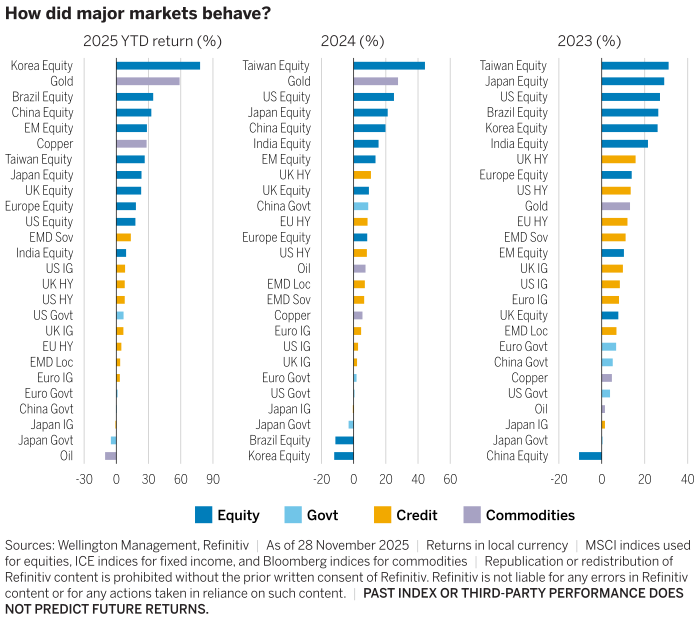
I’ll start with a look back at market results in 2025 (through the end of November), as well as 2024 and 2023 (Figure 1). The overall complexion of these three years is quite similar: Returns were strong for equities, reasonable for credit, lower for government bonds, and a mixed bag for commodities. Looking more specifically at what worked in 2025, gold was the number two performer for the second straight year. Emerging markets were top performers, including China, as were non-US equities broadly. Of course, US equities still held their own, thanks in large part to mega-cap stocks.
What didn't work in 2025? That list includes oil, the US dollar, Japanese government bonds, and bitcoin.
Figure 1
I’d also highlight a few lessons from 2025:
Key takeaway: Be prepared for a world where current trends continue (even if you expect them to reverse in the long term).
Our Wellington Solutions team maintains a 6- to 12-month outlook for tactical asset allocation purposes. As of December 2025, they have a moderately overweight view on global equities. While valuations are high, equity returns should benefit from lower global economic policy uncertainty, which has declined since the tariff-driven peak in April 2025, and central bank easing. Within equities, the team prefers Japan and the US, in that order, over Europe and emerging markets. They also have a moderately overweight view on developed market government bonds, a neutral view on credit, and a slight underweight view on commodities driven by a small underweight view on oil. Read more on the team’s views here.
Key takeaway: Following strong gains in 2025, the near-term outlook for equities remains upbeat.
To offer some perspective on areas of opportunity going forward, Figure 2 shows our capital market assumptions (CMAs) over a strategic (30 – 40 year) horizon, which is typically used to set asset allocation policy. Equity returns are expected to outpace fixed income, with non-US equities ahead of US equities — a somewhat different outlook than the 6- to 12-month view mentioned earlier. In government bonds and credit, expected returns are reasonably attractive, particularly compared to the 2010s.
Figure 2
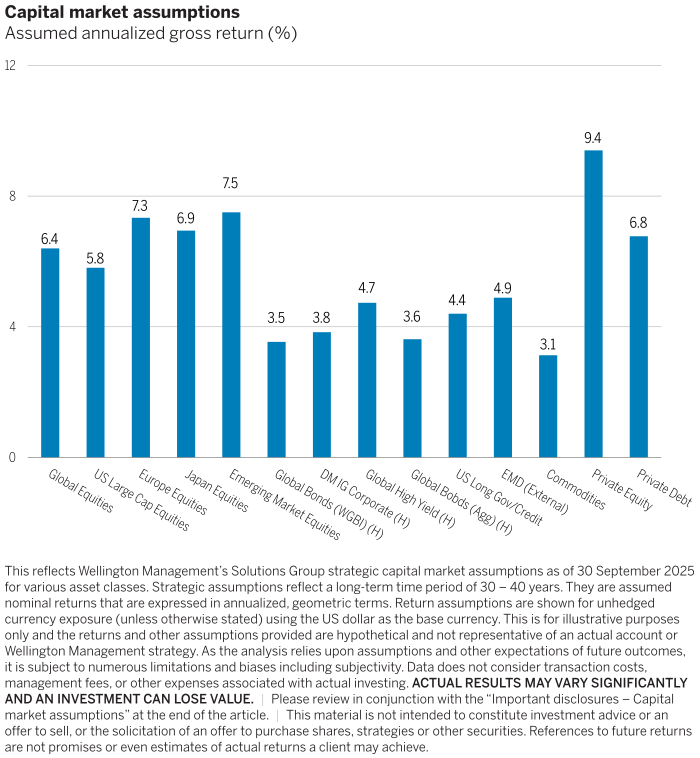
The key factor keeping the equity CMAs from being more exceptional is valuations. Forward P/E ratios are well above the 20-year average for US stocks, but Japan, Europe, and emerging markets are somewhat expensive as well. High valuations are also a limiting factor for our CMAs in most credit markets.
Given the valuation challenge, our expected return for a typical 60% equity/40% fixed income portfolio based on our CMAs is currently a bit above 5% — below the historical average, which is closer to 6%. This may be reason to think about diversification and potential new sources of return. With that in mind, I’ll offer a few ideas for 2026:
Key takeaway: There may be ample opportunity for diversification in 2026.
Another useful exercise is gauging the views already being priced in by the market. There’s some wisdom in crowds, but from a risk perspective it’s also worth being aware of what the market could be missing. Currently, I see the following as consensus views:
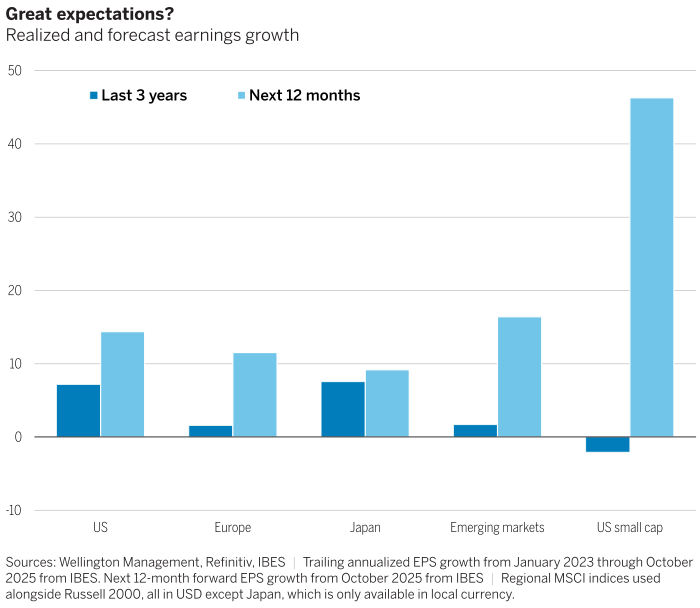
One way to judge consensus views is to look at where earnings are expected to be in the year ahead compared with realized earnings. In Figure 3, note the shift in small-cap stocks: Realized earnings were negative over the past three years, but expectations indicate nearly 50% earnings growth. The caveat is that these forecasts can tend to be overly optimistic, but even if small cap disappoints meaningfully, this data suggests we could still finally see a return to earnings growth.
We also see fairly heroic recoveries expected in Europe and emerging markets, and expectations remain quite healthy for the US. In Japan, on the other hand, very little improvement is expected.
Key takeaway: Markets are already assuming continuity, so any surprises could be quite unsettling.
Figure 3
This is an exercise made famous by the late Byron Wien, who defined surprises as events to which the average market participant would assign a probability of 30% or less but that he saw as more likely than not (50% or higher probability). My definition is more flexible — events that are generally viewed by the market as unlikely but in my estimation have at least a reasonable chance of occurring. With that, here’s my list for 2026:
Key takeaway: Be prepared for stronger growth, higher inflation, and surprises on the policy front. (Though, in the interest of full disclosure, only two of my 10 surprises came to fruition last year, so take all of this with a grain of salt!)
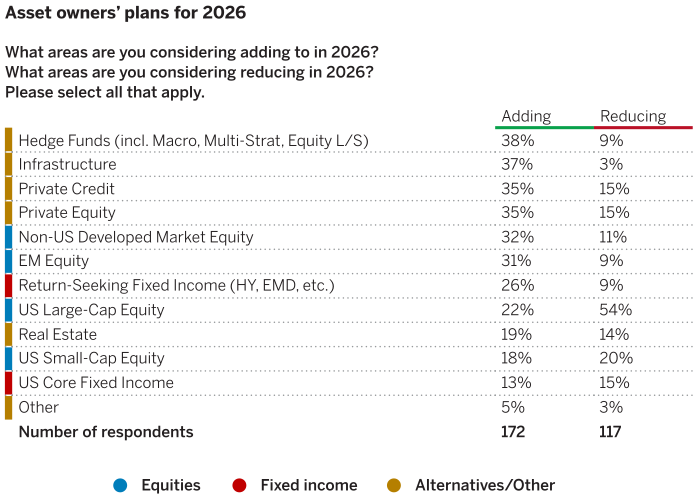
Turning to long-term portfolio opportunities, we found in a recent poll we conducted (Figure 4) that the top areas institutional asset owners were planning to add to in 2026 included hedge funds, infrastructure, private credit, private equity, non-US developed market equities, emerging market equities, and return-seeking fixed income. The area they were most likely to reduce was, by far, large-cap US equities.
Figure 4
In thinking about how to frame longer-term opportunities, my focus is very much on the current cycle. Many of its characteristics have been in place since the end of the global financial crisis, including slow and steady growth, fiscal and monetary support, technology sector leadership/market concentration, and significant capital flows to private assets. I think there are reasons to believe the cycle has room to run (e.g., strong AI-driven capex) but also factors that could bring it to an end (e.g., inflation). Allocators, therefore, need to be mindful about the extent to which they're positioned for the cycle to continue or to reverse.
But I think there are also strategies that could work either way:
Key takeaway: Favor strategies that are cycle-agnostic rather than make a big bet on whether the current cycle continues or turns.
Alternatives represent a significant area of exposure for many allocators and warrant a dedicated review to begin 2026.
Key takeaway: Alternatives may have a more prominent role to play in portfolios going forward, but make sure your approach is up to date for the current backdrop.
My list of risks to watch (downside and upside) in 2026 includes the US midterm election and the potential for more fiscal stimulus ahead of that election; the appointment of a new Fed chair; and optimism (and potential disappointment) about earnings, especially in technology. I would also highlight a few risks I think market participants are overlooking: liquidity risk; some speculative investing (in crypto, for example); and inflation, which I view as a medium-term concern given rising government debt.
How can all of this be brought into a risk-management process? I’d suggest two approaches. The first is scenario analysis — sketching out ways in which some of these things could go awry and gauging what that means for a portfolio. Scenarios we’re modeling in our own work include a “fiscal surge” in the US and globally (even if the economy is relatively healthy); a “balanced outcome” in which fiscal stimulus is sufficient to offset headwinds (e.g., fiscal support from the OBBBA offsets the impact of tariffs in the US); and an “economic soft patch” (e.g., a mild recession in the US).
The second approach is stress-testing portfolios with some extreme outcomes. If allocators are comfortable with the results, they’ll be better prepared to stick to their positioning. If not, it may be time to do some hedging or adjust current allocations. Among the outcomes we're currently using in stress testing: a US equity melt-up, with a strong influx of capital driving valuations even higher; a sell-off in private credit, which could have knock-on effects in public markets; a momentum reversal; and a stagflationary environment.
Key takeaway: Focus on risk management heading into 2026 and look beyond the risks making headlines.
Every allocator should spend time thinking about what could change liquidity needs in the year ahead, whether that’s a market crisis (like we saw in 2022) or a shift in the needs of the organization or individuals a portfolio is intended to support. I also think it’s important to regularly stress test one- and three-year liquidity needs and to assess the state of market liquidity.
In the year ahead, our trading desk is expecting liquidity conditions to remain generally consistent with what we saw in 2025. Among their views:
Key takeaway: Liquidity stress-testing should be an evergreen agenda item for allocators.
As a final step, I think allocators should narrow their priorities to a manageable list. Following are six possibilities, but be realistic — it may be hard to prioritize more than two or three in a given year:
Defense:
Offense:
Key takeaway: Whether you take some of my priorities or set your own, start the year with a few specific objectives around investment policy.
A final note: I hope this checklist is helpful. If we can be a thought partner on any of the topics discussed or help your organization set and implement specific objectives, we would welcome the opportunity for an in-depth discussion.
Best wishes to all for a happy, healthy, and profitable 2026.
1The "Neural Nine” include Nvidia, Apple, Microsoft, Alphabet, Broadcom, Meta, Oracle, Palantir, and AMD.
Important disclosures: Capital market assumptions
Strategic capital market assumptions reflect a period of approximately 30 – 40 years. If we developed expectations for different time periods, results shown would differ, perhaps significantly. Additionally, assumed annualized performance and results shown do not represent assumed performance for shorter periods (such as the one-year period) within the longer period, nor do they reflect our views of what we think may happen in other time periods. The annualized return represents our cumulative performance expectations annualized. The assumed returns shown do not reflect the potential for fluctuations and periods of negative performance.
This analysis is provided for illustrative purposes only. This material is not intended to constitute investment advice or an offer to sell, or the solicitation of an offer to purchase shares, strategies, or other securities. References to future returns are not promises or even estimates of actual returns a client may achieve. This material relies on assumptions that are based on historical performance and our expectations of the future. These return assumptions are forward-looking, hypothetical, and are not representative of any actual portfolio, or the results that an actual portfolio may achieve. Note that asset-class assumptions are market or beta only (i.e., they ignore the impact of active management, transaction costs, management fees, etc.).
The expectations of future outcomes are based on subjective inputs (i.e., strategist/analyst judgment) and are subject to change without notice. As such, this analysis is subject to numerous limitations and biases and the use of alternative assumptions would yield different results. Expected return estimates are subject to uncertainty and error. Future occurrences and results will differ, perhaps significantly, from those reflected in the assumptions. ACTUAL RESULTS MAY DIFFER SIGNIFICANTLY AND AN INVESTMENT CAN LOSE VALUE. Indices are unmanaged and used for illustrative purposes only. Investments cannot be made directly into an index.
This analysis does not consider transaction costs, management fees, or other expenses. It also does not consider liquidity (unless otherwise stated), or the impact associated with actual trading. These elements, among others, associated with actual investing would impact the assumed returns and risks, and results would likely be lower (returns) and higher (risk).