
Explore our insights
Asset class
Formats
2026 Midyear Investment Outlook

2026 Midyear Investment Outlook
Discover the untapped potential of Asian credit markets. With growing economic independence and robust financial systems, Asia offers compelling opportunities for fixed income investors seeking stability and growth.
For 25 years Asia has been accumulating vast reserves. Exporting to the world under ever-increasing globalization has seen the majority of those reserves held in US dollars, keeping Asian FX rates undervalued and funding significant borrowing from developed nations. Now, US policies seek to re-order global trade and reduce current-account deficits with countries in the region — a dynamic with important implications for fixed income markets.
Under this more uncertain worldview, we expect increasing cooperation and coordination within Asia. Growing intra-region trade will reduce demand for dollars with Asian currencies likely to outperform. Historically this may have pressured the earnings and export outlooks for the region, but capital being reinvested within Asia could drive real rates down and spur increased economic activity.
Governments and central banks in the region have long been concerned about dollar strength, often leading to conservative monetary and fiscal policies. A declining US dollar environment, in our view, will provide room for more dovish policy action again supporting fixed income returns.
In recent years China has committed significant investment to industrial spending at the expense of the real estate sector. That pivot to global manufacturing dominance is bearing fruit, particularly in its global leadership of the renewable energy supply chain. We expect this commitment to continue driving innovation but also reducing Asia’s reliance on volatile energy input costs through time.
So, at a time when investors are faced with growing uncertainty over inflation, government-debt sustainability, and fiscal deficits in developed economies, Asia’s growing independence over financing and energy costs is telling.
Similarly, companies in the region stand to benefit from this regime shift. Rising investment and consumption supports the growth outlook and deepening financial markets in the region are providing funding alternatives, lowering interest burdens and removing unwanted FX risks.
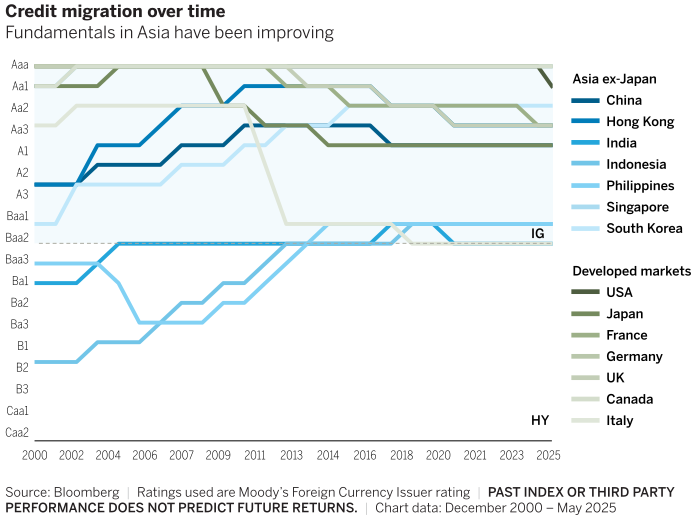
Credit ratings reflect the structural changes that have occurred over the past quarter of a century. Many developed nations borrowed heavily through the era of historically low interest rates following the global financial crisis. Now, they face alarming debt levels, which, coupled with political inertia, has led to sovereign downgrades. These countries now face increasingly challenging debt-service costs and fewer willing lenders. Conversely, Asia has saved too much, so debt levels remain low in aggregate and spending has been prudent, even through the COVID crisis and the period of higher inflation that followed.
Positive rating migration through time (Figure 1) has lowered volatility for fixed income investors in the region and we anticipate these divergent trends will continue.
Figure 1
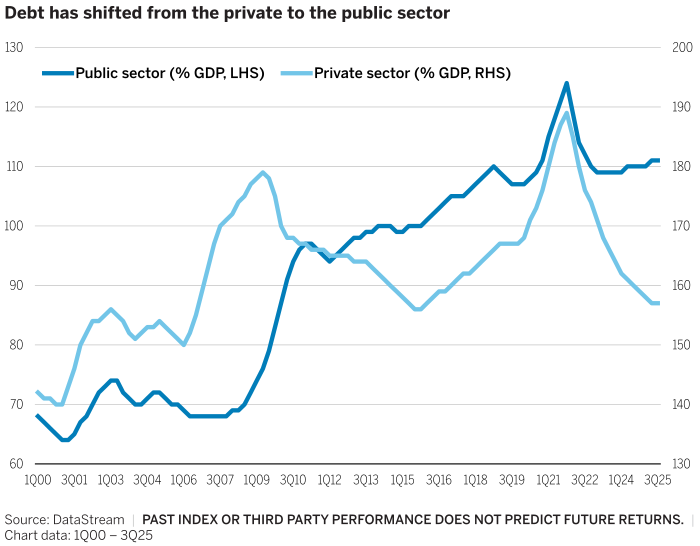
Around the world, corporate fundamentals look healthier. While governments have struggled to control balance sheets since the financial crisis, the private sector has been deleveraging (Figure 2). Credit spreads have been pricing in these improvements through time, but again we see scope for further outperformance as politicians show limited willingness to cut spending and companies enjoy the high nominal growth environment being engineered as a result.
Figure 2
Financial markets in Asia have been resilient and surprised many in the face of high trade and tariff uncertainty in 2025. Rates have fallen in most markets, currencies have been stable, and equities have outperformed. This may surprise some, but we believe large global capital shifts are only just beginning. In a more desynchronized, deglobalized world Asia looks ready to demonstrate further outperformance.
Regional allocations will become more relevant as economic cycles diverge and as the volatility of developed and emerging fixed income converges. Similarly, business cycles will be shorter and more volatile as central banks navigate more challenging growth and inflation tradeoffs. We believe flexible investment strategies will therefore be critical to protecting capital.
This year has witnessed some of the largest challenges to geopolitical order we’ve seen in a generation. Meanwhile Asia’s financial and political cohesion looks increasingly robust. Low inflation, high real rates and returning investment capital leave Asia fixed income markets attractive. Tariff and trade uncertainties may persist as we move into 2026, however, the structural issues look greater in developed markets than in Asia. The consequences of forcing global trade rebalancing will necessitate powerful shifts in capital. These shifts should ultimately benefit the region through higher rates of economic growth and investment, supporting financial assets in the process.
Given this landscape, we continue to see attractive opportunities in credit. At the same time, we seek to add value in investment portfolios by being dynamic in local Asian markets across rates and currencies. Amid the global uncertainty and noise, we believe the backdrop remains constructive for Asia and its relative outperformance versus other regions has potential to persist. Active managers with the ability to focus on quality companies and be nimble in adjusting portfolio risk and allocations may be better positioned to provide investors a blend of yield and relative stability of total returns.
The views expressed are those of the authors at the time of writing. Other teams may hold different views and make different investment decisions. The value of your investment may become worth more or less than at the time of original investment. While any third-party data used is considered reliable, its accuracy is not guaranteed. For professional, institutional or accredited investors only.
Experts






















Monthly Market Review — August 2026
A monthly update on equity, fixed income, currency, and commodity markets.
By