Explore our insights
Asset class
Formats

Education

Education
Real estate investment trusts (REITs), long considered an important element of strategic asset allocation, currently offer a rare convergence of potentially attractive valuations, growth potential, and diversification benefits. Years of rising interest rates, post-COVID earnings pressures, and equity market concentration have caused REITs to underperform relative to broader equities. With these headwinds subsiding, fundamentals and market conditions have turned favorable for public REITs, setting up what we believe could be a significant positive re-rating and growth rebound.
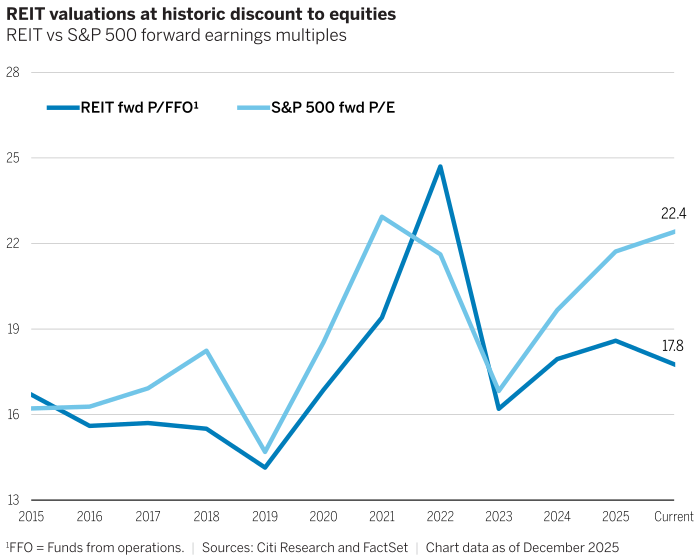
There are two reasons why we see public real estate as attractively valued today. First, REITs are historically cheap, trading at one of the widest valuation discounts relative to equities in decades (Figure 1). Historically, REITs have been priced cheaply during periods of major macro dislocations, including the 2000 tech bubble, the 2008 – 2009 global financial crisis, and the COVID-19 pandemic. After each crisis, fundamentals turned positive, and capital rotated out of equities and back into real estate. Like those past market events, the recent AI-driven equity boom has again depressed REIT valuations to a record-low spread. As the enthusiasm for a narrow set of AI stocks fades, we believe a REIT valuation reset will recur in earnest.
Figure 1
We also find REITs to be undervalued thanks to companies’ strong balance sheets. In many cases, metrics like debt/gross asset value and debt/next-12-months EBITDA are at low levels relative to history and private real estate markets. Here again, given improving fundamentals and falling interest rates, we believe public REITs can begin to play offense with both acquisitions and pricing.
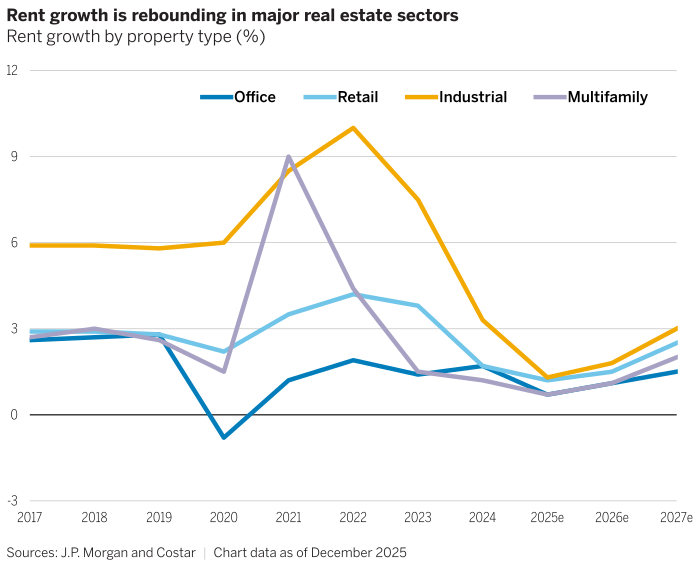
Just as REITs' valuations are poised for recovery, an earnings reset will likely catalyze a growth rebound. First, REITs have largely absorbed the post-COVID earnings contraction and are starting from a lower base. Second, supply has normalized, with construction contracting for years across most property types except data centers and certain pockets of the multifamily market. Third, given falling supply and stabilizing demand (with vacancies tight in most sectors), we believe rent growth has largely bottomed and is beginning to reaccelerate (Figure 2). In our view, the combination of these factors is a recipe for markedly improved REIT pricing power.
Figure 2
Diversifying a portfolio can help investors manage risk and stabilize returns, particularly in periods of high market concentration. History suggests that narrow leadership does not last. When it broadens, as it has begun to do recently, capital can rotate toward areas of the market that are attractively valued and feature improving fundamentals — precisely the conditions we see for public real estate today.
In addition to their role as portfolio diversifiers, REITs offer the potential for price appreciation and income generation. They can also be effective inflation hedges, as real estate values tend to be correlated with rising prices. Finally, public REITs are as liquid as public equities, with the same pricing and performance transparency.
While we believe public real estate is compelling, it is not without risk. We are closely monitoring several situations that could disrupt markets and present headwinds for the asset class. These include the potential bursting of the AI-driven equity bubble, a spike in unemployment, continued growth in fiscal deficits, and ongoing geopolitical uncertainty.
Notably, these risks are not uniform, and each one also carries opportunities. Macro and market situations vary significantly across the US, European, and Asia-Pacific regions, for example, and real estate subsectors are recovering at different rates. As a result of this market diversity, companies will likely perform very differently from one another. Those making prudent spending and capital allocation decisions, experiencing strong demand from tenants, and demonstrating sound property and financial management are more likely to outperform, as others fall behind.
We expect today’s market and macro environment to drive greater REIT performance dispersion across regions, property types, and individual companies, reinforcing the importance of active management. In our view, thoughtful navigation of both risks and opportunities is essential to capture what we believe is a rare and compelling setup for REITs, with valuation, growth, and diversification benefits converging.
The views expressed are those of the authors at the time of writing. Other teams may hold different views and make different investment decisions. The value of your investment may become worth more or less than at the time of original investment. While any third-party data used is considered reliable, its accuracy is not guaranteed. For professional, institutional or accredited investors only.