

- Director of Global Derivatives
Explore our insights
Asset class
Formats
Education

Education
The views expressed are those of the author at the time of writing. Other teams may hold different views and make different investment decisions. The value of your investment may become worth more or less than at the time of original investment. While any third-party data used is considered reliable, its accuracy is not guaranteed. For professional, institutional, or accredited investors only.
Despite some bumps along the way, most notably the 2008 global financial crisis, equity volatility expectations and credit spreads have historically enjoyed a long and mostly steady relationship. But following the COVID-induced market crash of 2020, an uncharacteristic rift developed between the two: Credit spreads returned to near their pre-COVID tights, while equity volatility remained stubbornly high. This led to disappointing results for investors who may have been counting on one of the most fundamental cross-asset relationships to hold.
Recently, however, widening credit spreads and a very limited response from equity volatility have enabled the two to more or less “reconcile” — for now anyway. So what are the prospects for a more stable union going forward?
The idea that credit spreads and equity volatility should be tightly intertwined has its roots in a model developed by Bob Merton in the 1970s. Merton’s model theorizes that the value of a firm’s equity should be thought of as a long call option on the assets of a company, with a strike price equal to the face value of the debt. Turning that around with put-call parity, the value of the debt can be likened to a short put option on the assets of a company, with that same debt-level strike price. As a result, we shouldn’t be surprised to find credit spreads and longer-dated downside equity put volatility to be closely related.
As shown in Figure 1, after a long period of following Merton’s predictions, the generally harmonious relationship between equity risk and credit risk “broke up” shortly after the COVID-driven market drawdown, when the former traded at a significant premium to the latter. I attribute this divergence to changing supply/demand dynamics in the two markets at the time. In other words, both were to blame for the “break-up”:
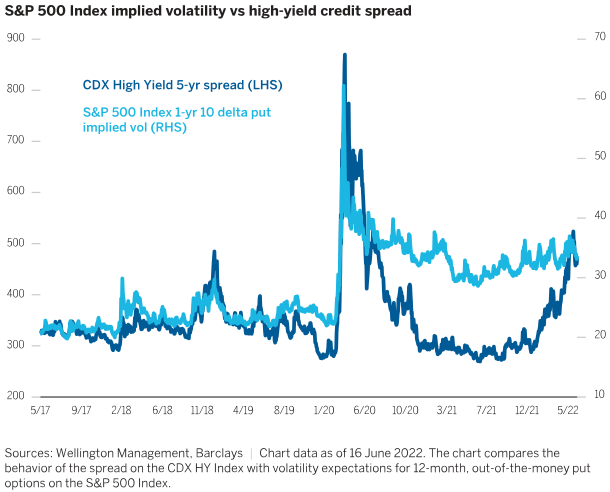
Although the sharp divergence between credit spreads and equity volatility lasted for two years, the two risk measures appear to be reconverging of late. A simple visual examination of Figure 1 suggests that it was a change in the pricing of credit risk that did most of the work to bring the relationship back into balance. Since January 2022, credit spreads have widened considerably, rising to meet equity volatility, which has remained anomalously stable throughout the 20%+ drawdown that markets have experienced over the past six months.
Now that the relationship between the two appears to have normalized, a key question for investors implementing cross-asset trades is what the prospects are for “things to go back to the way they were.” I’d say there’s now a much better chance that they’ll remain connected, thanks to a more recent change in the supply/demand picture for credit assets.
In my view, the shrinking supply of equity volatility was a key driver of the initial divergence between credit spreads and equity volatility, as it resulted in an elevated clearing price for equity volatility. This dynamic doesn’t appear to have changed, suggesting that the likelihood of the two risk measures continuing to converge is limited. However, credit has now lost some support as well, which may serve to drive up its equilibrium clearing level. With Fed interest-rate hikes and quantitative tightening (QT) now well underway, the excess liquidity that was finding its way into credit markets should be diminished, similarly raising its equilibrium clearing level.
My bottom line: Going forward, while the relationship between credit spreads and equity volatility may be less stable than it was before their 2020 “split,” I think the onset of QT means that the two risk measures are now more likely to stay “coupled” than not. In effect, cross-asset hedging strategies should hopefully fare better in the period ahead.

Can agency MBS bounce back from dismal performance?
Continue readingURL References
Related Insights

Top 5 fixed income ideas for 2025
Fixed Income Strategist Amar Reganti and Investment Communications Manager Adam Norman outline which five areas of fixed income may be best positioned in 2025.
Can agency MBS bounce back from dismal performance?
Fixed Income Portfolio Manager Brian Conroy and two colleagues weigh in on the mortgage-backed securities (MBS) market in the wake of a very challenging month.

URL References
Related Insights