

- Co-Head of Multi-Asset Portfolio Management and Portfolio Manager
United States, Institutional
Change
The views expressed are those of the authors at the time of writing. Other teams may hold different views and make different investment decisions. The value of your investment may become worth more or less than at the time of original investment. While any third-party data used is considered reliable, its accuracy is not guaranteed. For professional, institutional, or accredited investors only.
The global nature of many multi-asset portfolios makes currency exposure a critical part of the portfolio design and management process. In this article, we discuss two complementary frameworks that can help asset owners sort through the various approaches to currency exposure management.
First, we evaluate the trade-offs of different approaches across three dimensions: investment complexity, operational complexity and the frequency at which decisions and actions must be taken.
Second, we offer a novel framework for grouping currencies based on their characteristics and what they suggest about the impact of and rationale for different management approaches. Here, our focus is on foreign equity allocations, where the currency hedging decision can be more complex than with foreign fixed income allocations. We also share research that explains why, from a home or base market perspective, currency exposure will generally dominate the performance of foreign fixed income allocations, which we think argues for fully hedging that exposure.
There are many approaches to handling currencies in a multi-asset portfolio, but the primary options include:
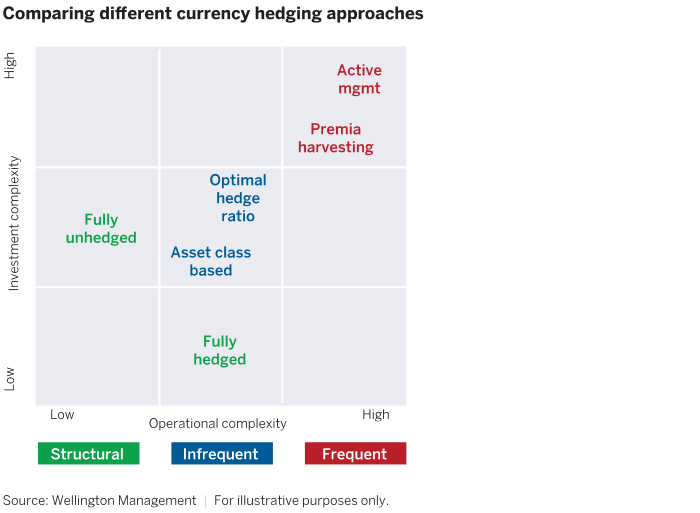
Each approach brings with it certain trade-offs, which we evaluate across three dimensions as illustrated in Figure 1:
Operational complexity (x-axis) — Currency management introduces operational complexity, not just at initiation but also to maintain hedges through currency forward rolls. The complexity is highest for approaches that require constant change, including active management and premia harvesting.
Investment complexity (y-axis) — Currency management can have a range of effects on investment complexity. Fully hedging currency exposure effectively eliminates the impact of currency variations on portfolio returns. A fully unhedged approach exposes the portfolio to the effects of currency movement, which can be either diversifying or volatility-enhancing depending on the nature of each asset owner’s base currency and the underlying portfolio currency exposures. Active currency management involves greater levels of complexity. Asset-class hedging can be a middle ground.
Frequency of decisions/activity (label colors) — Fully hedged and fully unhedged approaches are structural (i.e., permanent), requiring a single decision made once. Others entail relatively infrequent activity/decisions, including the asset-class-based and optimal-hedge-ratio approaches. Finally, active management and premia harvesting approaches require the highest level of activity/decision making.
Figure 1
Hedging currency exposure is of course not cost free. Specifically, offshore returns will be reduced (or increased) by the interest-rate differential1 between the two currencies under consideration if they are hedged (in that sense, hedging replaces an uncertain currency impact with a certain currency impact). We think there are three key factors to keep in mind when it comes to hedging costs:
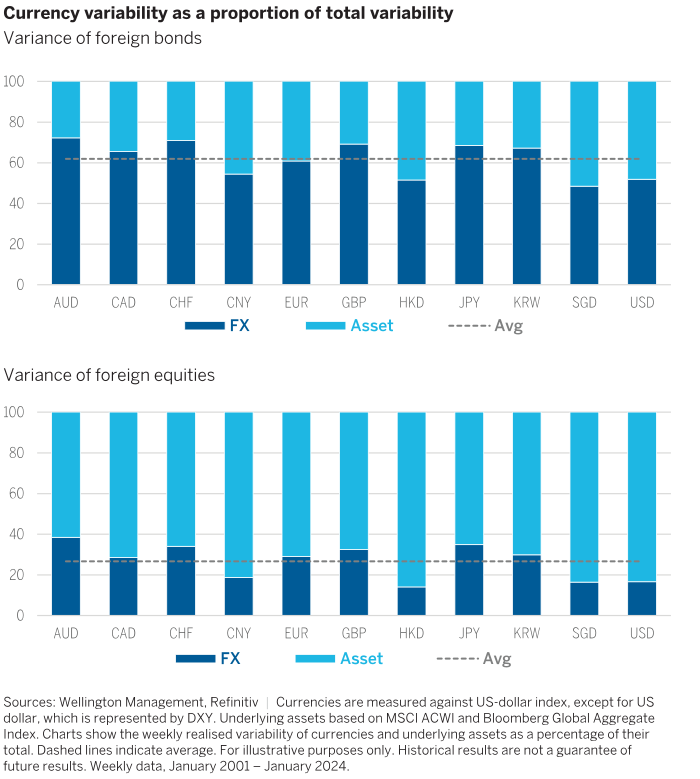
We have found that currency movements can dominate the performance of foreign fixed income investments to a much greater extent than the performance of foreign equities, and therefore we believe the former should always be hedged.2
The outsized impact on fixed income can be seen in the top chart in Figure 2, which shows that currency variability (in dark blue) far outweighs the variability of the underlying asset (in light blue) as a proportion of their combined sum.3 For equity exposures (bottom chart), on the other hand, currency variability is a much smaller proportion of the total.
Figure 2
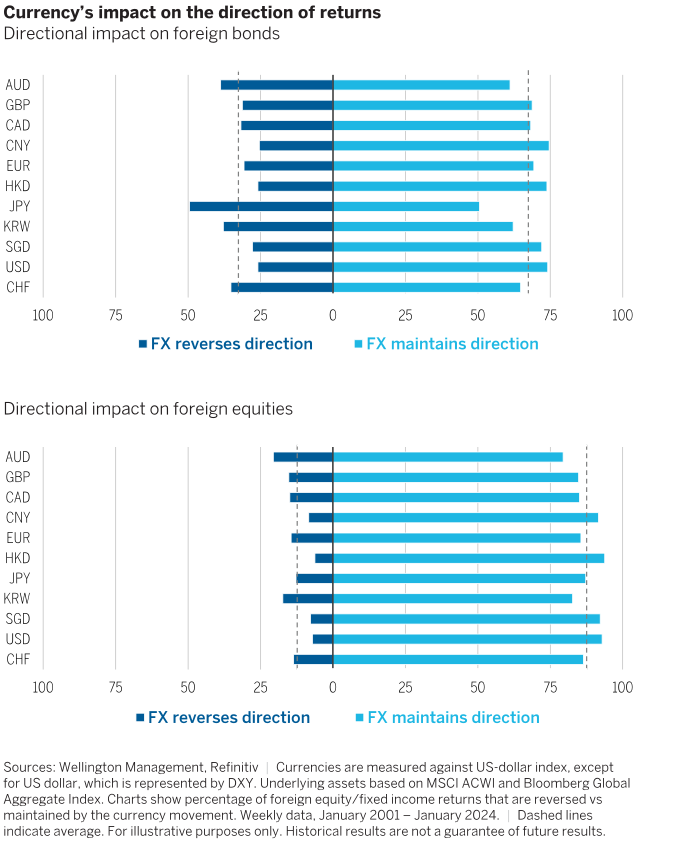
For a directional perspective, Figure 3 shows the percentage of times movements of various base currencies have reversed the return direction (i.e., changed gains to losses and losses to gains) for foreign bonds (top) and foreign equities (bottom). This effect was felt by fixed income far more often than equities.
Figure 3
Compared with fixed income, we think decisions about whether and how to manage currency exposure are more nuanced in the case of equities. We designed a currency grouping framework to help.
Base currency groupings
If left unhedged, the impact of a portfolio’s base currency on the foreign equity returns depends on two characteristics. The first is the volatility of the currency itself. The currency exposure has a volatility profile, and by investing in a foreign equity without hedging the currency, a domestic investor is exposed to that volatility in addition to the volatility of the underlying foreign investment.
The second characteristic is the correlation of the currency with the foreign equity. For instance, currencies that appreciate during risk-on periods will tend to be positively correlated with foreign equities, with both being driven higher by the same pro-risk dynamic. Conversely, defensive currencies will tend to be negatively correlated with global equities, as they will generally rally during the risk-off periods when global equities decline.
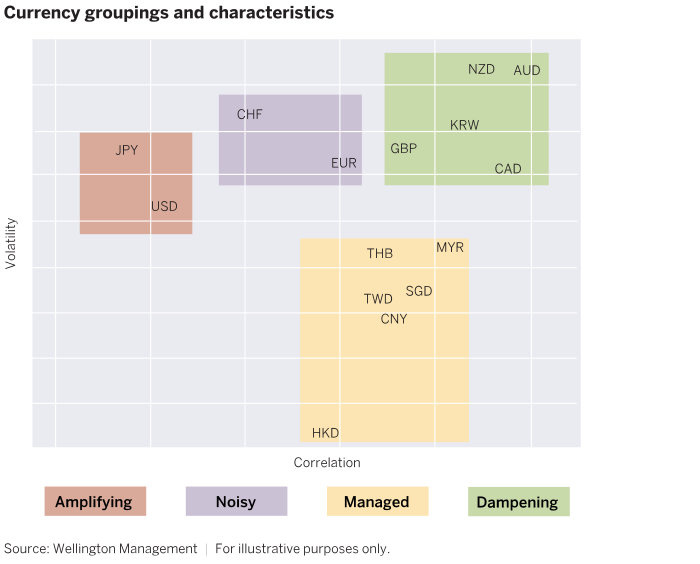
We can assign base currencies to one of four groupings based on these characteristics and what they imply for the currency impact and hedging process. The groupings, illustrated in Figure 4, include the following:
Dampening currencies are pro-risk in nature and show a positive correlation with foreign equities. By appreciating when foreign equity returns are positive and depreciating when foreign equity returns are negative, these currencies partially offset (dampen) the gains and losses (and therefore volatility) of the foreign equity allocation. The extent of this dampening is related to both the degree of correlation between the currency and the foreign equity, and the volatility of the currency itself. This group generally includes currencies of commodity-exporting countries and emerging markets. Examples include the Australian dollar, British pound, South Korean won and Canadian dollar.
Amplifying currencies are counter-risk in nature and show a negative correlation with foreign equities. By depreciating when foreign equity returns are positive and appreciating when foreign equity returns are negative, these base currencies partially increase (amplify) the gains and losses (and therefore volatility) of the foreign equity allocation. The extent of this amplification is related to both the degree of the correlation between the currency and the foreign equity, and the volatility of the currency itself. The US dollar and Japanese yen are in this group.
Managed currencies are, to varying extents, influenced more by the policymakers in a country than they are by markets. Typically, this management involves setting a specific band within which the currency can move. The realized and expected volatility of the currencies is typically very low, limiting their impact on the performance of the foreign equity. However, these currencies are subject to gap or jump risk — the potential for a market to move suddenly and significantly in price as a result not of market demand/supply but of a decision by the policymaker (central bank) to set the exchange rate higher. Specific examples in this group are the Chinese yuan and the Hong Kong dollar.
Noisy currencies are defined as having an impact on the performance of the foreign equity, though the extent and, importantly, the direction of this impact is unclear and fluctuating. These currencies introduce noise to the foreign equity allocation, though it is not clear whether this noise will dampen or amplify the equity return volatility, and therefore what effect hedging will have. The euro is an example of a currency in this group.
Figure 4
Often, the hedging decision for a portfolio is predetermined, with the portfolio manager having no discretion. When this is not the case, choosing a currency management approach is a key part of the portfolio construction process. Here, we believe two steps should be followed. First, as noted, we think the currency exposure associated with a portfolio’s foreign fixed income exposure should always be hedged.2 Second, and turning to the equity allocation, the four different currency groups discussed above can help guide the currency management decision.
Dampening currencies — For asset owners with a dampening base currency, hedging exposure to foreign currencies will add to the volatility of the foreign equity exposure. Assuming no long-term return from the currency exposure, this volatility will be uncompensated, and therefore adding it (through hedging) will be detrimental from a risk/return perspective.
Amplifying currencies — For asset owners with an amplifying base currency, hedging exposure to foreign currencies will reduce the volatility of the foreign equity allocation. Assuming no long-term return from the currency exposure, this volatility will be uncompensated, and therefore reducing it will be beneficial from a risk/return perspective.
Managed currencies — For asset owners with a managed base currency, hedging exposure to foreign currencies should help remove or reduce low probability but impactful currency jumps if policy decisions are made. The greater the potential change, the greater the reduction in gap or jump risk.
Noisy currencies — For asset owners with a noisy base currency, hedging exposure to foreign currencies should help manage the trade-off between operational and investment complexity. Operational complexity will be the lowest when the currency is left unhedged, but this will result in maximum investment complexity from the currency (and vice versa).
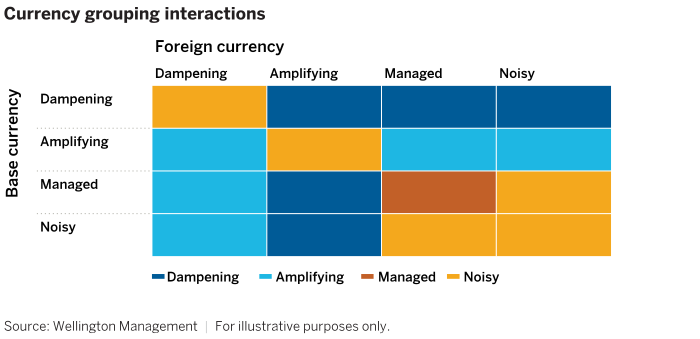
For a specific currency pair (i.e., a base currency and a foreign currency), what matters is the interaction between the groups in which each falls. Figure 5 illustrates this currency grouping interaction framework. For example, when paired, a base Dampening currency and another Dampening currency could cancel each other out and turn the relationship into a “Noisy” one.
Figure 5
To read more, please click the download link below.
1Technically, the costs include any execution charges, including departures of forward prices relative to the interest-rate differential. | 2The exception here is EM local currency where the currency itself is a desired exposure. | 3In other words, this ignores correlation effects.

The convergence of public and private markets — part 2
The convergence of public and private markets is opening new opportunities for wealth and institutional investors — but each will approach them differently. Part 2 of our series explores how evolving investor needs are shaping portfolio construction, product design, and implementation.

The rally: Refusing to yield?
Find out why we remain constructive but increasingly selective as AI investment supports equities, rising yields create opportunities in government bonds, and geopolitical risks complicate the outlook.

The total portfolio approach: A mindset, not a mandate
We explain why the total portfolio approach (TPA) to asset allocation doesn’t have to be an all-or-nothing overhaul — and how selected practices can drive more deliberate decisions about risk, liquidity, and active management.

Top of Mind: Challenging false investment dichotomies
Multi-Asset Strategist Adam Berger takes on three familiar investment debates where rigid “either/or” thinking may not serve investors well: active vs passive, US vs non-US, and public vs private.

Follow the money: 3 ways wealth is reshaping economic and investment outcomes
We explore how macroeconomic, demographic, and sector-specific trends are reshaping commercial real estate, and why selectivity by sector, asset, quality, and capital structure may matter more than broad asset-class exposure.

Finding opportunity in a narrowing market
In this quarter's outlook, our team explains why they believe insurers should maintain a moderately constructive but selective risk posture, emphasizing dependable income, downside resilience, liquidity, and reinvestment flexibility.

Funded ratios on the rise: A mid-year action plan
With corporate DB plans enjoying strong funded-ratio gains, we propose potential action steps, including refining liability-hedging strategies and choosing a path for surplus assets.

The rally and the reality
Can the markets remain resilient in the face of geopolitical disruption and inflation worries? We offer our views on the macro environment, AI-driven earnings, and the implications for equities, bonds, and commodities.

Looking beyond mega-caps
We explore how the growing concentration of capital in mega-cap private companies is reshaping the venture and growth opportunity set, and the implications for portfolio construction, manager selection, diversification, and potential return opportunities across private markets.

Growth outlook faces a new test: Inflation
Explore our latest views on risks and opportunities across global capital markets.

Loans from Federal Home Loan Banks: An opportunity for US insurers to enhance investment yield and total return
Learn why we believe FHLB loans provide compelling potential for insurers to add alpha or increase yield by borrowing at low rates and benefitting from possible favorable treatment by ratings agencies.
URL References
Related Insights