Climate investing in a constrained world


How structural bottlenecks are expanding the opportunity beyond cleantech to modernize systems running the physical economy

12 min read
2027-09-12
Archived info
Archived pieces remain available on the site. Please consider the publish date while reading these older pieces.
1338889422
Greg Wasserman, CFA, Head of Private Climate Investing
1338889422
Stephen Moch, Investment Director
1338889422

Key points

  • We see the climate opportunity as broader than traditional cleantech investments, spanning three general pathways: deep-tech innovation, asset and infrastructure buildout, and performance optimization.
  • Each pathway boasts a distinct risk profile, capital intensity, time horizon, and set of demand drivers.
  • Performance optimization is growing in importance as structural bottlenecks intensify across physical systems.
  • Public and private markets each provide access to distinct stages of innovation.

Overview

Climate investing entails more than building renewable energy or reducing emissions. The physical economy, power grids, industrial production, buildings, transportation networks, food systems, and supply chains are operating under tighter constraints. Demand is rising while capacity is harder to add, skilled labor remains scarce, networks are fragmented, and physical risk is increasing.

Historically, many systems ran with spare capacity or were able to add additional capacity relatively easily, so inefficiency was more tolerable. But today's systems are constrained. Inefficiency now shows up directly as cost, downtime, delay, and operational risk, where disruptions in one system quickly raise costs in other systems interconnected to it. Stronger system performance is becoming more critical to continued operation and growth. These structural bottlenecks place a premium on unlocking usable capacity from existing systems and deploying new capacity more intelligently.

We believe these conditions are expanding climate opportunities beyond the traditional focus on decarbonization and climate resilience, to also encompass modernizing constrained systems. Customers increasingly rely on software, automation, advanced controls, and artificial intelligence to improve utilization, reliability, productivity, and resilience. The development of new climate technologies and the deployment of physical assets and infrastructure run parallel to a third distinct lane of performance optimization for existing and new systems.

Customers often adopt these technologies to solve operational problems and improve economics, while emissions reduction, resource efficiency, or resilience benefits can emerge as an outcome of product usage rather than the primary purchasing driver. This distinction highlights how measurable customer return on investment (ROI) can support repeatable adoption and more durable demand.

In this paper, we explore how climate investing extends well beyond traditional cleantech, why structural bottlenecks are increasing the importance of performance optimization, how key climate pathways differ, and how public and private markets provide exposure across distinct stages of innovation.

So, what is climate investing?

Climate investing is often narrowly viewed as renewable energy, emissions-reduction technologies, or cleantech. But in practice, the opportunity set is far broader.

At its core, climate investing seeks to address:

  • the underlying causes of climate change in the form of emissions reduction (mitigation)
  • the impacts of climate change through greater resilience to extreme weather such as heat, storms, wildfire, drought, and floods (adaptation)

Climate solutions can take many forms, some more apparent than others. Renewable energy generation clearly reduces emissions, as do carbon capture and storage. Others are less obvious but still material. To name one: Supply chain software helps food manufacturers forecast sales to reduce waste from overproduction or logistical inefficiency. Likewise, reinforcing seawalls clearly builds resilience to storms and flooding. But so does the geospatial software that municipalities use to inform construction design standards and code requirements in higher-risk flood zones.

In our view, key investor questions are: how the solution is adopted, who pays for it, what measurable economic value it creates, and whether climate outcomes align with greater product usage.

Demand drivers for climate solutions

We believe demand for climate solutions falls on a spectrum between two broad drivers. At one end, climate benefits are the primary reason for adoption, with demand supported by regulation, incentives, corporate decarbonization commitments, or willingness to pay a green premium. These solutions may be essential to long-term decarbonization, but demand can be more sensitive to policy changes, financing conditions, and cost curves.

At the other end of the spectrum live market-driven solutions. Customers adopt these measures because they solve operational pain points and deliver clear economic value propositions through lower costs, improved productivity, increased uptime or throughput, reduced risk, and better capabilities. In these cases, climate outcomes are economically embedded, rather than externally motivated.

We believe this distinction matters because it changes how investors should underwrite demand durability. Solutions grounded in operational necessity and measurable customer ROI remain relevant even as policy environments, incentives, or sustainability priorities evolve. “Market-driven” does not mean every efficiency or productivity technology functions as a climate solution. Climate relevance still requires a material link to mitigation or adaptation and a credible connection between product usage and climate outcomes.

Why now? Structural bottlenecks are creating durable demand

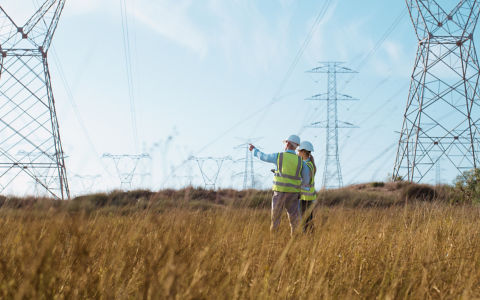
These opportunities are increasingly visible across the physical economy. Power grids struggle to meet rising electricity demand from electrification and digital infrastructure, including AI-driven compute, leading to congestion and interconnection constraints. Manufacturers continue operating with aging equipment and persistent labor shortages. Supply chains face fragmentation, trade disruption, and limited buffer amid geopolitical volatility. Physical infrastructure is increasingly vulnerable to extreme weather.

Median grid-interconnection timelines are now approximately five years — up from less than two years historically.¹ At the same time, 27 US weather and climate disasters exceeded US$1 billion in damages in 2024, totaling approximately US$180 billion.²

These constraints are becoming more binding just as advances in AI, edge computing, control software, and robotics are making technologies that improve system performance more capable, affordable, and deployable. By embedding software and sensing into physical assets and workflows, these technologies can unlock constrained capacity, improve utilization, reliability, and resilience, while enabling more efficient planning and deployment of new capacity required to support economic growth.

Three pathways within climate investing

We see three broad focus areas within the climate investment opportunity set. Attractive in their own ways, each carries a different risk profile, capital requirement, set of demand drivers, and time horizon. They can also play complementary roles in an investor's portfolio.

Path 1: Deep-tech climate innovation

Many investors initially think of deep-tech when discussing climate investing. This typically involves breakthrough technologies that can change the cost, performance, or emissions profile of large physical markets.

Examples include advanced battery chemistries, next-generation solar materials, advanced fuels, carbon capture systems, nuclear fusion reactors, and lower-emission industrial processes for steel, cement, or chemicals.

These companies can address large markets and advance long-term decarbonization. If one of these technologies achieves line of sight to cost parity and then moves past it to become the market standard, it can attract the capital to scale and become the cheapest option, just as solar photovoltaics and lithium-ion batteries did over the past two decades. Even then, the returns do not always go to the company that developed the technology. In solar and batteries, much of the value went to large incumbent manufacturers that scaled production, rather than the original innovators. These companies also tend to involve a distinct underwriting profile, with greater technical risk, scale-up complexity, and capital requirements than more asset-light models.

Adoption may depend on policy support, strategic customers, or green premiums until technologies become cost competitive with incumbent alternatives. Development is also often asset-intensive, requiring substantial capital and longer time horizons to prove and scale. As a result, this climate opportunity segment often aligns naturally with investors and LPs capable of supporting longer development cycles, higher capital intensity, and greater technology risk.

Path 2: Asset and infrastructure buildout

Asset and infrastructure buildout involves financing and constructing the physical infrastructure required for the energy transition and broader economic growth once underlying technologies are sufficiently proven for project deployment. This includes generation, transmission, and storage infrastructure, as well as industrial facilities, buildings, and municipal infrastructure.

Recent growth in renewable energy projects and data centers illustrates the scale of this buildout. Though essential, these projects frequently involve long timelines, permitting complexity, and significant upfront capital requirements, frequently supported through project finance structures.

Consequently, return profiles and investment horizons are often more aligned with infrastructure and real asset strategies than venture or growth equity investing. These assets have the potential to generate attractive risk-adjusted returns, and this part of the opportunity set may align naturally with investors seeking infrastructure-style duration, yield, and risk.

Path 3: Performance optimization

Performance optimization adds an intelligence layer to the physical economy, with the goal of improving operational efficiency of existing systems and enabling better planning, design, and management of new capacity.

These companies apply software and software-enabled hardware, including automation, advanced controls, and artificial intelligence, to help customers unlock constrained capacity, reduce costs, increase uptime and throughput, improve decision making, and manage risk. Grid intelligence, load orchestration, and compute optimization can increase usable power and compute capacity. Robotics, drones, and automation can improve productivity and help address labor shortages. Digital twins and simulation tools can improve planning and design for new infrastructure. Advanced controls allow assets to operate more dynamically based on real-time conditions rather than static operating assumptions.

These solutions address binding constraints in how essential systems operate. Utilities must manage load growth and grid congestion. Manufacturers must increase productivity despite labor scarcity and aging equipment. Building owners must manage energy costs and physical climate risk. Companies across sectors need better forecasting and visibility across supply chains.

The strongest companies in this pathway have the potential to grow because they solve operationally critical problems with measurable customer ROI. Technologies that manage load, automate workflows, coordinate distributed assets, or optimize operations in real time can defer capital expenditures, increase asset utilization, and reduce labor dependence or resource intensity.

Regulation and targeted incentives can accelerate adoption, but durable demand is typically anchored in measurable economic benefits through cost savings, reliability, and risk management.

Climate outcomes remain aligned with product usage. Lower energy consumption, reduced waste, improved asset utilization, and greater resilience can scale alongside commercial growth. We believe this creates a compelling part of the climate opportunity set, particularly within growth-stage private markets.

Asset-light versus asset-heavy

Across these pathways, capital intensity creates another important distinction for investors.

Deep-tech and asset-heavy businesses often require significant capital early in their life cycle, as manufacturing capacity, demonstration facilities, or physical infrastructure must be built well in advance of meaningful revenue generation.

In contrast, asset-light business models tend to scale more linearly through repeatable deployments with lower incremental capital requirements. These companies often apply existing technologies in new ways to physical systems, replicating software, data, or control-layer capabilities across customers without financing substantial new production capacity.

That does not inherently make asset-light companies less risky. They still face execution, procurement, integration, and competitive challenges. However, their scaling profile can differ meaningfully from businesses that require substantial capital investment to prove and expand capacity.

Public and private markets: Different stages of climate opportunity

Public and private markets can both provide exposure to climate-related modernization, but often at different points in the company life cycle.

Public markets generally provide access to scaled incumbents at later stages of adoption, with established revenue streams and greater liquidity. Private markets provide earlier exposure to emerging categories. Within private markets, early-stage venture investments fund technology development, product iteration, and customer pilots, at a stage in the life cycle where technical and product-market-fit risks are highest.

Growth-stage investing typically follows market validation. Technologies are more proven, customer adoption is clearer, and operating history allows investors to evaluate customer usage, expansion, renewal behavior, unit economics, and capital efficiency. At this stage, the emphasis shifts from proving technical feasibility, to assessing whether a company can scale efficiently and expand market penetration.

At the growth stage, product-market fit is more established, with visible operating data that allows investors to assess customer value propositions and adoption drivers. Public market research remains relevant at this stage, as it can help investors assess end-market durability, incumbent response, valuation, and potential exit pathways.

Bottom line on climate investing

The first phase of climate investing was defined by building new clean technologies and new clean capacity, and those efforts remain essential. Today, as systems across the physical economy hit limits, technologies that unlock constrained capacity, improve reliability, and reduce risk are becoming just as important.

We believe that when customers buy based on economics and climate outcomes scale with usage, company growth directly translates into greater climate impact.

¹ Lawrence Berkeley National Laboratory, Queued Up: 2026 Edition. | ² National Oceanic and Atmospheric Administration, US Billion-Dollar Weather and Climate Disasters, calendar year 2024, as of January 2025.

The views expressed are those of the author at the time of writing. Other teams may hold different views and make different investment decisions. The value of your investment may become worth more or less than at the time of original investment. While any third-party data used is considered reliable, its accuracy is not guaranteed. For professional, institutional or accredited investors only.

ExpertS

Get our latest market insights straight to your inbox.

Read more from our experts