United States, Institutional
Change




Recent events in the Middle East underscore the structural shift towards an inherently more volatile and cyclical macro world. Here we explore how investors can recalibrate portfolio diversification to maximise its effectiveness across different macro regimes. Our conclusion: there is a compelling case to seek broader diversification, with commodities playing a critical role given the growing risk of inflationary or even stagflationary outcomes.
What has happened to date?
- At the time of writing, the conflict continues unabated. Oil prices are acting as a real-time indicator of the market’s expectations about the duration of the conflict and the durability of energy supply, resulting in record-breaking price moves. These swings highlight the lack of clarity on the ultimate impact of the conflict on inflation and growth, as markets struggle to assess whether higher energy prices will be transitory or represent a more sustained shock.
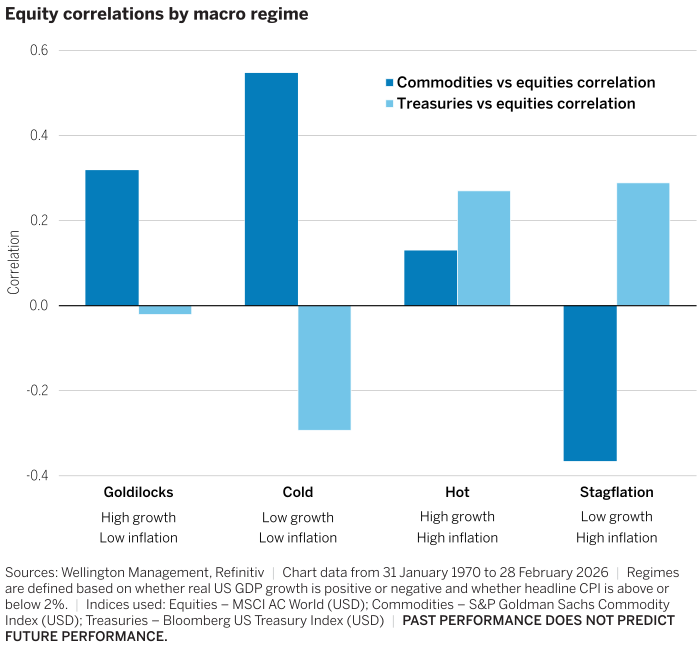
- History shows that the effectiveness of cross-asset diversification is shaped by the macro backdrop. Figure 1 highlights the correlation of equities with bonds and commodities across various inflation and growth regimes, with each regime defined by whether inflation is above or below 2% and whether real economic growth is positive or negative.
- The current events represent an acute risk to both growth and inflation. Because effective diversification is regime dependent, different assets contribute to portfolio resilience under different inflation and growth backdrops — underscoring the need to reassess diversification as macro conditions evolve.
Figure 1
What are the investment implications?
- Elevated inflation uncertainty strengthens the structural case for commodities as a portfolio diversifier when traditional stock bond relationships come under strain. While commodities do not consistently exhibit negative equity correlations in “hot” inflation regimes, they have historically been less positively correlated than bonds, helping to preserve diversification when inflation shocks weaken bond protection.
- Bonds have proved to be less effective as diversifiers when inflation risks dominate, regardless of the growth outcome. Positive equity bond correlations in both “hot” inflation and “stagflation” regimes suggest that the persistence of inflation rather than a slowdown in growth is the primary risk to portfolio diversification following energy price shocks.
- Commodities have historically offered the strongest diversification benefits in stagflationary regimes. Past oil supply shocks in the 1970s and 1980s exemplify severe geopolitical disruptions leading to both weak growth and high inflation. Stagflationary conditions, under which commodities have historically played their most effective defensive role, have been relatively infrequent in the past but, in our view, remain within the distribution of possibilities arising from current events, with the likelihood of stagflation increasing the longer the conflict persists.
What are we watching?
- The duration of energy supply disruptions. Global stakeholders are actively seeking ways to preserve supply and engineer some reopening of the Strait of Hormuz, but production and shipment remain extremely vulnerable to continued attacks by Iran (and, potentially, its proxies).
- Broader inflation impact. Signs that higher energy prices are feeding through to core prices.
- Stalling growth momentum as higher energy costs filter through the economy. If elevated energy prices begin to weigh meaningfully on consumption, margins and investment, the probability of a stagflationary outcome would increase.
The views expressed are those of the authors at the time of writing. Other teams may hold different views and make different investment decisions. The value of your investment may become worth more or less than at the time of original investment. While any third-party data used is considered reliable, its accuracy is not guaranteed. For professional, institutional or accredited investors only.