

- Co-Head of Multi-Asset Portfolio Management and Portfolio Manager
United States, Institutional
ChangeUnited States, Institutional
Changechevron_rightThank you for your registration
You will shortly receive an email with your unique link to our preference center.

The views expressed are those of the authors at the time of writing and are subject to change without notice. Other teams may hold different views and make different investment decisions. This content is for informational purposes only, should not be viewed as a current or past recommendation and is not intended to constitute investment advice or an offer to sell, or the solicitation of an offer to purchase shares or other securities. Forward-looking statements should not be considered as guarantees or predictions of future events. For professional, institutional, or accredited investors only.
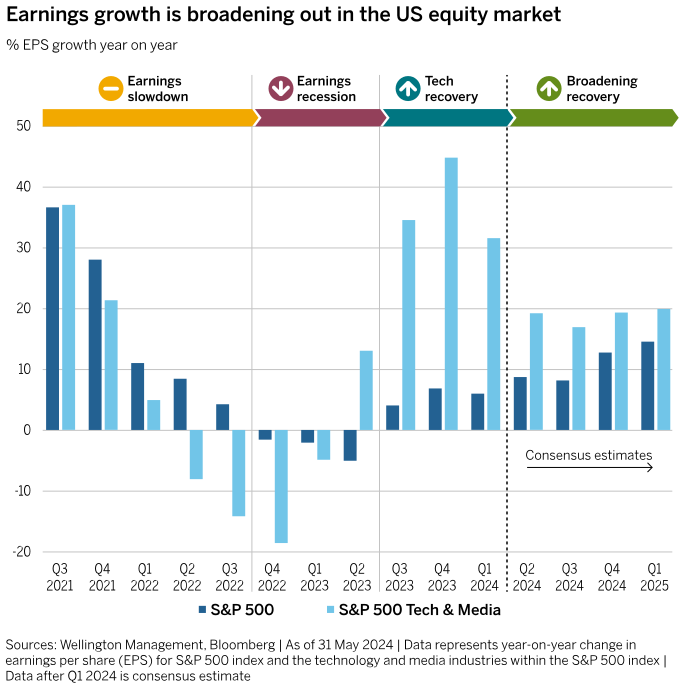
2021 was a banner year for earnings. But by the tail end of 2022, earnings decelerated into recessionary territory as the pandemic-era fiscal stimulus and release of pent-up consumer demand that had initially fuelled earnings recovery was seemingly spent. However, markets eventually found their hero in the mightily monikered “Magnificent Seven”, as the companies best poised to harness and benefit from new innovations within artificial intelligence were rewarded accordingly. These companies, concentrated within the technology and media sectors, quickly experienced a resurgence in earnings in 2023 that vastly outpaced the broader market.
While constituency has since changed as to which companies belong in the AI pantheon — “Magnificent Seven” quietly dropped to “fab five” and so forth — the overall trend of mega-cap stocks within tech and media leading earnings growth has remained a constant over the last year. However, that paradigm may be set to shift; over the next 12 months, earnings growth is expected to broaden beyond tech and media to the rest of the market. Consensus forecasts project annual S&P 500 earnings growth of 15% by the start of 2025, which could be supportive for returns outside of the current bias.
Experts


Rapid fire questions with Steven Angeli on quality growth equities
Continue readingThe three drivers of resilient portfolios in 2026
Continue readingRotations and reallocations: Rethinking equities
Continue readingRapid Fire Questions with Tim Manning
Continue readingBy
Chart in Focus: Earnings upgrades fueled the recent US equity market rally
Continue readingChart in Focus: Is growth investing still dominating?
Continue readingRapid Fire Questions with Philip Brooks (Part 2)
Continue readingURL References
Related Insights
Get our latest market insights straight to your inbox.
Thank you for your registration
You will shortly receive an email with your unique link to our preference center

Rapid fire questions with Steven Angeli on quality growth equities
Equity Portfolio Manager Steven Angeli shares his views on market concentration, the opportunities in quality growth equities, and the most attractive opportunities both within and beyond AI.

The three drivers of resilient portfolios in 2026
Natasha Brook-Walters sees three key areas for investors to focus on in 2026: the role of alpha, the role of income and the role of uncorrelated returns.

Rotations and reallocations: Rethinking equities
Since April's Liberation Day, equity markets have recovered losses and appear to be on an upwards trajectory. But under the surface of the highs, argues Equity Strategist Andrew Heiskell, is a market and an economy looking for direction. Why is the economy so stuck?

Rapid Fire Questions with Tim Manning
In this edition of “Rapid Fire Questions,” equity portfolio manager Tim Manning offers his views on rates, fiscal policy, tariffs, and AI — and shares why he remains constructive on the US equity market.
By

Chart in Focus: Earnings upgrades fueled the recent US equity market rally
Where are earnings heading? In this edition of Chart in Focus, we address the recent uptick in earnings expectations and its potential impact on equity returns.

Chart in Focus: Is growth investing still dominating?
Growth isn't global? In this edition of Chart in Focus, we compare the performance of value vs. growth stocks globally, highlighting the contrast by region, and in turn explore the implications for style investing.
Rapid Fire Questions with Philip Brooks (Part 2)
In part 2 of his “Rapid Fire Questions”, equity strategist Philip Brooks shares his views on 3 key questions, focusing on the topic of Quality and investible opportunities today in US and abroad.
Rapid Fire Questions with Philip Brooks (Part 1)
In part 1 of his “Rapid Fire Questions”, equity strategist Philip Brooks shares his views on 3 key questions, focusing on market outlook and risks.

There is more than one way to approach growth equities
Portfolio Managers Steven Angeli and Joe Chung, and Investment Specialist Casey Vale discuss how looking at growth equities in a different way may help uncover opportunities amid heightened uncertainty and volatility.
Multiple authors

WellSaid: Partnering with climate founders
Wellington head of private climate Greg Wasserman discusses his team's approach to helping private companies progress along their growth journey

Time to get active? 5 equity investment ideas for 2025
As we head into 2025, growth seems poised to accelerate, especially in the US. Equity Strategist Andrew Heiskell and Macro Strategist Nicolas Wylenzek see five themes that may create opportunity across global equity markets.
URL References
Related Insights
© Copyright 2026 Wellington Management Company LLP. All rights reserved. WELLINGTON MANAGEMENT ® is a registered service mark of Wellington Group Holdings LLP. For institutional or professional investors only.
Enjoying this content?
Get similar insights delivered straight to your inbox. Simply choose what you’re interested in and we’ll bring you our best research and market perspectives.
Thank you for joining our email preference center.
You’ll soon receive an email with a link to access and update your preferences.