Wellington Homepage

Changechevron_right

China’s biotech surge (and its impact on biotech venture capital)

4 min read
2028-01-31
Archived info
Archived pieces remain available on the site. Please consider the publish date while reading these older pieces.
Multiple authors
Biotech Innovations

Over the past decade, China’s biotech industry has transformed from a low-cost manufacturing base to a leading innovation hub. The convergence of regulatory reform, returning scientific talent, and local venture capital has fueled an explosion in clinical activity and partnerships.

In this paper, we explore why Chinese biotechs seem poised for long-term success, what it means for the future of biotech venture capital in the US and Europe, and much more.


Key points

  • China’s biotech sector’s long-term potential is underpinned by lower costs, faster development timelines, and increasingly translatable clinical data.
  • For Western biotechs and allocators, this highlights the need for capital efficiency, the benefit of streamlined development models, the role of strategic partnerships, and the importance of understanding each region’s competitive advantages.

China’s biotech industry moves from fast follower to global force

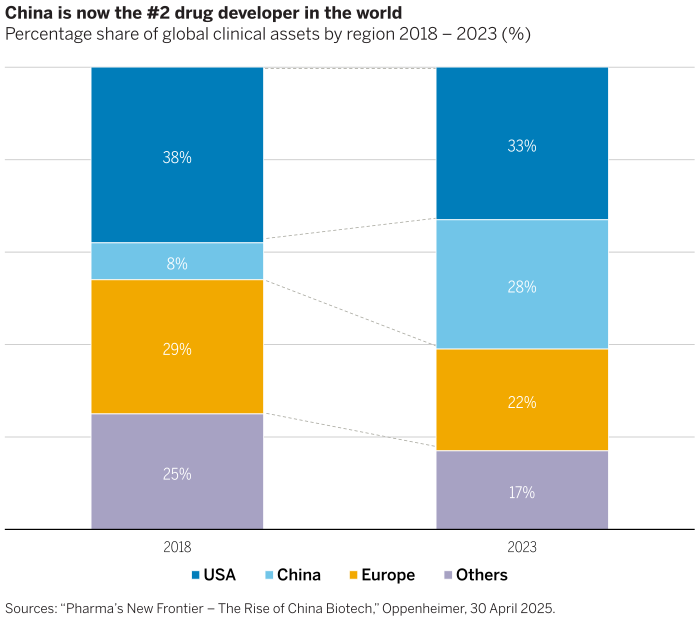
China’s share of global investigational new drug filings more than tripled (Figure 1) between 2018 and 2023. Meanwhile, its portion of global business development deal value rose from the low single digits to roughly 20%.1 This momentum continued accelerating in the first half of 2025, with Chinese companies accounting for roughly one-third of global out-licensing, totaling US$2.5 billion in upfronts and up to US$37 billion in total consideration.2

Notably, global pharmaceutical companies are no longer just licensing “fast follower” programs. Deals increasingly target best- or first-in-class assets, including Akeso’s ivonescimab (PD-1/VEGF bispecific), BeiGene’s zanubrutinib (BTK inhibitor), and Legend’s cilta-cel (CAR-T cell therapy).3 In our view, the direction of travel is clear as China increasingly becomes a leader in biotech innovation.

Figure 1

Yied differential

Three drivers of China’s biotech advantage

So, what’s driving China’s growth in the space? Cost, speed, and capital efficiency are major factors that define the country’s competitive edge. Preclinical and clinical testing costs in China are about 70% of US levels,4 while research and development (R&D) spend per employee is roughly one-quarter of that in the US.5 Moreover, development from candidate nomination to approval can be 30% to 40% faster, saving up to four years to market.6

Chinese biotechs have also benefited from strategic target selection. They generally focus on validated targets and modalities, which can derisk development. Popular categories (including PD-1, HER2, GLP-1, and Topo1) are often built using established scaffolds such as monoclonal antibodies, bispecifics, antibody-drug conjugates (ADCs), and tyrosine kinase inhibitors (TKIs).

Venture capital’s renewed focus on capital efficiency makes China’s lower costs, faster development, and strategic derisking particularly advantageous today.

Global partnerships: Harnessing China’s growth

Over the past few years, the biotech sector has reached an inflection point for global collaboration. The post-2021 funding downturn and improving translatability of Chinese clinical data have accelerated global dealmaking. Domestic venture capital in China has fallen to a seven-year low, pushing companies toward out-licensing, M&A, and partnerships. For example, in 2023, business development income nearly equaled venture investment, signaling a structural shift in how innovation is financed.7

Multinational pharmaceutical companies are responding to the opportunity this presents. Each successful trial replication in Western populations seems to increase confidence in Chinese data integrity. With Chinese assets typically transacting at a 40% to 50% discount to global peers,8 we believe pharma sees compelling risk-adjusted value and a chance to fill pipeline gaps, particularly in early-stage programs.

Implications for US and European biotech

China’s rise introduces both competition and a catalyst for Western biotech companies and investors. The country’s biotech sector could continue to erode pricing power and compress innovation margins for Western biotechs. But it also offers a mirror and a playbook for a more capital-disciplined, faster-moving industry.

We believe there are three key lessons for Western biotechs and investors:

  1. Capital efficiency matters: Smaller, milestone-based financings can drive focus and reduce burn.
  2. Speed compounds returns: Streamlined R&D cycles can shorten time to value realization.
  3. Strategic partnering: Collaborations with Chinese innovators can unlock non-dilutive capital and regional expertise.

Critically, not every modality is equally replicable. Areas such as cell and gene therapy, radioligand therapy, and AI-driven drug design still offer deep competitive moats where Western science maintains an edge. As investors explore allocations, it is important to consider where each region may have competitive advantages.

Bottom line on investing amid China’s biotech surge

Many investors view China’s biotech rise as a threat to US and European biotech. We believe it is better viewed as a signal. Innovation is globalizing, and the next decade will reward investors who can identify where and how value is being created across borders. Importantly, capital efficiency and time to value realization will also become crucial.

1“Shopping in China’s Biotech Supermarket,” Jefferies, 13 July 2025. | 2Ibid. | 3Examples given for illustrative purposes only. | 4“Pharma’s New Frontier – The Rise of China Biotech,” Oppenheimer, 30 April 2025. | 5Ibid. | 6Ibid. | 7“China Biotechnology, Going Global: China Remains the Global Innovative Hub in 2025 (exhibit 8),” HSBC Global Research, 14 February 2025. | 8“Shopping in China’s Biotech Supermarket,” Jefferies, 13 July 2025.

The views expressed are those of the authors at the time of writing. Other teams may hold different views and make different investment decisions. The value of your investment may become worth more or less than at the time of original investment. While any third-party data used is considered reliable, its accuracy is not guaranteed. For professional, institutional or accredited investors only. 

Experts

Get our latest market insights straight to your inbox.

Read more from our experts