



- Investment Director, Private Investment Capital Formation
Explore our insights
Asset class
Formats
2026 Midyear Investment Outlook

2026 Midyear Investment Outlook
Today’s private equity (PE) markets offer an increasingly wide range of potential investment opportunities with a similarly broad set of characteristics. In this paper, we explore four key questions to help investors better understand how these strategies compare and complement each other in a portfolio.
In particular, we compare three popular private equity investment strategies (venture capital, growth equity, and buyout), highlighting their distinct opportunity sets, risk-return characteristics, and portfolio roles.
Investments in the global financial landscape can broadly be divided into public and private markets. The most prominent difference between these markets is that private investments involve financing nonpublic companies in negotiated transactions, unlike the easily accessible exchanges on which the public market primarily operates.
There are a multitude of different private-market asset classes across the industry but the five most common are private equity, private debt, real estate, infrastructure, and natural resources. Each asset class provides a distinct investment profile due to different exposures, risks, structures, and target returns.
PE funds invest in the equity of companies that are not publicly traded, or in the equity of publicly traded firms that the fund intends to take private. They are generally structured as partnerships that consist of investments in individual private companies.
The types of private equity
Just as there are different asset classes in private markets, private equity is an umbrella term that describes a collection of unique strategies, such as venture capital, growth equity, buyout, fund-of-funds, and secondaries. The first three represent direct private equity investment strategies. Fund-of-funds are indirect investments and secondaries can be either direct or indirect.
Below, we dive deeper into venture capital, growth equity, and buyout strategies by examining their respective investment landscapes, risk-return profiles, and characteristics in a diversified portfolio.
Figure 1
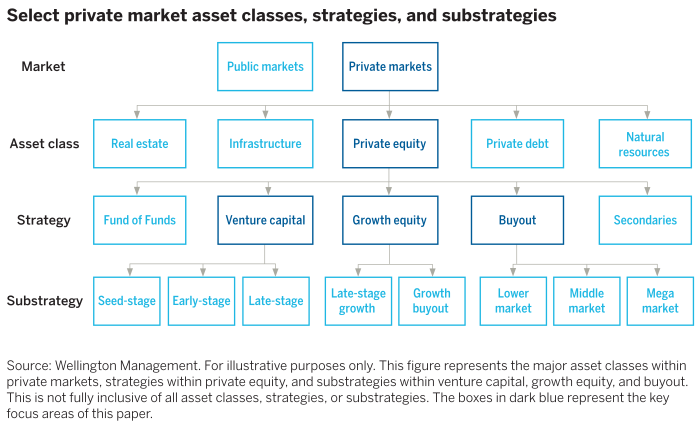
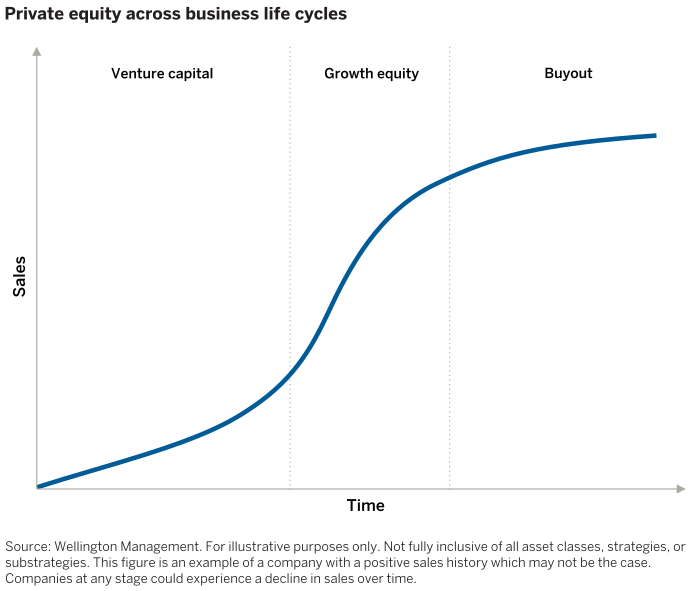
The characteristics of the companies that these strategies invest in vary significantly from one another. Generally speaking, venture capital targets companies that have the highest growth rate but are still relatively unproven, growth equity focuses on high-growth companies that are operating at a greater scale, and buyout targets companies that are profitable with stable reoccurring revenue but have more moderate growth.
The venture capital opportunity set
Venture capital is itself a broad strategy that is most frequently divided into the substrategies of seed-stage, early-stage, and late-stage. Venture capital firms generally raise funds that focus on one of these substrategies, although it is also common to raise diversified funds that invest across two or more.
Seed-stage companies typically require financing to research business ideas, develop prototype products, or conduct market research. Early-stage companies generally have well-articulated business and marketing plans but are pre-revenue. Late-stage companies have started their selling efforts and need capital to expand production capacity, develop products, and/or fund working capital.
The growth equity opportunity set
Within the growth equity landscape, it’s important to distinguish between late-stage growth and growth buyout strategies, as each typically focuses on minority investments in high-growth companies but targets different segments of the market.
Late-stage growth investments are typically made in companies that have already achieved significant commercial traction, and are experiencing rapid revenue expansion, often exceeding 40% annual growth. These businesses are usually venture-backed, operate in innovative sectors such as technology, and are raising capital to accelerate expansion ahead of a liquidity event, such as an IPO or M&A. Late-stage growth investors generally take minority positions and avoid the use of leverage, focusing instead on supporting organic growth and operational scaling.
Growth buyout targets are often profitable companies with established business models and annual growth rates in the 20% – 30% range. Unlike late-stage growth, these companies generally haven’t received venture capital funding and often have limited prior institutional ownership. Growth buyout transactions frequently involve the use of leverage, and investors may seek either minority or majority stakes, depending on the opportunity. As a result, growth buyout strategies offer a middle ground, blending elements of growth-oriented investing with the operational and financial engineering typical of buyouts.
The buyout opportunity set
Buyout funds typically invest in profitable companies with steady cash flows that can bear leverage. These funds target companies to which they believe they can add value through operational improvement, cost cutting, M&A, leadership changes, and/or financial engineering. The size and financial profile of the companies that buyout funds target vary depending on the substrategy. These are typically divided into lower market, middle market, and mega market. Notably, buyout substrategies are fairly consistent, with the major difference being the size of the company.
Investors generally allocate to private equity in pursuit of higher returns and diversification. This is for good reason, as over the last 10 years, the Cambridge Associates Venture Capital, Growth Equity, and Buyout Indices returned pooled net returns of 13.55%, 13.63%, and 14.23%, respectively, compared with annualized returns of 8.27% and 10.23% for the Russell 2000 and the MSCI World IMI indices, respectively.1 Importantly, private equity investments, as noted in our previous piece on Understanding private equity performance, are typically measured using performance metrics that are unique to these funds.
While the historical premium to public markets may be compelling, allocators to venture capital, growth equity, and buyout should consider the distinct risks associated with these investments.
Venture capital and growth equity funds rarely lever their investments, making them less vulnerable to financial risk and higher interest rates. All three strategies bear illiquidity risk as they cannot exit their investments when it may be most convenient and instead require a liquidity event. Despite these risks, investments in these strategies can potentially yield important diversification benefits that may be able to help “derisk” a portfolio. Figure 2 shows the potential risk-return profile for each strategy.
Figure 2
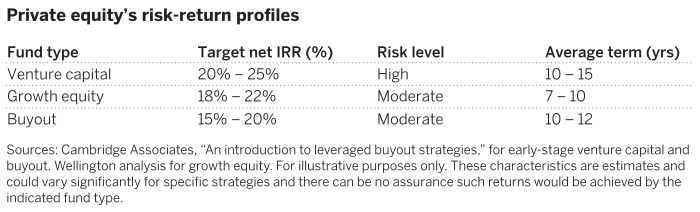
Venture capital, growth equity, and buyout are three of the most common strategies in the private equity industry. Many investors in this asset class allocate to buyout as a core holding given its moderate risk level and relatively stable returns, while investments in venture capital are frequently smaller and seek outsized returns. Growth equity is relatively new compared to the other two strategies, but its risk profile and potential for quicker return of capital may be attractive to investors implementing exposure to venture-backed companies at scale and maturity, building a new private investment program, or as an alternative to public equity small-cap strategies.
The combination of venture capital, growth equity, and buyout allows investors to allocate across a business’s life cycle (Figure 3), potentially achieving greater exposure and diversification. In addition, private equity investments historically have not been as correlated to downturns in the public market,2 so they may provide diversification benefits under certain market conditions for a well-diversified portfolio during these times.
Potential return, risk, and liquidity expectations are critical considerations for investors allocating to private equity, with the greatest diversification benefits historically having been achieved by investing across strategies. For this reason, many institutional investors have separate allocations to each substrategy.
Figure 3
1 Comparisons between private market indices and public market indices should be viewed with caution, as they reflect fundamentally different asset classes, liquidity profiles, valuation methodologies, and risk characteristics. Sources: Cambridge Associates Venture Capital and Buyout Indices sourced from their respective Cambridge Associates Private Benchmarks Q2 2025 reports. Data as of 30 September 2025. The buyout index is a horizon calculation based on data compiled from 2,079 buyout funds, including fully liquidated partnerships, formed between 1986 and 2025. The growth equity index is a horizon calculation based on data compiled from 886 growth equity funds, including fully liquidated partnerships, formed between 1986 and 2025. The venture index is a horizon calculation based on data compiled from 3,429 venture capital funds, including fully liquidated partnerships, formed between 1981 and 2025. Private indices are pooled horizon internal rate of return (IRR) calculations, net of fees, expenses, and carried interest. The timing and magnitude of fund cash flows are integral to the IRR performance calculation. Russell 2000 Index and MSCI World IMI Index data as of 30 September 2025. Indices are unmanaged and cannot be invested in directly. PAST RESULTS ARE NOT NECESSARILY INDICATIVE OF FUTURE RESULTS. | 2Source: Scientific Infra & Private Assets, “Do private equities track public markets (and when)?, November 2025.
The views expressed are those of the authors at the time of writing. Other teams may hold different views and make different investment decisions. The value of your investment may become worth more or less than at the time of original investment. While any third-party data used is considered reliable, its accuracy is not guaranteed. For professional, institutional or accredited investors only.
Experts