Asia's rising role in the global AI build-out

5 min read
2029-08-31
Archived info
Archived pieces remain available on the site. Please consider the publish date while reading these older pieces.
1838443-hero-image-v1
Yash Patodia, Sector co-head, Technology
1838443-hero-image-v1

The narrative around artificial intelligence (AI) has, until now, been largely driven by a handful of US names that are now commonplace in most households — the hyperscalers and the model developers racing to the next breakthrough. But as Portfolio Manager Yash Patodia explains, for those investors willing to look further along the value chain, a quieter, arguably more durable story may be unfolding.

Key points:

  • The narrative around AI has largely been driven by US hyperscalers and model developers, but investors may be overlooking Asia’s rising role in the AI build-out.
  • As AI adoption accelerates, demand for the technologies that underpin the ecosystem is likely to grow — benefiting Asian companies with leading positions in the hardware and infrastructure that enable AI.
  • The semiconductor value chain offers a broader way to participate in AI opportunities, reducing the need to predict which model, platform, or application will ultimately emerge as the dominant winner.

Profit pool is on the move

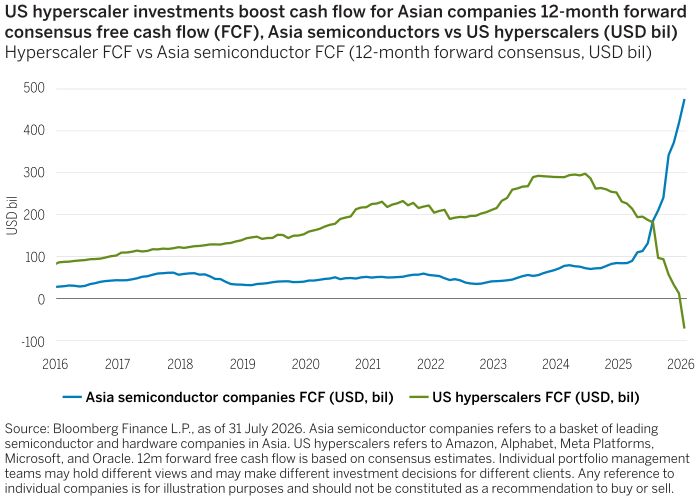
US hyperscalers remain formidably profitable businesses, and if anything, their AI ambitions are growing. Capital expenditure is rising rapidly as they race to expand compute capacity, build out infrastructure, and meet accelerating demand from consumers and enterprises, reflecting the attractive returns they continue to see from AI.

Recent calls from leading AI executives to pace frontier-model development do not, in our view, materially change this demand outlook. There have been no reported capacity cuts or order delays, while inference, broader deployment, and compute-intensive evaluation and safety work should continue to support demand.

This investment cycle is creating powerful tailwinds across the global technology supply chain, benefiting a group of Asian companies with leading positions in foundry, memory, semiconductor equipment, packaging, testing, and specialized materials. Many of these businesses are enjoying stronger pricing power and higher margins than at almost any point in their history. As AI adoption accelerates, demand for the technologies and infrastructure that underpin the ecosystem is likely to continue growing.

Figure 1: US hyperscaler investments boost cash flow for Asian companies 12-month forward consensus free cash flow (FCF), Asia semiconductors vs US hyperscalers (USD bil)

1838443_Asias-rising-role-fig1-v1

Asia dominates the semiconductor supply chain, accounting for more than 90% of global foundry capacity, 85% of assembly and packaging1, and the majority of silicon wafer and semiconductor equipment production. Importantly, Asia's semiconductor advantage is not easily replicated. Decades of accumulated knowledge, engineering talent, supplier relationships, and manufacturing expertise have created deeply interconnected ecosystems across Taiwan, South Korea, Japan, and, increasingly, parts of China. From leading-edge foundries and memory manufacturers to equipment suppliers, materials providers, advanced packaging specialists, and testing companies, the region has developed a level of specialization that would take years, if not decades, to recreate elsewhere.

While parts of the semiconductor industry remain cyclical, the sector is becoming increasingly differentiated, with some segments exhibiting less commodity-like and less cyclical characteristics than in the past. Capacity expansion has so far been relatively measured, and many of the key constraints across the AI supply chain are unlikely to be resolved quickly. As a result, supply and demand remain tight in several critical segments. More broadly, AI appears to represent a generational increase in compute demand and to form part of a broader megatrend of computing workloads moving to the cloud, underpinning sustained investment across the semiconductor value chain.

Lastly, much of the market debate so far has focused on whether model developers, hyperscalers, or application providers will ultimately capture the greatest share of value from AI. Yet the semiconductor value chain offers a broader way to participate in the trend, as rising demand for AI adoption flows across the global tech universe, reducing the need to predict which model, platform, or application will ultimately emerge as the dominant winner. However, the opportunity within AI in Asia isn’t restricted to the semiconductor value chain.

AI in Asia is far more than just semiconductors

We think about AI as two interconnected layers:

  1. Enablers — the hardware and infrastructure that make AI possible, including semiconductors, memory, networking, packaging, testing, and manufacturing capacity. Well-known examples include Taiwan Semiconductor Manufacturing Company (TSMC) and SK hynix, as well as many other companies across the Asian technology supply chain. Alibaba and Tencent are also examples because of their cloud and AI infrastructure businesses. This is currently where we see the clearest investment opportunities.
  2. Adopters — the companies integrating AI to personalize customer experience and automate operations. These firms are becoming the local champions of AI adoption across Asia. They include the consumer-facing businesses of companies such as Alibaba and Tencent, as well as businesses such as Trip.com, Coupang, and Grab, which can use AI to automate workflows, lower costs, improve customer engagement, and create new products and services.

Importantly, Asia offers exposure across both layers of the AI value chain, from the companies enabling the global AI build-out to those developing and deploying AI-powered products and services. The region also provides access to unique structural themes, such as China's semiconductor localization efforts, as well as opportunities across the full market-cap spectrum, including early-stage, smaller companies, and niche innovators. These are areas that many global technology portfolios often overlook, given their limited exposure to Asia and concentration in a handful of familiar mega-cap stocks.

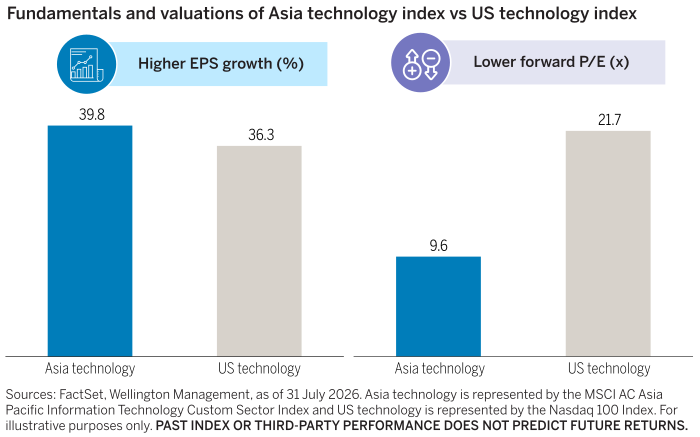
The opportunity is further supported by attractive valuations. At the index level, Asia technology has recently traded at roughly 10x forward earnings versus around 22x for US technology (see Figure 2), despite comparable or, in some cases, stronger earnings growth. The valuation gap becomes even more apparent when comparing individual companies across the two regions.

1838443_Asias-rising-role-fig2-v1

Looking ahead

While the path of AI adoption and the ultimate winners remain uncertain, we believe the structural increase in computing demand is likely to create opportunities across the ecosystem for years to come. A new generation of technology leaders is emerging, and we believe many of them will come from, or be enabled by, Asia. In our view, Asia’s combination of technological leadership, differentiated market exposures, and attractive valuations makes it an increasingly important part of the global AI investment landscape.

1Sources: Bloomberg Intelligence, as of 31 December 2024. Percentage indicate Asia’s proportion of global market share across the different stages in the semiconductor supply chain.

The views expressed are those of the author at the time of writing. Other teams may hold different views and make different investment decisions. The value of your investment may become worth more or less than at the time of original investment. While any third-party data used is considered reliable, its accuracy is not guaranteed. For professional, institutional or accredited investors only.

Experts

Get our latest market insights straight to your inbox.

Read more from our experts