
Explore our insights
Asset class
Formats
2026 Midyear Investment Outlook

2026 Midyear Investment Outlook
Asia’s leadership in gaming reflects a clear structural edge, underpinned by ownership of globally valuable digital IP and expanding monetization across multiple channels. What is changing now is the combination of a new product cycle, improving execution discipline, and AI-driven efficiency, making the industry more scalable and predictable.
While gaming has historically been viewed as cyclical, the shift toward IP-led ecosystems and recurring monetization is improving earnings visibility and reducing volatility. In our view, this marks an inflection point, positioning Asia tech — and gaming in particular — as a high-quality growth opportunity with increasing durability.
Figure 1
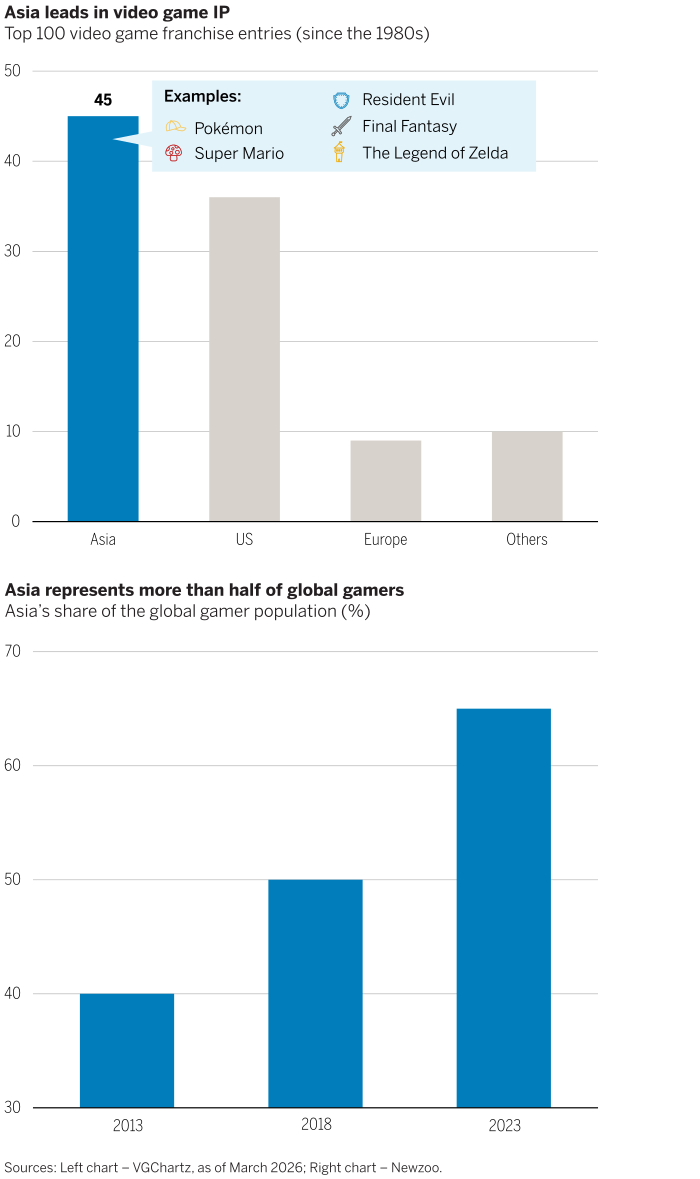
As shown in Figure 1, the region accounts for the largest share of top global gaming franchises and represents more than half of the global gamer population — creating a powerful combination of content and demand.
As the industry evolves, we see a compelling opportunity, particularly in Japan, driven by high-quality franchises, growing monetization, and improving execution. Japanese publishers have created enduring, globally recognized IP such as Pokémon, Super Mario, and Resident Evil. These are not one-off successes but multi-decade platforms monetized through new releases, cross-platform expansion, and licensing across merchandise, film, and theme parks — supporting high-margin incremental growth.
The industry is shifting from a hit-driven model to a more diversified, IP-led ecosystem. Companies are increasingly monetizing franchises beyond games — through toys, licensing, and direct-to-consumer channels — extending global reach while reducing earnings volatility and boosting the lifetime value of core IP.
A supportive backdrop is emerging, driven by a new hardware cycle (including the Switch 2) and a strengthening software pipeline. Platform improvements are also encouraging broader third-party participation. At the same time, companies are showing greater discipline around ROI, cost control, and pipeline management, supporting more consistent execution.
AI is becoming a key enabler across the gaming value chain — improving development efficiency, enhancing content creation and engagement, and enabling new monetization models. For IP owners, this reinforces the ability to scale content and grow margins.
In our view, gaming is becoming one of the most compelling opportunities in Asia technology — supported by secular adoption, expanding monetization, and the accelerating shift toward AI-enabled platforms.
The views expressed are those of the authors at the time of writing. Other teams may hold different views and make different investment decisions. The value of your investment may become worth more or less than at the time of original investment. While any third-party data used is considered reliable, its accuracy is not guaranteed. For professional, institutional or accredited investors only.
Expert

Contributors