
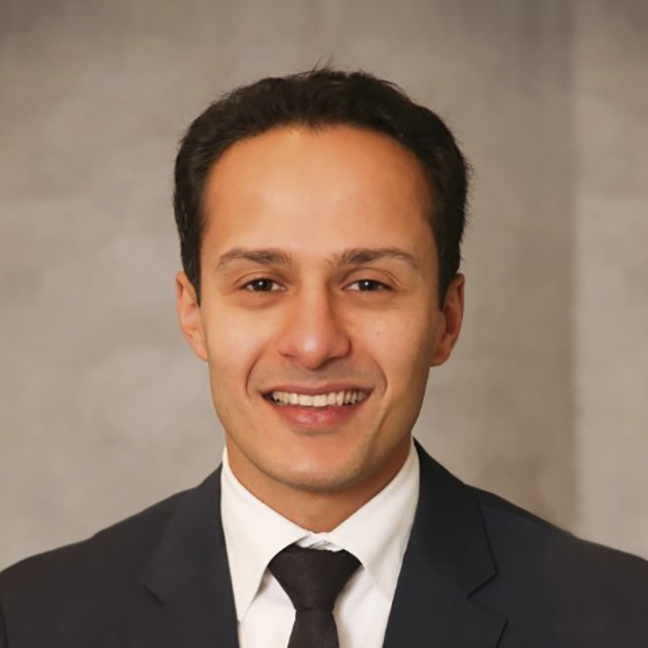
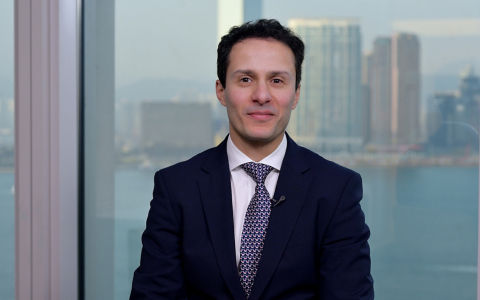

- Portfolio Manager, Hedge Fund Multi-Manager Strategies
Netherlands, Intermediary
ChangeIn this edition of “Rapid fire questions,” Ehab Hosny, portfolio manager on the hedge fund multi-manager team, provides an inside perspective at Wellington’s hedge fund platform. He discusses the firm’s competitive advantages, its approach to risk management and talent, and where he sees the most compelling opportunities in equity long/short today.
Question: What is your primary focus day-to-day?
My name is Ehab Hosny. I am a portfolio manager on the hedge fund multi-manager team, and I also lead the research and assessment process of our equity long/short teams. We allocate capital to hedge fund investment teams inside of Wellington, and we also run a hedge book over the top. In terms of day-to-day, it typically involves monitoring the existing allocations that we have, to see if they are behaving in line with our expectations, relative to what is happening in markets and relative to how these portfolios are positioned.
Question: What is Wellington’s key competitive advantage in hedge fund investing?
It is something that I sometimes refer to as scale and breadth, combined with full transparency inside of the firm. And what I mean by that is if you think about the size of Wellington—so we run over $1.3 trillion in total assets under management, and that includes over $35 billion in hedge funds —and that is with good representation across different types of strategies. And when you combine that with a completely open and transparent internal architecture, where everyone sees everyone’s positions—and so the long-only portfolio managers can see what the hedge fund portfolio managers are doing, and vice versa—that creates a very powerful investment dialogue inside of the firm. And what comes out of that is, effectively, like a live feed on buyside sentiment, all inside of the walls of Wellington. And I think it is very difficult to replicate, especially at this scale.
Question: How does Wellington go about managing hedge fund risk?
Our approach to risk is a little bit different, in the sense that we customize the risk limits for every single investment team. Because, really, the hunt for us is that we want to find the sweet spot of the philosophy and process of every single portfolio manager, and then we take care of the rest. So, for some portfolio managers, the risk limits are very tight, and for others, we give them a little bit more latitude, but within reasonable ranges—but only if it aligns with the philosophy and process of the strategy. And then we hedge any residual risks using our hedge book over the top, and we stay laser focused on maintaining drawdown diversification across all of the strategies at all times.
Question: What is Wellington’s approach to talent?
The war on talent is very real. And in order to have a successful hedge fund business, you need a very well-structured approach to talent. For Wellington, we have three different sources of talent: there is the homegrown talent. And so, these are individuals who grew up, professionally speaking, inside of the firm. They understand the ecosystem incredibly well, and they know how to extract the most value out of being inside of the firm. And then the second source is external. And so, we hire externally when we are trying to find either a new way of doing things, or a new perspective, or a new skill set that helps fill a gap in what we have inside of the firm. And lastly is our hedge fund incubation program. So, about ten years ago, the firm created a seeding program where we create a safe environment for portfolio managers to fine-tune and perfect their strategy before we entrust them with client capital. And we have used this for talent development purposes, and we have also used it with more seasoned portfolio managers who may have a new idea, but we want to see more of a proof of concept first.
Question: Where do you see the most exciting opportunities across Wellington’s Equity Long/Short platform?
For the team that I am on, where we allocate capital to different investment teams, we try to limit the extent to which we take strong investment views from a top-down perspective. We are certainly very focused on the risk picture from a top-down perspective, but we found that when you try to do that from the investment side, it can sometimes lead you to leave money on the table.
So, if you think about financials or Europe more broadly, these are areas that have attracted a lot of interest, I'd say, more recently, but were probably left for dead for many years before that. For us, they have actually been profit centers for a very long time. And so, we care a lot more about what the dynamics of the opportunity set are, and how the portfolio managers' skill sets are relevant to extracting value from them. Finding ways to diversify the alpha patterns that we have in the portfolio. And so, some areas where we have either added recently or are about to are Asia ex-Japan, parts of the health care market globally, US consumer and industrials. So, a lot going on, and a lot for us to be excited about.
The views expressed are those of the speaker at the time of filming. Other teams may hold different views and make different investment decisions. The value of your investment may become worth more or less than at the time of original investment. While any third-party data used is considered reliable, its accuracy is not guaranteed. For professional, institutional, or accredited investors only.