





- Investment Strategist
FEATURED EQUITY FUNDS
FEATURED FIXED INCOME FUNDS
Asset classes

Asset classes
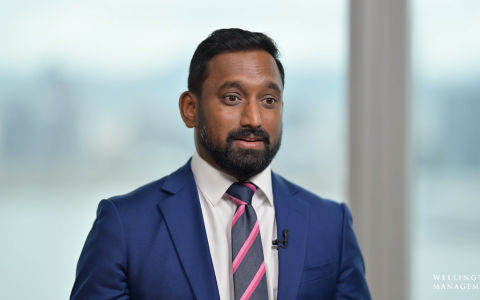
Investment Strategist Jeremy Butterworth discusses why credit markets have remained resilient despite shifting rate expectations, where dispersion is creating opportunities for active investors, and why Asia continues to offer a compelling credit opportunity set.
Q: What has surprised you most about fixed income markets in 2026?
When I think about fixed income markets this year, and I look at the course of the year, where we started and where we've ended up – it’s actually been quite different. We’ve experienced greater volatility and expectations for inflation and economic growth. This has meant policy expectations have shifted multiple times throughout the year.
Just think about the amount of rate cuts that we had priced in at the start of the year versus where we are today. We’re at a point where there’s a greater possibility of modest tightening before year end. And if I look at rate markets, we've experienced a bear steepening in the yield curve. So longer dated yields have risen faster than the front end of the curve. And that's translated into higher real yields and higher term premia.
What's interesting is if you contrast that with what we're seeing in credit markets. Credit markets have been pretty well behaved. We’ve only had very short bouts of volatility. And the spread widening we've seen, I would suggest, has been driven more by issuance rather than a deterioration in economic fundamentals.
Q: Credit spreads remain relatively tight. How should investors position portfolios in this environment?
We would agree. If you look broadly across spreads and index valuations, they are trading towards the tighter side. What's less appreciated, and the nuance with index valuations, is that they're not telling the full story. When you look beneath the surface, we're seeing significant dispersion across sectors, industries and issuers.
Just look at high yield as an example, and the performance we've seen year to date. There’s been wide dispersion between the underlying industries. Take energy and pharmaceuticals, which have done extremely well this year. And then compare that to, say, paper and packaging, which have been under more meaningful pressure. And so in this environment, bottom-up research and issuer selection are becoming increasingly important and a key area to add value to portfolios.
In addition, when I think about constructing a portfolio, having that flexibility to be able to capitalize on opportunity and having dry powder are going to become increasingly important in adding value for clients and investment experience.
Q: Where are you seeing some of the more compelling credit opportunities today, including in Asia?
There's a wide range of opportunities if I look across credit subsectors globally. One area that is particularly interesting is in our own backyard, and that's Asia. If I think about Asia today, corporate fundamentals across the region remain relatively healthy. In addition, you have this very positive supply and demand dynamic, which is creating strong technicals that continue to underpin the market.
What really stands out to me is the breadth of the opportunity. We’re finding opportunities not only in investment grade markets. We’re finding them in higher yield. And we're also finding them in sovereign markets, in hard currency. Increasingly, local rates and currency markets are becoming interesting. That range really matters because it gives you dimensionality to your returns and multiple levers to pull, rather than relying on any single part of the market to perform well.
Q: Beyond the opportunities we've discussed, what are some of the developments or key risks you are watching most closely right now?
There are three key developments we’re watching in markets right now. Firstly, the direction of inflation and policy expectations. They remain incredibly important to watch. We believe the Fed is going to be heavily data-dependent. And we should really be conscious of its resolve to bring inflation back to target.
In addition, you really want to be conscious of the Treasury's reaction function alongside that. Number two, we're looking at geopolitics and trade-related developments because they have the capacity to continue to create volatility. And then the third development, which I think is the most interesting, is the growing development in how companies are funding themselves as they continue to invest in their AI capex goals.
What we’ve witnessed this year is this growth in technological debt issuance surrounding the build-out of AI. And it’s definitely impacting issuance, but it’s also impacting spreads. And this is something we’re monitoring closely. If you look at this year, we’ve had hundreds of billions of dollars of funding and that funding base continues to broaden. If I think about the new deals that are coming to market, they’re coming in all shapes and sizes and a variety of structures and issuer types.
Because of that, each of these deals requires specialist expertise to evaluate the merits, potential risk and compensation of each deal. With that, we think this is a growing opportunity for active investors in credit markets. But it is an area where you do need specialist expertise and a focus on fundamentals, valuation and risk compensation.

The views expressed are those of the speaker at the time of filming. Other teams may hold different views and make different investment decisions. The value of your investment may become worth more or less than at the time of original investment. While any third-party data used is considered reliable, its accuracy is not guaranteed.
DISCLOSURE
This material and its contents may not be reproduced or distributed, in whole or in part, without the express written consent of Wellington Management. This document is intended for information purposes only. It is not an offer or a solicitation by anyone, to subscribe for shares in Wellington Management Funds (Luxembourg) III SICAV (the Fund). Nothing in this document should be interpreted as advice, nor is it a recommendation to buy or sell shares. Investment in the Fund may not be suitable for all investors. Any views expressed are those of the author at the time of writing and are subject to change without notice. Investors should carefully read the Key Facts Statement (KFS), Prospectus, and Hong Kong Covering Document for the Fund and the sub-fund(s) for details, including risk factors, before making an investment decision. Other relevant documents are the annual report (and semi-annual report).
© 2026 Morningstar, Inc. All Rights Reserved. The information contained herein: (1) is proprietary to Morningstar; (2) may not be copied or distributed; and (3) is not warranted to be accurate, complete or timely. Neither Morningstar nor its content providers are responsible for any damages or losses arising from any use of this information. The Overall Morningstar Rating for a fund is derived from a weighted average of the three, five, and ten year (if applicable) ratings, based on risk-adjusted return. Past performance is no guarantee of future results.
Issued by Wellington Management Hong Kong Limited. Investment involves risk. Past performance is not indicative of future performance. This document has not been reviewed by the Securities and Futures Commission of Hong Kong.