FEATURED EQUITY FUNDS
FEATURED FIXED INCOME FUNDS

Asset classes

Asset classes
AI is no longer just an equity story. Increasingly, it is also a defining force in the high-yield bond market. What began as a technology-driven narrative is evolving into a broad-based capital cycle, with meaningful implications for bond issuance, sector dynamics, and credit risk.
For me, the key takeaway is clear: AI is not a single theme within high yield, it is a structural shift that is reshaping the opportunity set, driving dispersion, and underscoring the importance of active management and flexibility.
At the heart of the AI story is an extraordinary surge in capital expenditure. Building the infrastructure required to support AI, like data centers to power generation, requires trillions of dollars in investment globally over an extended period. To finance this growth, issuers are increasingly turning to credit markets, including high yield.
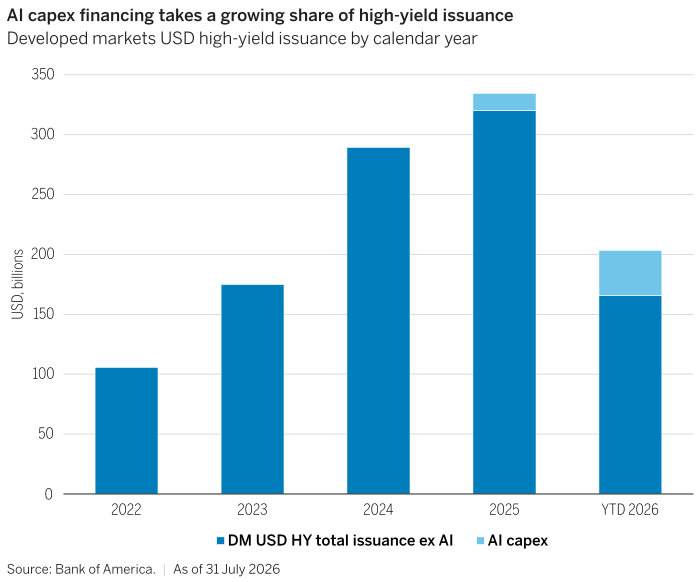
The impact is already visible. High-yield issuance tied to AI infrastructure is accelerating sharply, equating to roughly 20% of total high-yield issuance year to date compared to 5% in 2025 (Figure 1).
Figure 1
Emergence of a new, investable subsector
AI is creating a new subsector within high yield, focused on data centers and digital infrastructure. A diverse range of issuers is now tapping high-yield markets to finance expansion. These new issuers are often supported by long-term contracts with hyperscalers, but their financing structures can be complex, incorporating elements of structured credit, securitization, and project finance.1
For investors, this creates exposure to both:
While the market primarily focuses on investment-grade-rated technology companies given the scale of “Mag 7” issuance, the opportunity set within high yield relates to the broader AI ecosystem, including:
A growing divide between winners and losers
As the AI theme matures, a clear credit divide is emerging. On one side are companies benefiting from the build-out, notably those tied to infrastructure, energy, and enabling technologies. On the other side, we see companies facing disruption, particularly in software, IT services, media, and insurance brokers.
Lessons from past capital cycles
Previous large capex cycles, for example in the telecom sector in the 1990s and the energy sector in the mid-2010s, were characterized by overinvestment, increasing leverage ratios, and higher defaults. The AI build-out shows early signs of similar dynamics. The scale of investment is enormous but the ultimate level of demand, pricing power, and returns remain uncertain. Not all issuers will generate sustainable cash flows, and not all valuations will prove justified, implying significant dispersion ahead.
At a high level, I expect continued volatility among issuers facing potential AI-driven disintermediation risk. While it remains too early to determine the ultimate extent of AI’s disruptive impact, I believe the resulting uncertainty will create attractive investment opportunities.
From a positioning perspective, I think investors need to question long-held assumptions about how assets are likely to behave throughout the cycle, with issuer dispersion likely to increase further as markets seek to assess a wide range of potential scenarios.
Given the above, I believe flexible, total-return-oriented strategies that emphasize fundamental credit selection are best positioned to capitalize on opportunities and generate alpha.
1 Project finance is a form of financing used to fund large, long-lived infrastructure and industrial projects, where lenders are repaid primarily from the project's future cash flows rather than the balance sheet of the sponsor.
The views expressed are those of the author at the time of writing. Other teams may hold different views and make different investment decisions. The value of your investment may become worth more or less than at the time of original investment. While any third-party data used is considered reliable, its accuracy is not guaranteed. For professional, institutional or accredited investors only.
DISCLOSURE
This material and its contents may not be reproduced or distributed, in whole or in part, without the express written consent of Wellington Management. This document is intended for information purposes only. It is not an offer or a solicitation by anyone, to subscribe for shares in Wellington Management Funds (Luxembourg) III SICAV (the Fund). Nothing in this document should be interpreted as advice, nor is it a recommendation to buy or sell shares. Investment in the Fund may not be suitable for all investors. Any views expressed are those of the author at the time of writing and are subject to change without notice. Investors should carefully read the Key Facts Statement (KFS), Prospectus, and Hong Kong Covering Document for the Fund and the sub-fund(s) for details, including risk factors, before making an investment decision. Other relevant documents are the annual report (and semi-annual report).
© 2026 Morningstar, Inc. All Rights Reserved. The information contained herein: (1) is proprietary to Morningstar; (2) may not be copied or distributed; and (3) is not warranted to be accurate, complete or timely. Neither Morningstar nor its content providers are responsible for any damages or losses arising from any use of this information. The Overall Morningstar Rating for a fund is derived from a weighted average of the three, five, and ten year (if applicable) ratings, based on risk-adjusted return. Past performance is no guarantee of future results.
Issued by Wellington Management Hong Kong Limited. Investment involves risk. Past performance is not indicative of future performance. This document has not been reviewed by the Securities and Futures Commission of Hong Kong.