AI: The surprise may be that investors are underestimating what’s going right
The prevailing narrative may not tell the full story, so what signals should investors be following? My recent discussions with our Technology Team have yielded several worth considering:
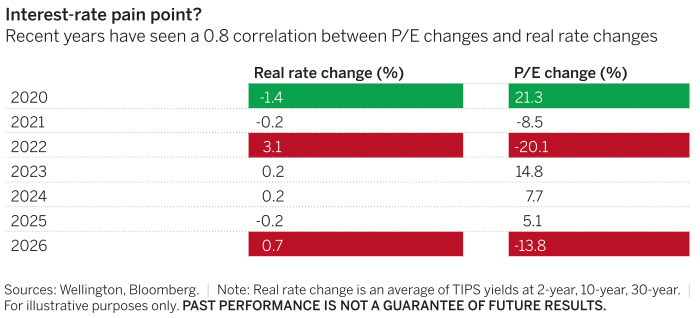
1. AI fundamentals may be stronger than investor sentiment suggests. Many investors worry that AI-related equities are approaching bubble territory (63% of asset owners we polled in September said the market was either approaching or already in a bubble1), but the underlying fundamentals tell a different story. Technology companies continue to generate strong earnings growth, AI adoption is accelerating, and many technology stocks trade at valuations that appear attractive relative to their growth prospects (and P/E multiples have actually been contracting despite the earnings growth). In the team’s conversations with asset owners, the discussion is overwhelmingly centered on what could go wrong, even as the evidence supporting the investment case continues to improve. So, in that sense, there may even be a contrarian opportunity in taking a more constructive view of AI.
2. This cycle is being driven by real demand, not just expectations. Unlike past technology booms that relied heavily on future promises — such as the early days of the internet — today's AI cycle is supported by observable demand and measurable returns. Enterprises are reporting productivity gains and cost savings; spending tends to increase after initial adoption rather than decline; and demand for AI infrastructure continues to exceed supply.
One of the clearest signs of this demand can be seen in the compute market itself. Even older-generation GPUs continue to command meaningful rental rates and, in some cases, rising prices. If compute supply were abundant, prices of legacy hardware would likely fall sharply as newer generations came online. Instead, sustained demand for both new- and older-generation capacity suggests that the appetite for AI compute continues to outpace available supply. In some areas, the constraint is no longer identifying use cases for the technology but securing enough compute capacity to meet demand. The result is a cycle increasingly supported by real economic activity rather than by investor expectations alone.
3. Growth in the number of tasks, roles, and products being shaped by AI is accelerating. From that perspective, this cycle is similar to prior technology disruption cycles. What's different is the pace. Advances in model capabilities are unlocking new applications across science, physics, and other forms of knowledge work, while beginning to move into the physical world as well.
As more applications are unlocked, the opportunity set continues to broaden. The enabling technologies remain critical, from the companies bringing power to data centers and supplying the chips that fill them to the businesses building the services that sit on top of that infrastructure. In addition, businesses that use AI to solve problems cheaper, faster, or better may gain a meaningful advantage, while those that are slower to adapt risk falling behind.
4. Watch demand signals, not sentiment. Investors concerned that the market might be overextended should monitor whether enterprises continue expanding AI spending, whether next-generation models continue to deliver meaningful gains in efficacy, and whether supply begins to come more in line with demand. Those may be the developments most likely to indicate that AI adoption or infrastructure demand is beginning to moderate.
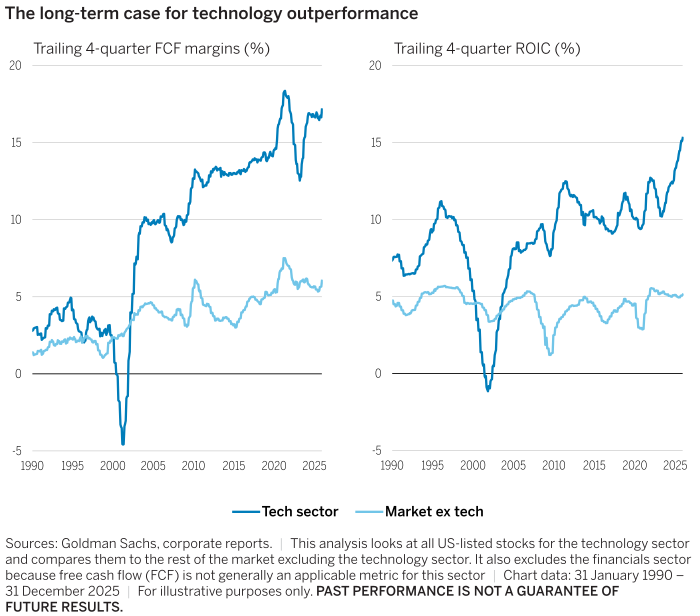
Until then, demand remains robust, adoption continues to broaden, and the long-term trend of tech companies delivering stronger free-cash-flow margins and ROIC is difficult to ignore (Figure 1). Technology adoption has experienced periods of acceleration and deceleration, but at every point in history the forward curve on technology adoption has ultimately pointed higher.