
Explore our insights
Asset class
Formats
2026 Midyear Investment Outlook

2026 Midyear Investment Outlook
In 2025, life insurers saw substantial increases in net income and solid premium growth.1 In the property & casualty (P&C) sector, combined ratios remained below 100%, catastrophe losses were contained, and returns on capital were robust. In short, the industry delivered one of its best underwriting years in recent memory2 and, after the inflation shock of 2022, enters the new year on firmer footing.
That said, the strength of 2025 also argues for some caution in the year ahead. We expect premium growth to moderate and new capital to flow into the market, pressuring profitability. Macro conditions remain broadly supportive of risk assets, yet valuations are stretched and risk premium buffers are thin. Against that backdrop, this year’s Outlook offers our view on what’s next for the economy and then delves into three topics we think should be top of mind for insurers in the coming year:
The global economy, and the US economy in particular, remains in strong shape. While we don’t expect a repeat of 2025 in terms of GDP and capital markets gains, we expect healthy but gradually slowing growth in 2026. Tailwinds include fiscal stimulus, a deleveraged private sector, and relatively clean balance sheets for US banks, households, state and local governments, and corporations. Moreover, the majority of the spending cuts in the One Big Beautiful Bill Act will not crystallize until late 2026. In the meantime, we expect the accelerated capex deprecation to stabilize the manufacturing sector, which was buffeted by the policy uncertainty of 2025.
While one can debate what the neutral rate is for US monetary policy, our view is that policy is not that restrictive in the current environment. Globally, however, policy rates outside of the US and the UK have likely troughed and additional help from monetary policy will only arrive if we see substantially weaker data.
Not everything is rosy of course. The US faces meaningful imbalances and headwinds: The subprime US consumer segment is challenged and much of the current consumer spending can be linked to the substantial increase in the liquid net worth of higher-income consumers. Labor markets are tepid and likely weakening. And while interest rates have come down, inflation remains pernicious (though one can argue that the biggest contributor, shelter costs, remain sticky due to a data lag).
Geopolitical risk continues to grow, as we see the rapid unraveling of the 1990s Washington consensus. As we draft this Outlook, the US has sanctioned Thierry Breton, a former EU commissioner, for his role in drafting the Digital Services Act, which the Trump administration described as digital censorship. The White House has also appointed Jeff Landry, former governor of Louisiana, to the role of Special Envoy to Greenland, adding pressure on Denmark, a traditional US ally. In the meantime, war continues unabated in a several-hour flight from London and the current peace discussions do not seem aligned with an outcome acceptable to all parties. Finally, it goes without saying that the recent incursion into Venezuela, which remains open-ended thus far, adds to tensions in the Western Hemisphere.
In rates, a second bite at the apple
We think the total return potential for government bonds remains very attractive despite the risks to the upside for yields noted above. Insurers should consider locking in yields with forward dollar rates at high levels and term premia at multiyear highs. From a tactical standpoint, we have a modest overweight view on duration given the absolute level of interest rates and tight credit valuations, but from a strategic asset allocation perspective, we believe we have seen the highwater mark for rates, though we do not expect them to decline dramatically during 2026. Moreover, while the Liberation Day aftershocks were substantial in 2025, the economic policy surprise index has declined… or it is possible that the market is becoming more inured to policy statements from the US administration as they are subject to change. Given the still dovish bias of the Fed and the expected shifts in FOMC membership in 2026, we view the directionality of policy rates as downward despite the lack of consensus on the committee.
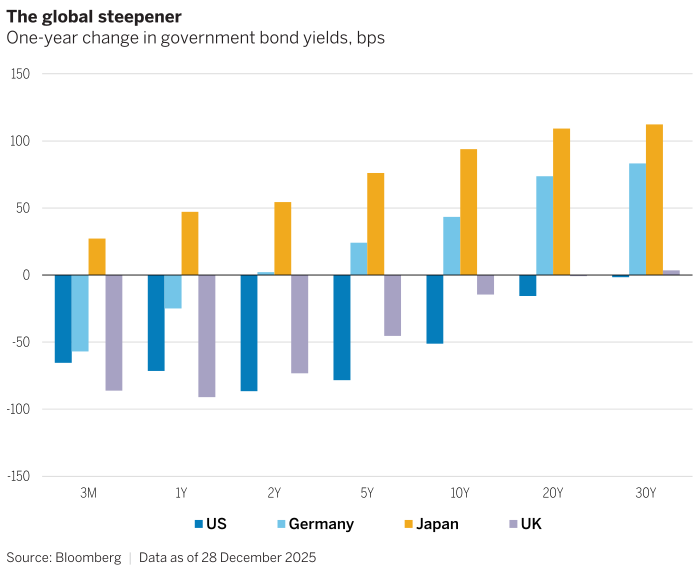
As noted earlier, a steeper yield curve should also allow for compelling carry and rolldown dynamics (Figure 1). Increased volatility and divergence are likely though, as markets increasingly price in local growth and inflation dynamics.
Figure 1
A gradual pivot in credit
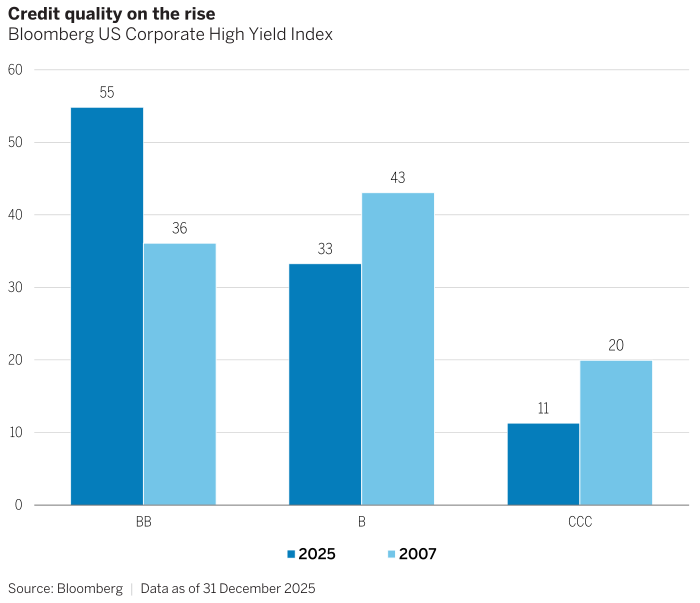
Because spreads in many segments of the credit market are exceptionally tight, we think investing in it requires a thoughtful, active approach with a discerning eye for sector and security selection, as well as credit quality and seniority. While credit performed well in 2025, market returns were primarily driven by a duration effect, along with modest spread tightening. “Drawing blood from a stone” might be an apt phrase to describe those seeking substantially more spread tightening from here, and we believe the carry trade will likely dominate. While spreads remain tight in public credit, in many cases they reflect the overall improved quality of the indices (with more problematic credits moving into the private credit markets). For example, Figure 2 shows the improvement in the US high-yield index over time.
Figure 2
With all of this in mind, we think insurers should consider evolving their credit allocations over time: utilizing securitized credit, while moving up gradually in the credit quality spectrum for other allocations (depending on starting points), and all the while diversifying exposure. Here, we would offer four specific points:
1. We remain bullish on the potential for securitized credit to serve as a core element of an insurance portfolio. The securitized market continues to evolve with the addition and development of the asset-backed finance (ABF)/private securitized market. We think a balanced approach to securitized is critical. Some private deals may come at levels that do not appear to compensate the buyer for illiquidity risk, and pricing is driven by a mismatch between the supply of new deals and the rapid growth of demand from private allocations.
Implementation matters at this stage in the ABF market, and we think it likely makes sense to have blended public/private allocations so that genuine relative-value-driven deployment of capital takes place.
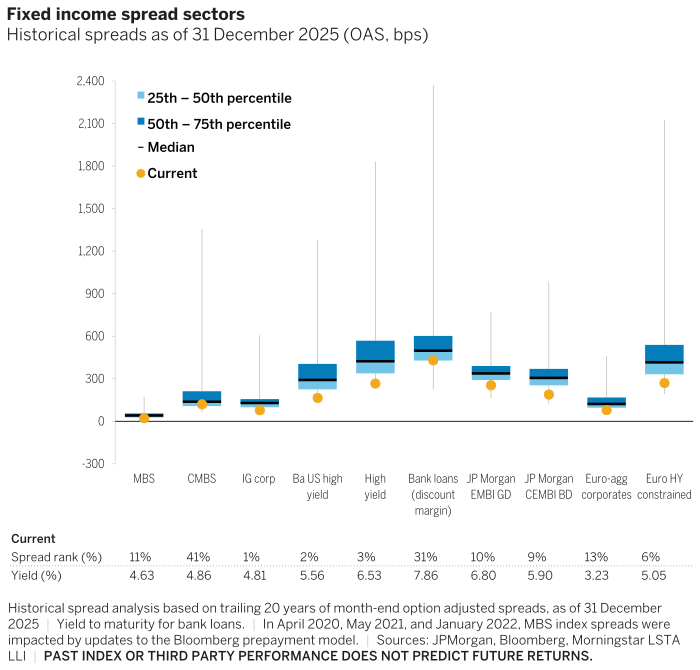
2. We see a case for shifting equity exposure to both high-yield and emerging market debt (EMD). Our strategic asset allocation analysis is shying away from most developed market public equity allocations. We think insurers should consider deploying the marginal dollar to lower-volatility and lower risk-based-capital asset classes with high yields, such as sub-investment-grade credit and emerging market sovereign debt. We expect both to deliver a yield to worst (YTW) comparable to what was once the traditional equity risk premia. While spreads are tight in all areas (Figure 3), the YTWs are priced to deliver potentially robust total returns in coming years.
Figure 3
3. We think investment-grade private credit is more attractive than direct lending. Over the last several years, we’ve noted our concern about the rapid growth of the direct lending industry. It’s important to note this is not an “anti-private credit” view. The growth of the industry has revolutionized the credit channel in the US. Historically, a bank collapse like we saw with SVB in 2023 would have immediately led to a restrictive credit environment. But direct lenders kept fundraising and deploying capital, effectively cushioning the impact and diversifying the credit impulse in the US. However, underneath the surface, we’ve noted several issues that are often harbingers of poor credit performance, including a flood of capital into the space, with sharp competition between nonbank lenders for individual deals, and opacity in total market data and performance relative to public peers. We’ve also seen some indications that a lack of pricing transparency could be an issue. For example, Jay Clayton, the current US Attorney for the Southern District in New York, noted pricing differentials for the same credits between different holders of the same risk.3
Given the challenges that are likely going to work their way through the system, we believe the best marginal deployment of capital into illiquids is into investment-grade private placements. The IG private placement space may offer an illiquidity premium to its public counterpart, and we think it has the potential to offer attractive yields with enhanced diversification and credit protection. This is one of our top fixed income ideas for 2026 and we believe it is absolutely applicable to the insurance space.
4. We think CLO equity can serve as a proxy/replacement for traditional private equity. While there are various private equity approaches that we still think are worth considering, we believe CLO equity has the potential to provide robust returns and almost immediate cash flows — all at a similar risk-based-capital charge to private equity, particularly for P&C and health insurers. Moreover, capital is locked up for a shorter period and there can be more dynamic management as an active manager rotates through collateral that offers strong relative value. In addition, the quarterly distributions of CLO equity are less sensitive to fluctuations in short-term interest rates than some other asset classes, as discussed in this paper.
A focus on where the regulatory ball is rolling
Regulators are busy and there will likely be real implications for insurance investment strategy. In the US, the use of covariance between equities, spreads, and interest rates is underway. In Europe, portions of the securitized credit markets may no longer be anathema to regulators. Following are some of the proposals and changes we think will be most immediately impactful:
1National Association of Insurance Commissioners, US Life and A&H Insurance Industry Analysis Report, 2025 Mid-Year Results | 2National Association of Insurance Commissioners, US Property & Casualty Insurance Industry Report, 2025 First-Half Results | 3Debevoise & Plimpton, Debevoise in Depth, 2 December 2025
The views expressed are those of the authors at the time of writing. Other teams may hold different views and make different investment decisions. The value of your investment may become worth more or less than at the time of original investment. While any third-party data used is considered reliable, its accuracy is not guaranteed. For professional, institutional or accredited investors only.