
Explore our insights
Asset class
Formats
2026 Midyear Investment Outlook

2026 Midyear Investment Outlook
While geopolitical considerations are front of mind for market participants in 2026, another trend we are watching closely is the growing capital intensity of the US corporate bond market. Corporate issuers have raised aggregate capex by an astonishing 70% over the past three years, following a 10-year stretch in which we saw zero growth.1 As discussed in this article, this surge in capital intensity has been driven primarily by AI-related investments and it’s yielding a range of creative new deal structures. Among the investment implications we see:
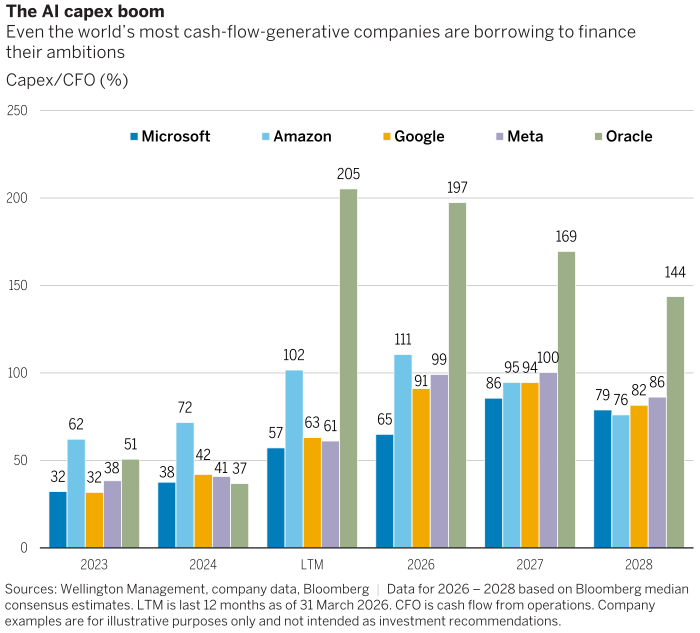
The scale of the increase is so large that we expect many of the leading technology companies to outspend their cash flows by 2027. Even AAA-rated Microsoft could spend 86% of its operating cash flow on capex by 2027 — more than double the rate in 2023 (Figure 1).2
Figure 1
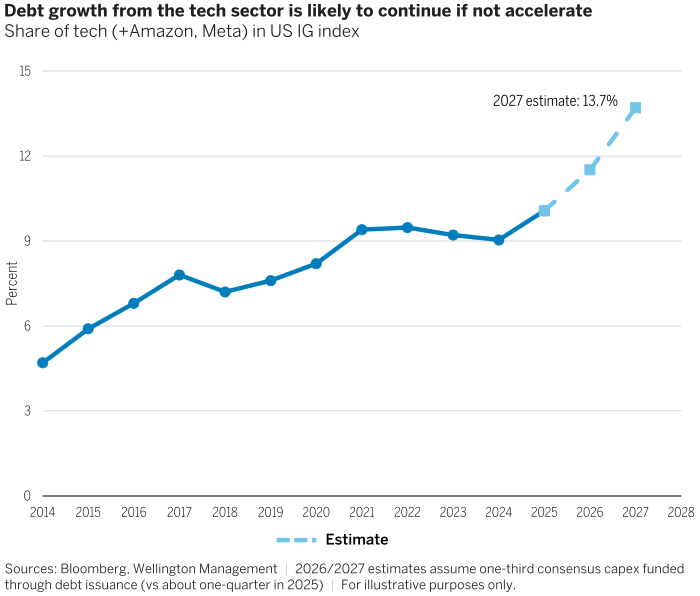
As technology companies look to fund their growing investments, they have diversified their funding sources. With capex approaching the level of organic cash flow for many, issuers have increasingly turned to the credit and asset-backed debt markets to fund incremental investment. Rising capital needs have led to a surge in supply in both the public and private markets. In fact, new issuance in public investment-grade (IG) fixed income in the first quarter of 2026 was the second largest quarterly total on record ($636 billion), trailing only the second quarter of 2020. The big four “hyperscalers” (Amazon, Microsoft, Alphabet, and Meta) accounted for around 20% of this new gross issuance on a duration-adjusted basis and close to 50% on a net duration basis.2 Morgan Stanley estimates that tech issuance, along with M&A financing, could propel gross and net IG issuance to record levels in 2026. By our estimates, the technology sector could represent close to 14% of the IG index by the end of 2027 — almost a 3x increase from 2014 levels (Figure 2).
Figure 2
In addition to the quantum of supply, issuers are becoming increasingly creative with the security types. This includes traditional corporate debt that rolls up to the ultimate parent, as well as data center or chip-related deals with structures that are more akin to project finance and/or asset-backed finance (ABF). We have seen bonds secured by future lease payments, guarantees on the residual value of assets, and real estate. Each deal is unique, with a wide array of potential risks and return profiles. Potential risks can include construction execution, electricity procurement, regulatory challenges, and refinancing needs. For issuers, this approach can lower funding costs relative to bank-led project finance or private structured financing, while still providing fixed income investors with additional structural protections during the construction and ramp up phase.
For example, we saw a new bond deal in late April, referred to as Project Mitten, to help fund a one-gigawatt data center in Saline Township, Michigan. The data center is fully contracted to Oracle America Cloud Services, which is fully guaranteed by Oracle Corporation.2 Another example is an investment-grade bond sale by QTS tied to a multi-tenant data center in Georgia. While the associated hyperscaler, Microsoft, was of the highest quality, the structure of the security created significant refinancing risk in the medium term.
With Project Mitten, investors underwrote a strategic, fully contracted asset with long dated cash flows. While this profile might be more commonly found in the ABF markets, the issuer opted for a bond format given the greater depth and liquidity of the public IG corporate market. Still, the security shares characteristics of the ABF and project finance markets, including an interest-only feature for six years, full amortization, and security of the data center itself. For this transaction, investors trade single-asset and company risk for clarity and predictability of cash flows.
From a technical perspective, index providers have evaluated the structure of each new deal, including how it is marketed to investors, when thinking about index inclusion. Some new deals have been included in IG and high-yield indices while others have not. We expect to see ongoing AI-related issuance in many different formats as the capex boom continues and markets evolve and deepen.
For investors, we believe this issuance can represent an attractive opportunity to add to the highest-quality, most profitable companies in the market at attractive valuations. Given the large size of many of the recent hyperscaler deals, we have seen underperformance in their bonds leading up to the new issuance as the market anticipates these large deals. Combined with the additional new issue discount, we think this makes the opportunity even more attractive.
Further, after a dearth of supply at the long end of the IG market since 2022, we are seeing this new tech issuance bring long-end corporate supply back toward long-term historical levels. We believe this has the potential to loosen up credit spreads at the long end as investors sell other holdings to buy this cheaper technology new issuance. We would caution investors against painting all technology issuance with a broad brush as the opportunity set has become increasingly diverse. We are excited by the nuances that each deal brings, as they allow us to leverage what we believe is our core edge as investors — bottom-up fundamental research.
As we evaluate the IG opportunity set, we believe that navigating the growing technology sector will be one of the biggest opportunities and risks over the next few years. Understanding the risks and merits of each individual deal will be of critical importance, highlighting the opportunity for active managers to take advantage of inefficiencies in the pricing of credit risk.
1Source: S&P Capital IQ | 2Company examples are for illustrative purposes only and are not intended as investment recommendations.
The views expressed are those of the authors at the time of writing. Other teams may hold different views and make different investment decisions. The value of your investment may become worth more or less than at the time of original investment. While any third-party data used is considered reliable, its accuracy is not guaranteed. For professional, institutional or accredited investors only.
Experts