
Explore our insights
Asset class
Formats
2026 Midyear Investment Outlook

2026 Midyear Investment Outlook
Cash-balance liabilities have been growing as a percentage of defined benefit plan liabilities. Many plans started out using a traditional benefit formula (e.g., final average pay or dollar times service) and later converted to a cash-balance design, leaving them with both traditional and cash-balance liabilities. In this article, we consider how best to integrate these very different liabilities in a plan’s investment strategy.
Among our conclusions:
To begin, let’s consider two potential approaches to hedging traditional and cash-balance liabilities within a single plan.
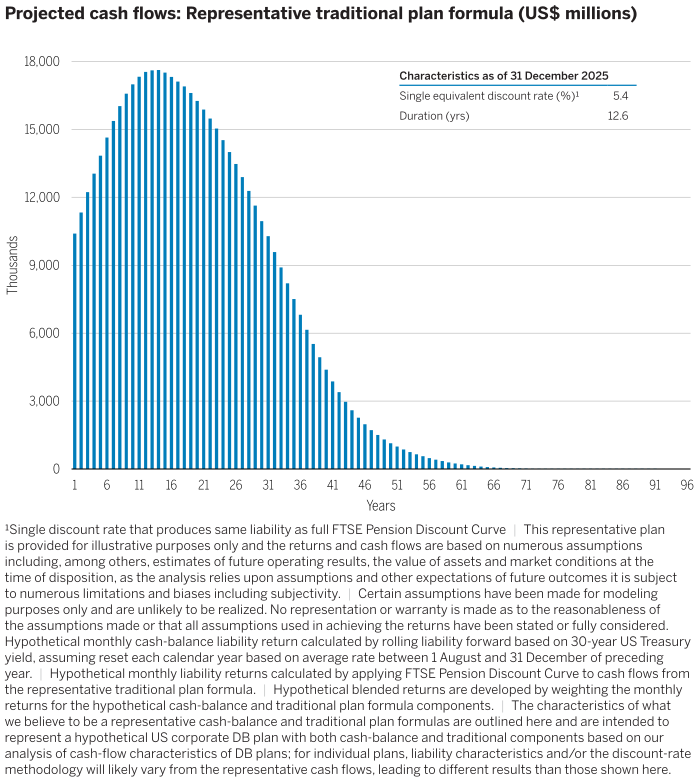
1.Simple duration blend — This is a fairly common approach, which requires calculating a blended interest-rate duration across the two liability components and using it as the duration target for the liability-hedging portfolio. For example, a plan would calculate the duration of the projected cash flows for its traditional liabilities and blend that result on a liability-weighted basis with a zero-year duration for the cash-balance liabilities.
There are many ways a portfolio could be constructed to achieve this duration target, all of which are generally equivalent to using cash to hedge the cash-balance liabilities and a duration-matched approach to hedge the traditional liability. To offer an example, the left-hand chart in Figure 1 assumes a hypothetical plan with a split of 60% cash-balance liabilities and 40% traditional liabilities. The plan’s liability-hedging portfolio is allocated accordingly, with 60% in cash and the remaining 40% invested in a duration-matched blend of corporate and government bonds.
Figure 1
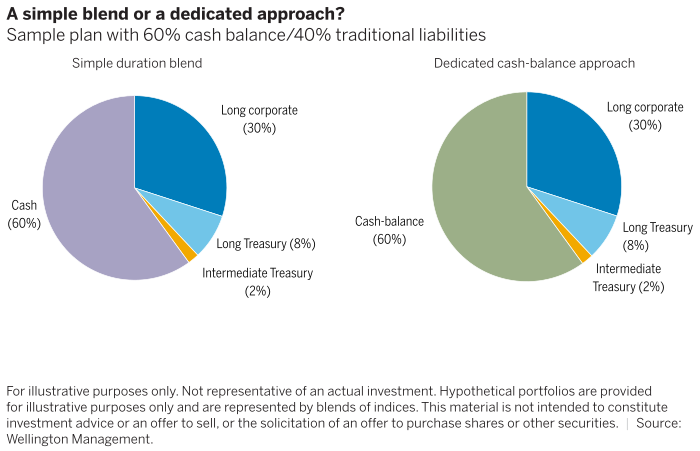
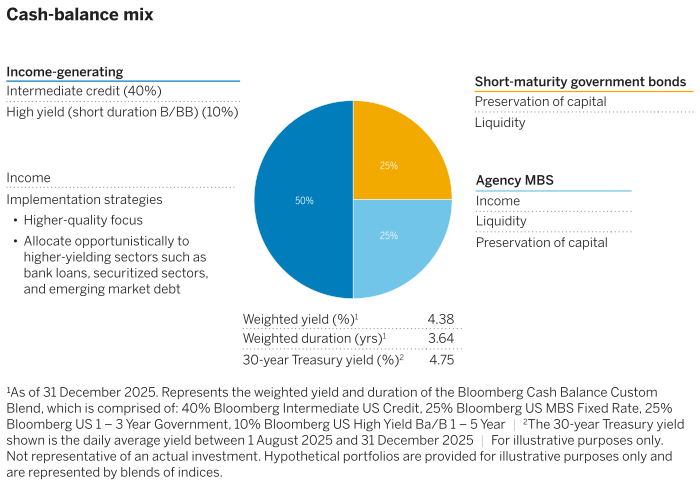
2. Dedicated cash-balance approach — We think plans should consider an alternative approach in which a dedicated investment strategy is used to track the cash-balance liability. To illustrate the idea, the right-hand chart in Figure 1 replaces the 60% cash allocation with a 60% allocation to a “cash-balance mix” of income-generating assets (50%), short-maturity government bonds (25%), and agency MBS (25%), as shown in Figure 2, while using the same duration-matched blend of corporate and government bonds as in the simple duration blend to hedge the traditional liability. The cash-balance mix was designed to target what we think are the three key attributes of a cash-balance investment strategy: capital preservation, consistent income, and liquidity.
Figure 2
Next, we ran historical simulations to compare the two investment approaches shown in Figure 1. We assumed a model liability with a cash-balance component (using an interest-crediting rate based on the 30-year Treasury yield) and a traditional liability component (with a duration of about 12 to 13 years). Figure 3 shows the results of the simulation. The leftmost column is a 100% cash-balance liability and the rightmost column is a 100% traditional liability, and in between there are different weightings of the two.
Starting with the funded-ratio volatility chart on top, we see that for the simple duration blend (dark blue bars), the more the plan was weighted toward the cash-balance liabilities, the lower the funded-ratio volatility. That relationship makes sense, because a cash-balance liability has zero interest-rate duration and therefore contributes very little to funded-ratio volatility (this, after all, is why so many plans have adopted cash-balance plans). In addition, we matched the cash-balance liability duration in our example with cash, which also has very little volatility.
Turning to the dedicated cash-balance approach (light blue bars), we see that when cash-balance liabilities made up the majority of the overall liability, funded-ratio volatility was higher than with the simple duration blend — although the absolute level of funded-ratio volatility was still low at under 3%. Why is funded-ratio volatility somewhat higher? The cash-balance mix (Figure 2) entails moderate levels of spread and duration risk in order to keep pace with the interest-crediting rate.
Figure 3
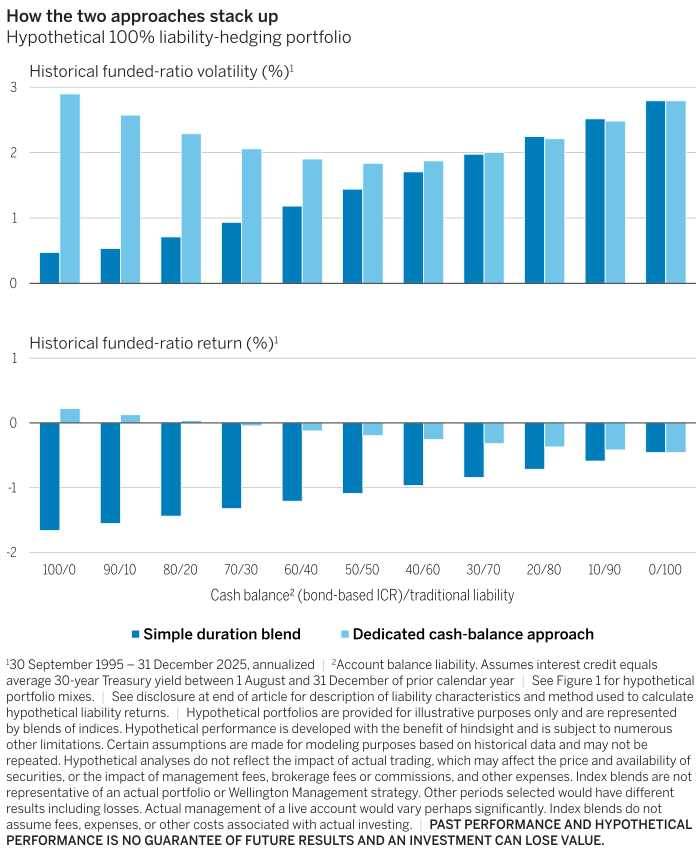
If we based the investment decision solely on these funded-ratio volatility results, the simple duration blend might be the clear choice. But we also need to consider funded-ratio return. As shown in the bottom chart in Figure 3, the simple duration blend (dark blue bars) lagged the liability (i.e., generated a negative funded-ratio return) and the more the liability was weighted toward cash-balance liabilities, the more negative the return. With the dedicated cash-balance approach, on the other hand, the funded-ratio return was close to neutral across the different liability mixes, meaning that it kept the funded ratio fairly stable.
What explains the difference in returns between the two approaches? Remember that the simple duration blend is equivalent to using cash for the cash-balance portion of the liabilities, and despite the occasional inversion of the yield curve as in 2023 – 2024, cash hasn't historically provided enough yield to keep pace with the 30-year interest-crediting rate — nor would most investors expect it to do so going forward over the long term. In contrast, the dedicated cash-balance approach seeks to keep pace with the interest-crediting rate, relying again on the three attributes of capital preservation, consistent income, and liquidity.
Based on this example, we believe there is a compelling case for considering a dedicated cash-balance approach, which may be better equipped to maintain the funded ratio while keeping funded-ratio volatility low and manageable.
The example above assumes 100% of assets are in the liability-hedging allocation. But we think a dedicated cash-balance strategy can potentially play a helpful role alongside return-seeking assets, as well.
To illustrate, we paired a 50% return-seeking allocation with a 50% allocation to the two liability-hedging approaches we discussed above. For simplicity, the return-seeking allocation is based on global equities (MSCI ACWI). As shown in the top chart in Figure 4, there is at most a modest difference in the funded-ratio volatility between these two mixes — a result of the equity volatility from the return-seeking allocation, which dominates the risk profile. But when we look at funded-ratio return (bottom chart in Figure 4), we see that the dedicated cash-balance approach again had the advantage — largely as a result of the higher income generated by that approach. Importantly, that income generation potential can help the liability-hedging allocation keep pace with the interest-crediting rate while allowing the return-seeking allocation to remain focused on delivering more funded-ratio growth (i.e., the return-seeking assets don't need to make up for gaps in the liability-hedging portfolio).
Plans that seek the higher return associated with a dedicated cash-balance approach but also further reduction in funded-ratio volatility might consider extending duration within the traditional liability-hedging component.
Figure 4
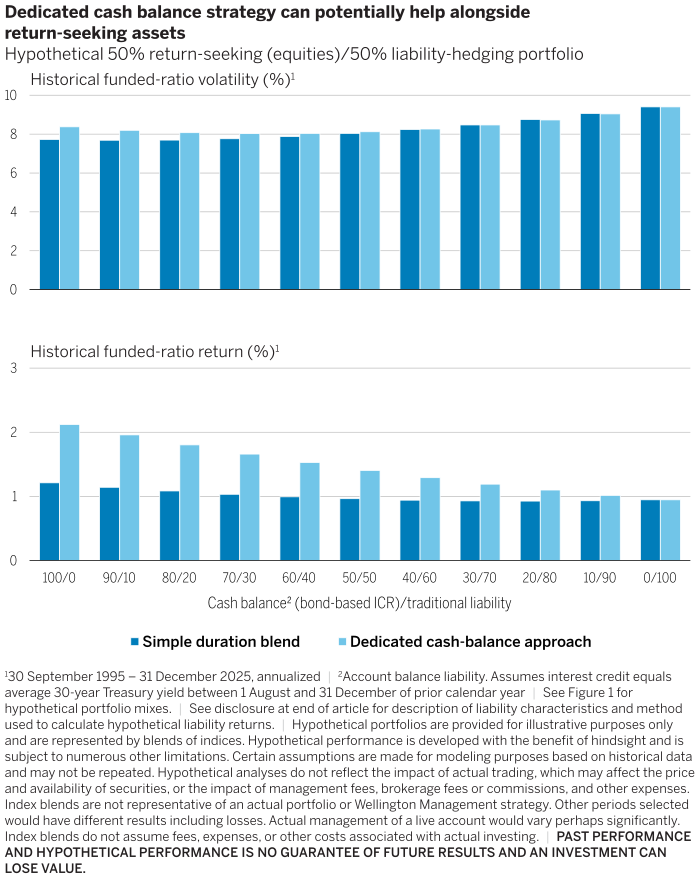
While every plan’s goals and risk tolerances will vary, these results suggest that it may be worth beginning to think about a dedicated approach for cash-balance liabilities when they amount to 20% – 30% or more of total plan liabilities, in order to avoid a potential funded-ratio return give-up. We believe that using a dedicated cash-balance strategy to back cash-balance liabilities has better potential to keep pace with liability growth (versus simply matching the duration of the cash-balance liabilities) while helping to keep volatility low or at least comparable to a simple duration blend.
IMPORTANT DISCLOSURES
Hypothetical liability-hedging portfolios
Simple duration blend: blend of 75% Bloomberg US Long Corporate/20% Bloomberg US Long Treasury/5% Bloomberg US Intermediate Treasury based on percent of liability attributable to the traditional liability; and ICE BofA US 3-Month T-Bill based on percent of liability attributable to cash-balance liability.
Dedicated cash-balance mix: blend of 75% Bloomberg US Long Corporate/20% Bloomberg US Long Treasury/5% Bloomberg US Intermediate Treasury based on percent of liability attributable to the traditional liability; and blend shown below in “Hypothetical cash-balance historical simulation assumptions” based on percent of liability attributable to cash-balance liability.
Hypothetical cash-balance historical simulation assumptions
The performance shown is hypothetical and is not representative of an actual account. Hypothetical performance is developed with the benefit of hindsight (i.e., actual knowledge of market conditions, results of similar strategies) and thus has many inherent limitations.
Time period: 30 September 1995 – 31 December 2025
25% Bloomberg Barclays US 1 – 3 Year Government Index/25% Bloomberg Barclays US MBS Index/40% Bloomberg Barclays US Intermediate Credit Index/10% Bloomberg Barclays US 1 – 5 Year High Yield Rated B and BB Index
Other periods selected could have different results including losses, higher volatility, and/or drawdowns. PAST PERFORMANCE AND HYPOTHETICAL RESULTS ARE NO GUARANTEE OF FUTURE RESULTS AND AN INVESTMENT CAN LOSE VALUE. The management of an actual client account would produce different results than the hypothetical results presented. Examples of factors not taken into consideration for the hypothetical volatility, drawdowns, and contribution to risk analysis include different cash flows, expenses, performance calculation methods, and the method used to select accounts, size, and strategy. Since trades have not actually been executed, results may have under- or overcompensated for the impact, if any, of certain market factors, such as lack of liquidity, and may not reflect the impact that certain economic or market factors may have had on the decision-making process if client funds were actually managed.
The views expressed are those of the authors at the time of writing. Other teams may hold different views and make different investment decisions. The value of your investment may become worth more or less than at the time of original investment. While any third-party data used is considered reliable, its accuracy is not guaranteed. For professional, institutional or accredited investors only.
Experts