




- Head of Portfolio Management, Investment Grade Private Credit
Explore our insights
Asset class
Formats
2026 Midyear Investment Outlook

2026 Midyear Investment Outlook
For many corporate defined benefit (DB) plans, a key objective today is refining the liability-hedging allocation to ensure that it provides a robust hedge, manages risk, and generates returns that keep pace with the liability. As we’ve written previously, we think “liability-hedging diversifiers” can help. These asset classes and strategies fall outside the traditional liability-hedging toolkit and range from long-duration securitized assets to multisector credit to portable alpha. In this article, we focus on one liability-hedging diversifier in particular: investment-grade (IG) private credit, or private placements.
Among our key takeaways:
Below, we offer our views on common questions about the investment-grade private credit opportunity set, recent market headlines, and key implementation considerations.
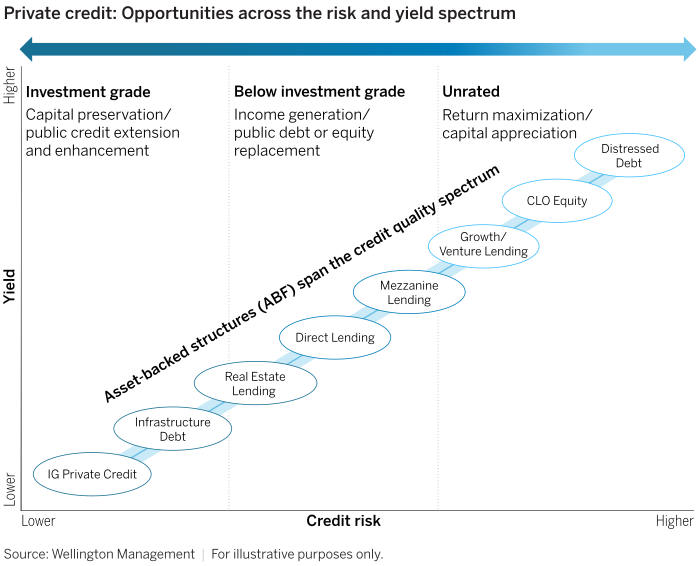
While below-investment-grade direct lending tends to garner a lot of attention, IG private credit occupies a distinct segment of the market (Figure 1). For decades, IG private credit has been used by long-term institutional investors, namely life insurers, seeking to match assets with long-duration liabilities. The market is primarily comprised of investment-grade transactions issued as fixed-rate debt across a broad range of maturities, which we think makes it a natural complement to liability-driven investment strategies centered on IG public credit.
Unlike many areas of private credit that are primarily return-seeking, IG private credit is generally viewed as an extension of a core or liability-hedging fixed income allocation providing income and investment-grade credit exposures. For corporate DB plans, its role is to broaden the liability-hedging opportunity set and seek to improve returns, diversification, and portfolio resiliency.
Figure 1
We would highlight three in particular:
1. Expanding the opportunity set without adding substantial liability tracking risk
For corporate DB plans, we think the starting point when considering an allocation to IG private credit is to recognize that it may have a nominal impact on projected liability tracking risk given its fixed-rate, investment-grade debt profile. As noted, we often think of it as an extension of the public IG universe.
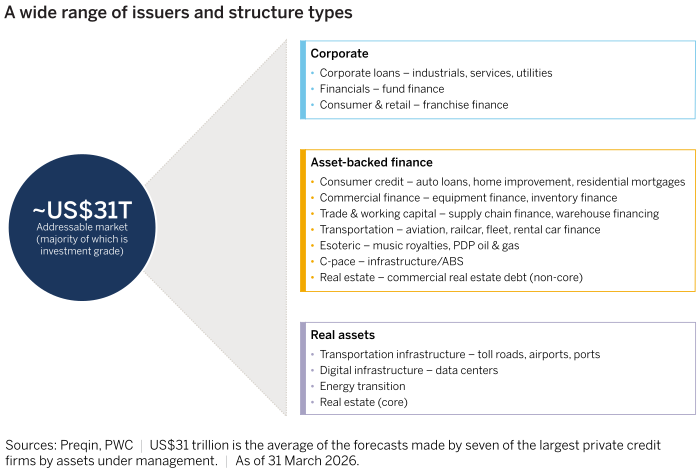
IG private credit could potentially even help reduce risk at the margins. It brings in a diverse set of issuers (Figure 2) with a different sector and geographic footprint than public IG credit, low overlap, and the possibility of non-corporate credit (depending on the fund mandate/guidelines). Alongside corporate issuance, the IG private credit market has continued to expand through infrastructure, project finance, asset-backed, and other structured financing opportunities that we think are well suited to private markets because of their size, complexity, or need for bespoke financing.
Figure 2
2. Seeking the return benefit of being a liquidity provider
A plan with a typical liability profile — even a more mature, frozen plan — is expected to pay out upwards of 40% of its liability more than 10 years from now. This can make plans natural liquidity providers, a position they may want to take advantage of in the IG private credit market.
IG private credit has historically offered additional spread relative to comparable public investment-grade bonds while maintaining similar credit quality and duration characteristics. This incremental spread compensates investors for reduced liquidity, the buy-and-hold nature of the asset class, bespoke transaction structures, and the complexity associated with sourcing and negotiating private investments.
We believe managers with broad sourcing capabilities (including club deals and direct origination, in addition to agented issuance), deep underwriting expertise, and strong structuring capabilities may be well positioned to capture an attractive premium through access to diversified investment opportunities. Spreads close to 100 bps could be a reasonable expectation in our estimation.
Today's market environment may be particularly beneficial for spread premiums. As higher interest rates have increased yields across the IG public market, private borrowers have also had to offer wider spreads to attract capital. As a result, private credit illiquidity premiums have risen above historical averages. For example, the traditional agented market has typically provided approximately 50 basis points of additional spread over comparable public bonds. More recently, that premium has averaged closer to 70 basis points, reflecting the higher-for-longer rate environment and the increasing complexity of borrowers’ financing needs.1
3. Mitigating downside risk
IG private credit transactions frequently include negotiated contractual protections that are less common in public bond markets. These provisions may provide investors with greater influence following material changes in an issuer’s financial profile, including the ability to renegotiate terms, reprice the investment, or require repayment under certain circumstances.
Prepayment protections, including make-whole provisions, may also help preserve expected yields if issuers refinance in a lower-rate environment. Together with broader covenant protections, these structural features may enhance portfolio resilience. For long-term liability investors, they may support capital preservation while providing greater certainty around expected cash flows — an important consideration for portfolios designed to meet future benefit obligations.
As noted, we think the long periods over which DB plans pay benefits can give them an opportunity to reap an illiquidity premium. This, in turn, can help make the liability-hedging assets “work harder,” which may be appealing as plans hold smaller return-seeking allocations and look to keep pace with the liability discount rate.
For instance, for corporate plans using a AA corporate discount rate, credit migration, or what we call “downgrade drag,” has historically resulted in a headwind between a duration-matched hedging portfolio and the liability. This is because downgraded bonds are typically negative for index returns but have no bearing on the liability. The potential additional spread from the IG private credit allocation may help plans offset a portion of this headwind with nominal impact on funded-ratio volatility (as noted above), versus relying on risk assets, which might be correlated with downgrade cycles and exacerbate the risk.
Recent headlines have largely focused on more leveraged, below-investment-grade segments of the private credit market, particularly direct lending strategies with greater exposure to software and more aggressive capital structures. IG private credit is distinct, generally featuring higher-quality borrowers, more conservative capital structures, stronger contractual protections, and broader sector diversification.
We believe investors should avoid viewing private credit as a single, homogeneous asset class. As with public fixed income, risks and opportunities can vary meaningfully across market segments, borrowers, and transaction structures. Disciplined underwriting, thoughtful portfolio construction, and ongoing credit surveillance remain essential regardless of the sector or legal structure.
In general, we think an IG private credit allocation of at least 5% – 10% of liability-hedging assets may be appropriate. Plans may need that level at minimum to reap the potential benefits, and those with more liquidity flexibility, such as plans with longer liability durations, could consider allocating above that range.
We think the choice of manager can be critical in this negotiated asset class. We encourage plans to dig into managers’ underwriting and deal structuring capabilities, especially with respect to experience through cycles. In addition, plans should evaluate managers’ ability to source a diversified funnel of deals and pursue opportunities selectively. We also think a differentiated outcome rests on a manager’s ability to deliver on the specific investment needs of a client. This makes it critical to explore any competing areas of focus for a manager, carefully consider their client relationship servicing and reporting capabilities, and assess their ability to manage exposures holistically across public and private allocations.
While some investors focus on specific segments of the market, such as corporate, asset-backed finance, or infrastructure debt, we believe access to a broader investment universe provides greater flexibility to construct portfolios that complement public fixed income exposure and enhance the overall liability-hedging allocation.
Unsecured corporate transactions remain a significant portion of IG private credit issuance, but opportunities are growing across corporate-backed project finance, infrastructure, and asset-backed structures. Although these investments may differ in legal form, many ultimately derive their credit strength from operating businesses, contracted cash flows, or essential-use assets.
Accordingly, we believe investors should look beyond a transaction’s legal structure or sector classification. Evaluating these investments requires an understanding of not only the underlying collateral and source of repayment, but also the contractual protections, the financial strength of any affiliated operating company or enterprise supporting the transaction, and other credit fundamentals.
Broad access to the investment-grade opportunity set also gives managers flexibility as transactions evolve throughout the deal underwriting and negotiation process. This broad perspective may also help managers identify similar exposures across financing channels or legal structures, supporting relative value decisions and potentially limiting unintended portfolio concentration.
Some investors gravitate toward corporate-only portfolios because they may offer closer alignment with the IG index and liability discount rate. However, as noted, we think this approach could overlook opportunities with corporate-like characteristics that can help enhance return potential and diversification. Alternatively, an exclusive focus on higher-spread sectors, such as asset-backed or structured issues, might have higher return potential but with less diversification and fewer opportunities for managers to make relative value decisions.
Successfully implementing an IG private credit allocation requires consideration of several interconnected factors, including vehicle structure, portfolio construction, liquidity management, and the operational infrastructure needed to access and manage private investments. The appropriate approach will depend on an investor’s objectives, time horizon, liquidity needs, and broader portfolio considerations.
An essential part of that implementation is aligning the liquidity profile of the underlying investments with both the investment vehicle and the needs of its investors. As noted, IG private credit is typically viewed as a long-term, buy-and-hold asset class, and historically the market has been supported by a predominantly institutional investor base with long investment horizons and relatively predictable liquidity requirements. Many DB plans share these traits, so they may be well aligned with the asset class.
As IG private credit becomes accessible through a broader range of vehicles and to a broader investor base, thoughtful structuring becomes increasingly important. Recent attention to liquidity management in certain retail-oriented private credit vehicles has highlighted the challenges that can arise when the liquidity offered to investors is not well matched with that of the underlying assets. For institutional investors, we believe this reinforces a longstanding principle: Vehicle structure, portfolio construction, and liquidity terms should be designed with the needs of the intended investor base in mind.
Implementation also requires specialized operational infrastructure and expertise. Private transactions can involve bespoke documentation, physical settlement, and ongoing administrative requirements that differ from those in public fixed income markets. Managers with established infrastructure, dedicated resources, and experience navigating these complexities may therefore be better positioned to source, execute, and manage investments efficiently across a range of vehicles and customized solutions.
Ultimately, we believe the relevant consideration is less about whether investors access the market through an open-end fund, closed-end fund, or separately managed account, and more about whether the overall solution has been thoughtfully designed and supported for the strategy and its investors. Depending on the structure, managers can employ a range of liquidity management tools, including contractual cash flows, amortizing investments, laddered maturities, dedicated liquidity allocations, and appropriately designed redemption frameworks. Combined with the necessary investment and operational capabilities, these tools can help managers deliver access to IG private credit across a range of structures while preserving the long-term return and liability-matching characteristics that potentially make the asset class attractive.
One consideration is the duration target. IG private credit issuance spans maturities, enabling large investors with separately managed accounts to build custom portfolios aligned with their duration targets. Commingled vehicles, however, might be more accessible for many corporate DB plans and often have a core-like duration profile, although approaches may vary. This duration may be a fit for plans migrating their hedging portfolio into intermediate or full maturity credit, but could require supplementing duration — for example, via long STRIPS or an overlay — in hedging portfolios with longer durations.
Plans likely to conduct an annuity buyout in the near term may want to inquire about how an IG private allocation could affect pricing, timing, and the ability to transact. Insurer practices vary as to the conditions under which they accept IG private credit in an asset-in-kind (AIK) transfer; for those that do, additional time may be required to conduct proper due diligence of the securities. That said, our experience suggests that it’s possible to effectively sell down an illiquid private credit portfolio via a planned liquidity glidepath, close monitoring of the plan’s evolving liquidity needs, and an ability to successfully transact in the IG private credit secondary market.
Corporate DB plans are increasingly evaluating public and private investment-grade credit as complementary components of a single liability-hedging portfolio.
From an investment standpoint, pairing public and private credit allows managers to evaluate opportunities across the full investment-grade universe and allocate capital based on relative value, issuer fundamentals, and portfolio objectives, while potentially taking advantage of the complementary characteristics of each market. Public credit may provide liquidity and efficient implementation, while private credit may offer enhanced spread potential, differentiated issuer exposure, and negotiated structural protections.
An integrated approach may also simplify implementation, removing the need to oversee separate public and private mandates. By sharing portfolio insights and maintaining a certain level of visibility across public and private exposures, managers can evaluate opportunities in the context of the overall liability-hedging portfolio while managing liquidity, the pacing of private investments, and relative value opportunities across both markets.
For corporate DB plans refining their liability-hedging allocations, IG private credit may offer a compelling way to broaden the opportunity set, seek incremental spread, and enhance portfolio resilience without fundamentally changing the role of the hedging portfolio. Realizing those benefits, however, requires careful attention to sizing, liquidity needs, vehicle design, and manager capabilities. We would welcome the opportunity to discuss these and other considerations. And you can learn more about the asset class in our podcast on the evolution of IG private credit.
1Source: Bank of America US Private Placement Market Snapshot, as of June 2026.
The views expressed are those of the authors at the time of writing. Other teams may hold different views and make different investment decisions. The value of your investment may become worth more or less than at the time of original investment. While any third-party data used is considered reliable, its accuracy is not guaranteed. For professional, institutional or accredited investors only.