
Explore our insights
Asset class
Formats
2026 Midyear Investment Outlook

2026 Midyear Investment Outlook
Equity investors have long gravitated toward quality companies — for good reason. These companies, which are characterized by high free cash flow, high return on equity, low leverage, and stable earnings, have historically performed well, especially during times of market stress.
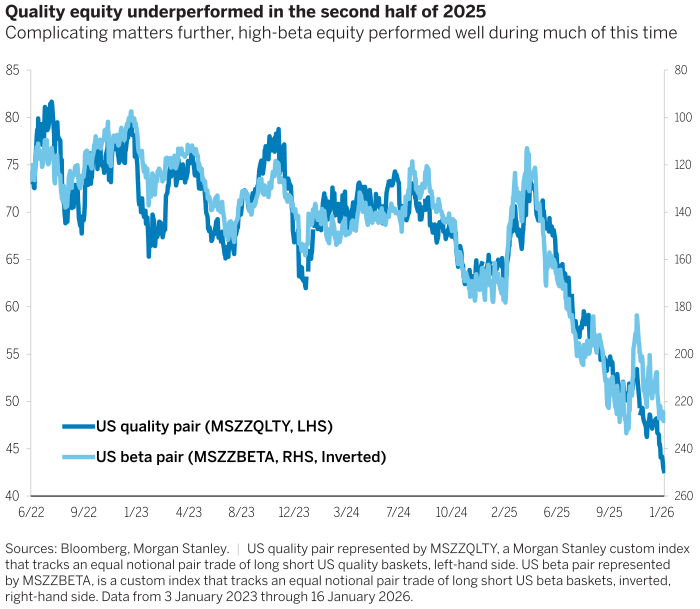
So, it may have come as a surprise to some investors when, in the second half of 2025, quality dramatically underperformed, delivering its worst relative value compared to the broader market in more than 20 years.
As Figure 1 illustrates, quality equity, as represented by the dark blue line, fell quite sharply in the second half of last year. For much of this period, high-beta, or low-quality, equities, as represented by the light blue line, performed well. So, investors who allocated heavily to quality equity at the expense of high-beta equity suffered not only from poor performance among quality but also lack of exposure to high beta. This has undoubtedly been a source of stress for many.
Figure 1
Why did this happen? Several things went wrong for quality in 2025, for example:
Notably, none of these dynamics represents a structural reason for underperformance. They’re relatively anomalous and, in our view, it’s only a matter of time before quality performance snaps back.
Although recent underperformance in quality has (rightly) prompted investors to reassess their portfolios, we believe it’s important to look at quality more holistically over time.
Figure 2 illustrates global quality equity performance compared to the broader global equity market since 1994. Over the long term, quality has strongly outperformed. And, as explained above, the dynamics that weighed on quality performance in 2025 aren’t structural in nature, so they’re unlikely to drag quality down forever. When markets normalize and recency bias lifts, the long-term case for companies with high free cash flow and return on equity, low leverage, and stable earnings remains.
Figure 2
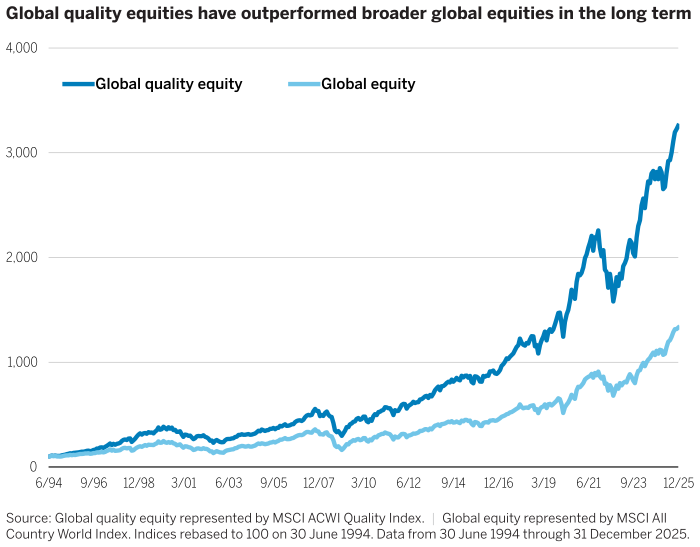
While investors have good reason to take stock of what’s in their portfolios considering recent quality equity underperformance, we’d caution them against throwing the baby out with the proverbial bathwater. The overall case for quality is unchanged, and we have no reason to believe the historical pattern of long-term quality outperformance over the broader market won’t resume.
The views expressed are those of the authors at the time of writing. Other teams may hold different views and make different investment decisions. The value of your investment may become worth more or less than at the time of original investment. While any third-party data used is considered reliable, its accuracy is not guaranteed. For professional, institutional or accredited investors only.






















Monthly Market Review — August 2026
A monthly update on equity, fixed income, currency, and commodity markets.
By