





- Fixed Income Portfolio Manager
FEATURED EQUITY FUNDS
FEATURED FIXED INCOME FUNDS
Asset classes

Asset classes
The views expressed are those of the author at the time of writing. Other teams may hold different views and make different investment decisions. The value of your investment may become worth more or less than at the time of original investment. While any third-party data used is considered reliable, its accuracy is not guaranteed.
An inverted US Treasury yield curve is often viewed as a reliable recession indicator, so the significant flattening of the curve over the past few months — and in an environment of persistent inflationary pressures, to boot — has some economic prognosticators calling for an impending US recession. I say not so fast.
While I acknowledge that the economic outlook will likely deteriorate at the margin as monetary policy tightens, particularly if energy prices remain elevated, I do not believe the recent flattening of the yield curve portends a US recession in the near term. US consumer balance sheets look very healthy, household savings rates are robust, and rising worker wages may help cushion against the impact of higher goods and energy prices. Furthermore, the US should remain relatively shielded from today’s uncertain geopolitical landscape, given its lower oil imports from Russia and its greater domestic oil production compared to Europe.
The recent flattening (and inversion) between the two-year and 10-year parts of the yield curve has been primarily driven by the increase in short-term yields following the more aggressive policy tightening stance adopted by the US Federal Reserve (Fed) in response to stubborn inflationary pressures. Yet the three-month and 10-year “shape” of the curve — historically a more reliable recession indicator — still has a ways to go before inverting, given that the Fed has only just begun to hike the fed funds rate (Figure 1).
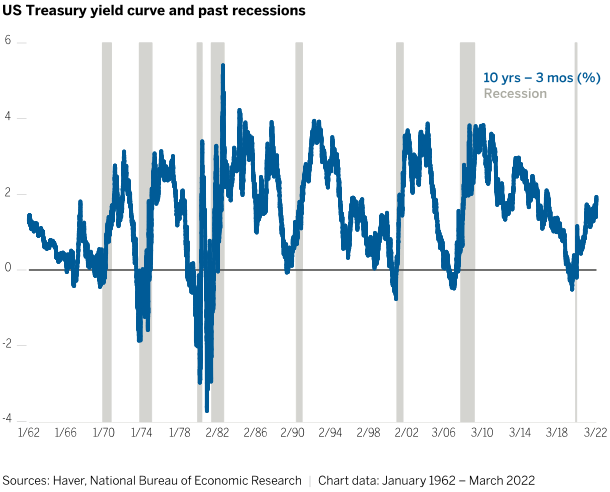
The Fed intends to tighten financial conditions in an effort to alleviate the effects of higher inflation, but it will likely be mindful of the attendant risks to the economic cycle. Specifically, I expect the Fed to remain keenly cognizant of the danger of tightening policy too aggressively against a backdrop of heightened geopolitical tensions. This type of measured approach should further contribute to the “stickiness” of inflation and could raise the odds of a stagflationary outcome (i.e., high inflation in tandem with slowing growth).
That being said, I think a lot would need to go wrong in order for US economic growth to contract in the period ahead. All else being equal, it would likely take one to two years of steady Fed interest-rate hikes for tighter monetary policy to tip the US economy into recession. Projections by the Fed and futures markets have the policy rate increasing to 2.8% and 2.6%, respectively, by the end of 2023 — only slightly above the neutral rate and not overly restrictive, in my view.
While inflation can indeed erode the returns provided by traditional high-grade, rate-sensitive fixed income assets, I believe a number of bond sectors can prove resilient and even be net beneficiaries of higher inflation, including persistently elevated energy prices.
Obvious choices for sectors that can potentially benefit from inflation include bank loans (given the floating-rate nature of their coupons, which reset higher as interest rates rise) and Treasury Inflation-Protected Securities, aka TIPS (since their coupons are directly indexed to, and thus protected from, inflation). I also expect high-yield corporates, convertible bonds, securitized credit, and emerging markets (EM) local debt to outperform most traditional high-grade fixed income sectors in a rising-rate/high-inflation environment, particularly if the global economic expansion continues throughout 2022 and beyond. Some points to consider:
While my outlook for the US credit cycle has worsened somewhat on the back of tighter financial conditions and significant inflationary pressures, I still do not believe a central bank-induced recession is around the corner. I am seeing plenty of investment opportunities in today’s environment in spite of — in fact, because of — the high levels of economic uncertainty and market volatility that have characterized 2022 so far.

Rapid fire questions with Jeremy Butterworth on 2026 credit markets
Continue readingResilient growth, rising risks: Investing through the energy shock
Continue readingIncome investing in the Warsh Fed era: What investors should consider
Continue readingHigh asset prices, not low interest rates, are driving inflation
Continue readingBy
URL References
Related Insights

Rapid fire questions with Jeremy Butterworth on 2026 credit markets
Investment Strategist Jeremy Butterworth discusses why credit markets have remained resilient despite shifting rate expectations, where dispersion is creating opportunities for active investors, and why Asia continues to offer a compelling credit opportunity set.

Resilient growth, rising risks: Investing through the energy shock
Macro Strategist Eoin O’Callaghan explores the drivers of resilient growth amid the continued energy shock and discusses why investors need to keep a close eye on evolving macro conditions.
Income investing in the Warsh Fed era: What investors should consider
How should income investors be positioned for a Warsh-led Fed? Our experts believe it begins by rethinking fundamentals, and being more deliberate and adaptive.

European high yield: time for selectivity
Portfolio Managers Konstantin Leidman and Thomas Kelly, and Investment Director Jennifer Martin discuss how European high-yield investors should rethink their approach in response to historically tight spreads.

September FOMC: Doves capitulate
For the first time in over three years, the Fed raised the target rate range to 3.75%-4.00% in September. Our team looks at what's driving the shift and what it means going forward.

AI capex and the new credit cycle
Fixed Income Portfolio Managers Alyssa Irving and Liz Kleinerman, and Head of Investment Grade Private Credit Emeka Onukwugha explore the emergence of an AI investment cycle in credit markets.

Band-aids, bazookas, and boomerangs: Equity investing in a volatile US rate regime
With fiscal pressures and Treasury-market fragilities keeping bond yields volatile, Macro Strategist Juhi Dhawan outlines implications for equity investors.

High asset prices, not low interest rates, are driving inflation
Wealth distribution in the US has rendered the Federal Reserve’s usual tools less effective. The Fed will need to address asset prices head-on in creative ways if it is going to return inflation to target.
By

How AI is impacting the high yield market
Fixed Income Portfolio Manager Blake Huynh examines how AI is reshaping the high-yield market using the latest issuance data. He explores what this transformation may mean for investors.
By

Tighter spreads, wider dispersion
Fixed Income Portfolio Managers Campe Goodman and Rob Burn share their midyear outlook for credit markets. They find that tight index spreads do not mean a lack of opportunity.

Flexibility with focus: how to position fixed income for volatility
Portfolio Manager Martin Harvey and Investment Director Marco Giordano explore how a focused use of flexibility can help position fixed income portfolios for volatility.
URL References
Related Insights
DISCLOSURE
This material and its contents may not be reproduced or distributed, in whole or in part, without the express written consent of Wellington Management. This document is intended for information purposes only. It is not an offer or a solicitation by anyone, to subscribe for shares in Wellington Management Funds (Luxembourg) III SICAV (the Fund). Nothing in this document should be interpreted as advice, nor is it a recommendation to buy or sell shares. Investment in the Fund may not be suitable for all investors. Any views expressed are those of the author at the time of writing and are subject to change without notice. Investors should carefully read the Key Facts Statement (KFS), Prospectus, and Hong Kong Covering Document for the Fund and the sub-fund(s) for details, including risk factors, before making an investment decision. Other relevant documents are the annual report (and semi-annual report).
© 2026 Morningstar, Inc. All Rights Reserved. The information contained herein: (1) is proprietary to Morningstar; (2) may not be copied or distributed; and (3) is not warranted to be accurate, complete or timely. Neither Morningstar nor its content providers are responsible for any damages or losses arising from any use of this information. The Overall Morningstar Rating for a fund is derived from a weighted average of the three, five, and ten year (if applicable) ratings, based on risk-adjusted return. Past performance is no guarantee of future results.
Issued by Wellington Management Hong Kong Limited. Investment involves risk. Past performance is not indicative of future performance. This document has not been reviewed by the Securities and Futures Commission of Hong Kong.