FEATURED EQUITY FUNDS
FEATURED FIXED INCOME FUNDS

Asset classes

Asset classes
Stocks and bonds have traditionally held complementary roles in investment portfolios. Historically, the two have been negatively correlated, meaning when stocks have faltered, bonds have risen, offsetting equity declines.
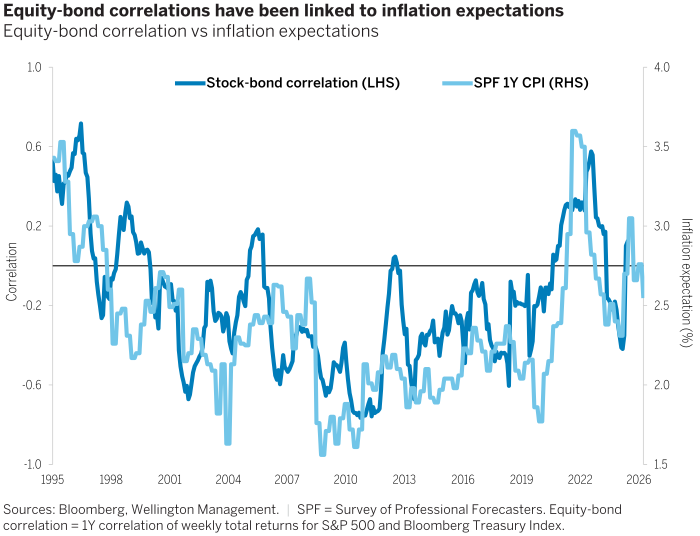
When stocks and bonds experience a positive correlation or move in the same direction ― a defining feature of markets in recent years ― it creates portfolio-construction challenges for many types of investment strategies.
While there are many factors that can influence these relative movements, in my view, inflation expectations are the most important driver today. Prior to the war in Iran, US markets embraced a disinflationary narrative driven by potential labor displacement from continued advancements in AI.
However, the conflict in Iran has triggered an energy shock, pushing inflation expectations higher and reinforcing positive equity–bond correlations. In this environment, rising inflation drives rates higher, pressuring both asset classes at the same time. This limits the effectiveness of diversification. Outcomes become more dependent on direction rather than balance.
That said, we don’t see this as permanent. While inflation may stay elevated near term, the structural disinflationary forces — principally the impacts of AI — remain intact. As they reassert themselves, both asset classes could rally and, over time, more traditional diversification dynamics are likely to return.
Figure 1
Because today’s backdrop of positive correlations, which renders traditional diversification less effective in the near term, is likely transitory, we believe a flexible, adaptable approach to portfolio construction may be prudent. Actively managed strategies may be well positioned to meet current challenges and pivot if structural disinflation reasserts itself, broadening the opportunity set and restoring traditional diversification dynamics.
The views expressed are those of the author at the time of writing. Other teams may hold different views and make different investment decisions. The value of your investment may become worth more or less than at the time of original investment. While any third-party data used is considered reliable, its accuracy is not guaranteed.
DISCLOSURE
This material and its contents may not be reproduced or distributed, in whole or in part, without the express written consent of Wellington Management. This document is intended for information purposes only. It is not an offer or a solicitation by anyone, to subscribe for shares in Wellington Management Funds (Luxembourg) III SICAV (the Fund). Nothing in this document should be interpreted as advice, nor is it a recommendation to buy or sell shares. Investment in the Fund may not be suitable for all investors. Any views expressed are those of the author at the time of writing and are subject to change without notice. Investors should carefully read the Key Facts Statement (KFS), Prospectus, and Hong Kong Covering Document for the Fund and the sub-fund(s) for details, including risk factors, before making an investment decision. Other relevant documents are the annual report (and semi-annual report).
© 2026 Morningstar, Inc. All Rights Reserved. The information contained herein: (1) is proprietary to Morningstar; (2) may not be copied or distributed; and (3) is not warranted to be accurate, complete or timely. Neither Morningstar nor its content providers are responsible for any damages or losses arising from any use of this information. The Overall Morningstar Rating for a fund is derived from a weighted average of the three, five, and ten year (if applicable) ratings, based on risk-adjusted return. Past performance is no guarantee of future results.
Issued by Wellington Management Hong Kong Limited. Investment involves risk. Past performance is not indicative of future performance. This document has not been reviewed by the Securities and Futures Commission of Hong Kong.