
Explore our insights
Asset class
Formats
2026 Midyear Investment Outlook

2026 Midyear Investment Outlook
The views expressed are those of the author at the time of writing. Other teams may hold different views and make different investment decisions. The value of your investment may become worth more or less than at the time of original investment. While any third-party data used is considered reliable, its accuracy is not guaranteed. For professional, institutional, or accredited investors only.
Over the past several years at Wellington, we have partnered with asset-owner clients to help them implement their decarbonization goals in actively managed equity and corporate credit strategies. For most clients, the primary challenge when implementing these goals is balancing their decarbonization ambitions with their financial return objectives. To meet this challenge, defining robust guidelines is, in our view, essential to setting mandates up for success — both in achieving investors’ climate transition goals and in meeting their financial objectives.
For those clients who have requested implementation of a decarbonization glidepath in the portfolios we manage on their behalf, we collaborate with them to strike the right balance for their organization, and to formulate tailored guidelines using sensible metrics and high-integrity implementation. Here, we share some of the notable lessons learned.
For asset owners seeking to implement decarbonization goals successfully within their investment strategies, we recommend a tailored, five-step approach:
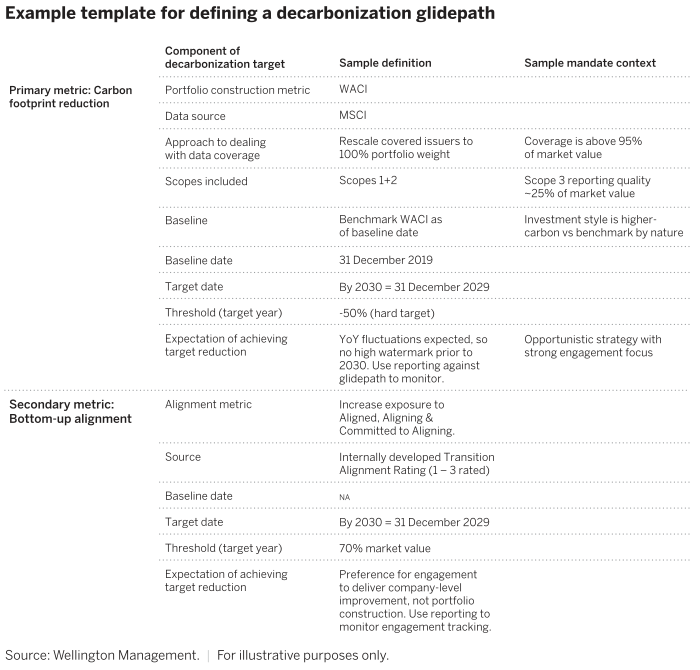
To help asset owners implement these key lessons learned, we provide a sample template at the end of the paper which sets out the details we find most useful for defining a decarbonization glidepath.
While it may seem obvious, different investment universes and styles have different starting points in terms of transition metrics. With this in mind, we start by assessing the data coverage of the opportunity set, which is highest across equities and corporate credit. We then look at benchmark-relative or absolute contribution to understand the carbon intensity of the mandate. We have selected weighted average carbon intensity (WACI) as the portfolio metric our investment teams will monitor and target for the interim 2030 decarbonization goal. We find WACI less sensitive than other portfolio metrics — such as financed emissions — to changes in market movements and capital structures.. For benchmark-relative mandates, we use two-factor attribution to assess how much of a portfolio’s carbon footprint comes from sector allocation and how much comes from security selection. The example in Figure 1 compares a global, value-orientated equity portfolio with its global, core benchmark:
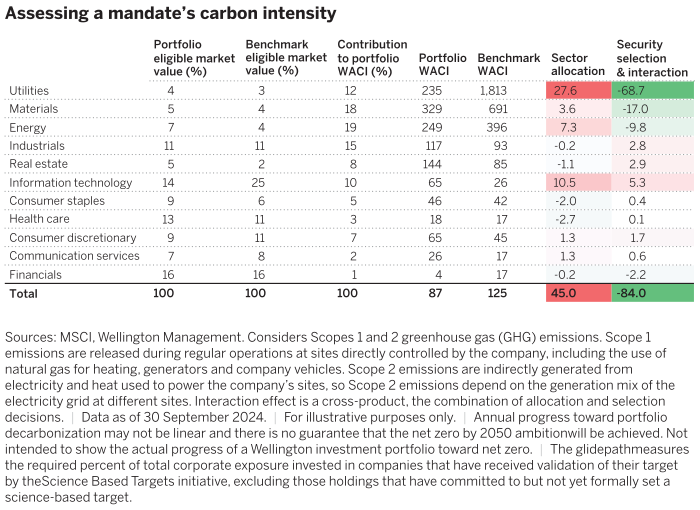
Figure 1 shows that the portfolio is overweight the most carbon-intensive sector, utilities. However, the utilities stocks held in the portfolio are less carbon-intensive than the average within the sector.
Attribution is most often used for point-in-time analysis. Some mandates, particularly those that are opportunistic or less benchmark-sensitive, may experience significant fluctuations in carbon performance over time. When considering the appropriate pace for a WACI glidepath, we use sensitivity analysis to assess the impact of prospective high-conviction investment decisions on WACI.
Assessing the carbon intensity of specific mandates provides deeper insight and line-of-sight for asset owners about how portfolios will perform over time and interact with proposed target thresholds. For example, if the same portfolio from Figure 1 leaned into utilities holdings with higher carbon intensity today and engaged with those companies to enhance their transition plans, the current portfolio WACI could increase substantially, at least in the short term. This may be consistent with the philosophy and process of the investment team and may be a desired outcome for the asset owner. Crucially, we seek to avoid any investment-style “creep” because of a climate objective and, instead, maintain a consistent fundamental role in our clients’ portfolios.
As an active manager, we believe engagement with companies can be a powerful tool to seek to achieve better investment outcomes for our clients. These discussions can help portfolio companies appreciate the potentially wide-ranging effects on security valuations of the low-carbon transition. Company meetings help investors better understand a business’s emissions footprint and transition-risk-management approach. Where transition risk is material to the company, we aim to highlight this risk and encourage risk mitigation.
As more company management teams appreciate the contribution of a robust transition-risk-management strategy to long-term financial success, the investable universe of climate-ready companies is likely to expand. This trend is supportive for active managers, who can then consider transition alignment on an equal footing with other factors in their investment process.
To read case studies about our engagement on climate-change risks and opportunities, see Section 3 of Wellington’s Climate Report.
Fundamental analysis is predicated on assessing companies’ forward planning, so it follows that transition assessment metrics should enhance this analysis. Exposure to companies with science-based emissions-reduction targets (SBT) is a forward-looking portfolio metric based on portfolio companies’ published medium-term targets. At the same time, because validation by the Science Based Targets initiative (SBTi) reflects a high bar and it can take several years for a company to take all the necessary steps to receive this validation, the presence or absence of an SBT is binary — tagging companies as “investable” or “not investable.” As such, this metric can understate incremental progress toward best practice.
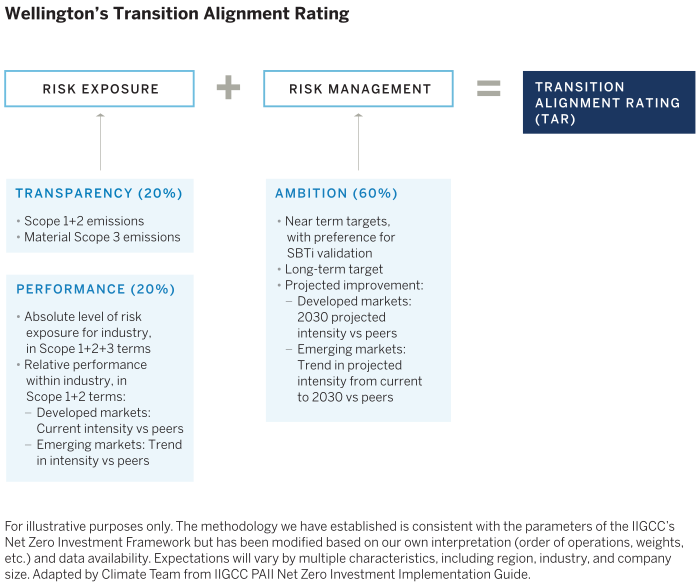
To better differentiate between companies, we have developed a proprietary Transition Alignment Rating (TAR), shown in Figure 2. The TAR is a quantitatively derived, forward-looking rating that combines multiple metrics and uses industry- and region-relative comparisons. The industry-relative comparison also ensures that transition alignment is assessed relative to the business model.
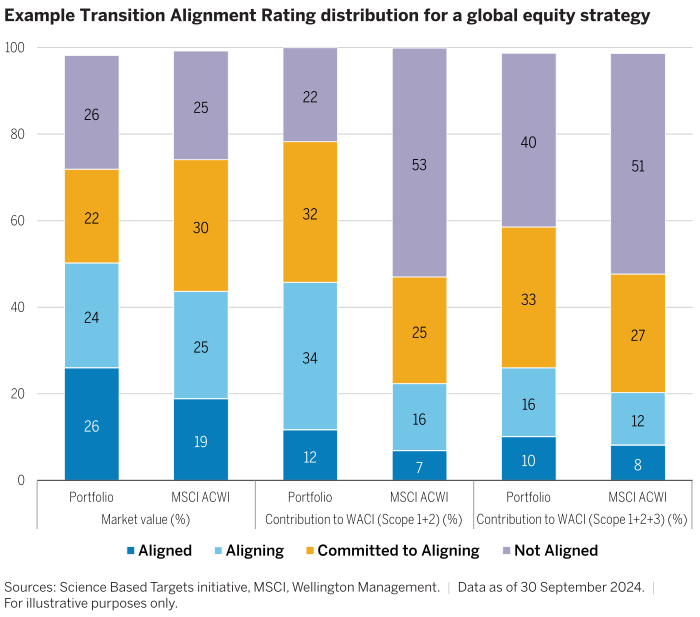
The TAR methodology organically increases differentiation of transition risk-management practices among companies within the same industry by rating companies across a spectrum of 1 to 5, where 1 signifies the most robust transition alignment. Figure 3 shows an example of this distribution for a global equity strategy versus a core global benchmark. It illustrates that 50% of the portfolio’s market value is “Aligned” or “Aligning.” The underlying rating components of the TAR (e.g., emissions transparency, relative performance versus their industry) then support further transition-risk analysis on the holdings in the remaining 50% of the market value of the portfolio, which are either “Committed to Aligning” or “Not Aligned.”
The TAR also supports engagement preparation and outcome tracking, focusing dialogue and tracking incremental progress in underlying data points. For example, when a consumer staples company published its updated annual sustainability report with clearer and more ambitious emissions-reduction targets, our ESG analyst cited recent improvement in the TAR “Ambition” component to verify his fundamental view about the positive trend.
As exemplified by our development and use of TAR, we encourage the use of multiple reporting metrics to provide the most holistic picture, as opposed to relying on a single metric.
The quality of specific climate metrics determines how meaningfully managers can incorporate them into investment decisions. To this end, one of the most common questions we receive from asset owners is: Should we include Scope 3 in our interim target?
Scope 3 emissions are indirectly generated throughout the value chain, from upstream activities such as purchased goods and business travel to downstream activities such as the use of sold products. In our view, including Scope 3 emissions data is useful for research purposes, as it can help investors develop a full picture of transition-risk exposure for a company and its supply chain. Here, there is reason for optimism; the first mandatory Scope 3 disclosure in Europe began in 2025 for large companies, and other jurisdictions are adopting similar requirements with longer phase-in periods.
For now, though, Scope 3’s reporting quality remains relatively poor. We continue to closely monitor progress on reporting, as shown in Figure 4. Almost 90% of the global large-cap universe, as measured by the MSCI All Country World Index (ACWI), are reporting some Scope 3 data. However, only about 25% have robust Scope 3 disclosure, meaning they capture material categories and aggregate emissions volume is commensurate with their business. By contrast, more than 85% of the ACWI have disclosed Scopes 1 and 2 emissions in a robust and comparable manner.
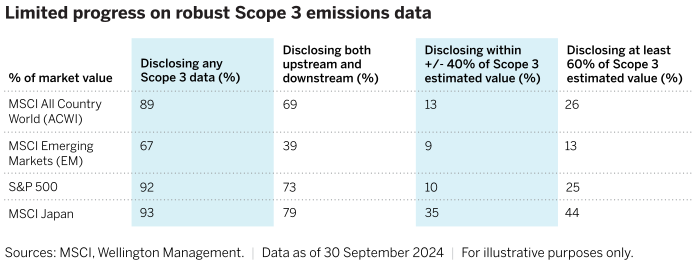
Using Scope 3 estimates by third parties can be directionally informative in comparing one industry to another and surmising likely material Scope 3 categories to consider in bottom-up research and engagement with companies in those industries. However, in our view, it is not useful for comparing two issuers within the same industry. As such, we do not recommend including Scope 3 in portfolio construction for interim targets (e.g., before 2030). Before we begin including Scope 3 in portfolio construction and target setting, we need to see a larger share of high-quality data to facilitate peer-relative comparison, not just industry-level conclusions.
In certain cases, to reflect the importance of incorporating Scope 3 emissions into portfolio targets for our clients, we include a date and/or the rationale for resetting targets inclusive of Scope 3. We also provide clients with portfolio reporting inclusive of Scope 3, using estimated data for comparability, to avoid surprises when the target is restated in the future.
Ultimately, we focus on developing a shared understanding of intent in terms of the climate-related goals clients are seeking to achieve within their investments, considering all the nuances of transition-related methodologies. Clarifying definitions, dates, and other technical details in writing is an integral step in the process.
Discussing the principle of the climate target is also useful to ensure that the investment manager understands the spirit as well as the letter. For example, clients have different expectations about how they anticipate their portfolio will behave prior to the interim target, or how they may prioritize climate and investment objectives, should they ever come into conflict.
Consider, for instance, these two examples of climate-related guidelines, which differ in some key details:
The language in the first guideline connotes a strict guideline, which has pre-trade implications starting immediately at the effective date, an interim target that sets a progressively challenging high watermark, and an inclusion date for Scope 3 emissions. In contrast, the language in the second guideline demonstrates a softer guideline, which clarifies how the manager will use regular reviews to assess the impact of the guideline and adjust as needed. The second guideline may be more appropriate for investment universes with more carbon-intensive starting points and/or less transition planning from constituent companies, such as emerging markets or high-yield credit.
Given the long-term nature of many clients’ decarbonization ambitions, guidelines should not be seen as a “set it and forget it” exercise. We use soft guidelines, tools, and reporting to track progress, and we commit to iterating with our clients as facts and circumstances evolve.
To help asset owners implement the key lessons learned as outlined above, the template in Figure 5 below sets out the details we find most useful when defining a decarbonization glidepath.
For more information on our approach to helping clients implement their decarbonization goals or to discuss your specific needs, please contact your relationship management team.
Most recent update: February 2025
Expert

Julie Delongchamp
, CFA
Stay up to date with the latest market insights and our point of view.