



- Head of Biotech Private Investments
United States, Institutional
Change
The views expressed are those of the authors at the time of writing. Other teams may hold different views and make different investment decisions. The value of your investment may become worth more or less than at the time of original investment. While any third-party data used is considered reliable, its accuracy is not guaranteed. For professional, institutional, or accredited investors only.
For many private biotech companies, a successful initial public offering (IPO) remains a major aspiration as it can be a crucial catalyst for growth. It’s a move that can deliver vital funding for what are often the most capital-intensive stages of drug development: late-stage clinical trials, regulatory approval, and (eventually) commercial launch. It may also be an important way to create value for shareholders by delivering key derisking data as a public company. The public markets can therefore play a critical role in helping companies advance their most promising assets or technologies through these final miles. But unlocking access to these broader, and deeper, capital pools is not without challenges.
In this article, we discuss potential factors for success in a biotech IPO today — analyzing current market trends, key characteristics for a positive IPO trajectory, and best practices to sustain momentum as a public biotechnology company over time.
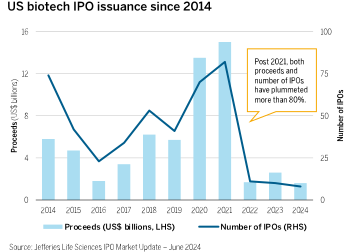
The biotech IPO market has cooled over the past few years in the wake of historical levels of issuance and proceeds in 2020 and 2021 (Figure 1). In the current market environment, we believe investors have become more discerning about the valuation, differentiation, and maturity of biotech companies and moved away from a momentum-driven approach. In our view, the suspension of disbelief of recent years may now have swung to a “too” discriminating and discerning environment.
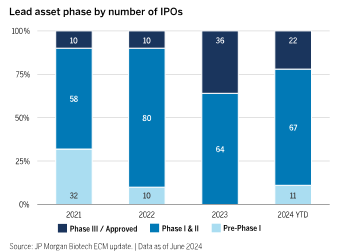
Much of the activity in 2020 and 2021 appeared to be fueled by the combination of a near-zero interest rate environment and COVID-driven enthusiasm for the space. Prior to this period, biotech companies typically needed to demonstrate sufficient data (often clinical) and positive program development to successfully launch an IPO. The new dynamic was clear in 2021 (Figure 2), as roughly one-third of all IPOs were preclinical companies with assets that were earlier and naturally riskier compared to clinical-stage companies. The fallout, perhaps unsurprisingly, resulted in the SPDR S&P Biotech ETF dropping 11% in 2021 and 47% in 2022 as many companies were unable to demonstrate scientific progress in the public markets.1 Notably, many of the earlier-stage companies were trading at or even below cash post-IPO.
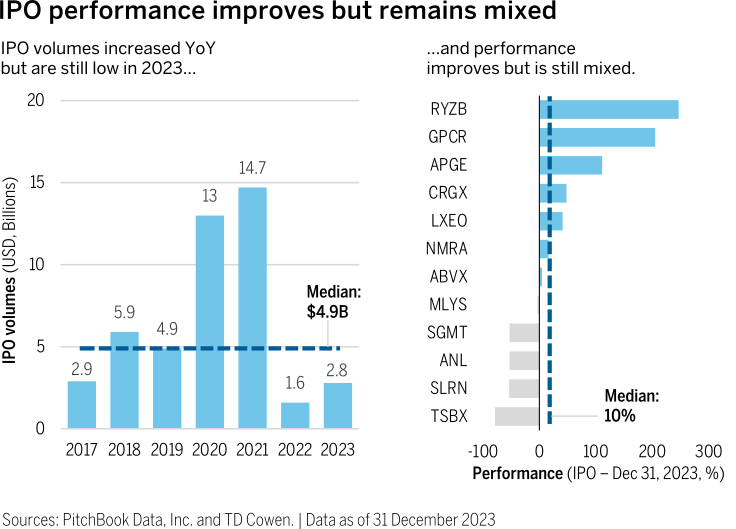
2023 appeared to bring a noticeable change in the phenotype of biotech IPOs with all 10 companies having clinical-stage assets (and roughly a third having Phase III assets). This shift and the reduced issuances are signs of a trend toward more derisked and clearly differentiated stories. Critically, however, performance for the class of 2023 remained mixed post-IPO (Figure 3). This raises the question: What does it take for a biotech IPO to succeed in this market environment?
Every biotech IPO charts its own distinct path toward success or failure. But we believe there are certain characteristics that increase the probability of a positive public list. A few examples include:
In addition to the above characteristics, biotech start-ups can consider the following best practices to prepare themselves for the IPO process:
The biotech landscape has experienced significant volatility over the past few years but now appears to be moving into a more normalized environment.
With the exuberance of 2020 and 2021 seemingly behind us, we believe management teams should focus on delivering a clear and compelling opportunity, timelines to derisking, and differentiated data. We believe that companies that have unique assets with derisked and understood biology should continue to find favor among public investors and succeed regardless of market conditions.
1Source: SPDR S&P Biotech ETF. Data as of 31 December 2022.