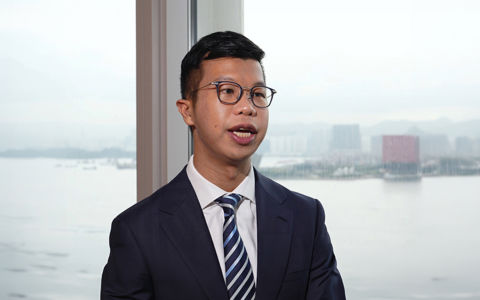





- Investment Director
FEATURED EQUITY FUNDS
FEATURED FIXED INCOME FUNDS
Asset classes

Asset classes
The views expressed are those of the speaker at the time of filming. Other teams may hold different views and make different investment decisions. The value of your investment may become worth more or less than at the time of original investment. While any third-party data used is considered reliable, its accuracy is not guaranteed.
In this edition of “Rapid Fire Questions,” Philip Brooks, investment director and equity strategist, answers key questions on Asian equities—exploring the structural drivers of the asset class, the traits of quality businesses, and the most compelling quality dividend opportunities today.
Question: Why are you excited about Asian equities?
There's a lot to be excited about in Asia today. Whether it's the corporate reform story in Korea, which is really just getting started, but should be a long-term driver of opportunity in that market. Or, recently, the AI excitement that we're seeing in China, and that's actually starting to come through in terms of being a driver of company revenues.
Much less recognized in the market as well—staying in China—is there's also a strong corporate reform story starting to happen there. With capital returns to shareholders through both buybacks and increasing dividend payouts, being an increasing driver of opportunities in that market.
Longer term, there's a really powerful structural story in India, one of the fastest growing economies in the world. And we're seeing a great deal of opportunities across financial and consumer businesses in that market.
Really, there's a huge amount of opportunities across the region today.
Question: How do you define quality in today’s Asian equities market?
There's really three key characteristics that we focus on in identifying quality companies.
The first one is the strength of the company's competitive position. We prefer to invest in companies that are well-established leaders in their industries, or strongly up and coming competitors in their industries.
The second one is a focus on the management team. Does the company have the strength and operational excellence of the management team to drive returns from their business model, from their competitive position?
And the third one is a commitment to governance. So, here, what we're talking about is not just corporate governance, but a focus on doing the right thing by all of the stakeholders for the business. So, certainly their shareholders, but also their employees, their customers, and their suppliers.
We believe that companies that have those three characteristics will, over time, be strong and high-quality companies to invest in in portfolios.
Question: What makes a dividend strategy particularly attractive today in Asia?
Well, I would say, over time, actually dividends in Asia are an underappreciated source of company performance in the region.
When we look back at the longer term, and this might surprise you, what we've seen is that companies with higher dividend payout ratios have actually fairly consistently outperformed the market here in Asia. And that's the story over time, as the markets are maturing, in some cases—China—for example, growth rates are slowing, the total dividend payout of a business becomes a larger part of the overall investment return for companies.
We focus on three types of dividend businesses. Dividend surprisers: So, here, these are companies that we believe are going to increase their dividend payout and surprise the market as that dividend increases. Dividend compounders: So, these are well-established dividend payers who, over time, will gradually further increase their dividend payout. And then dividend leaders: These are typically mature, well-established businesses with high, but sustainably high, levels of dividend payout. And, today, we see opportunities across all three of those categories across the Asian region.
Question: Where are you finding dividend opportunities right now in Asia?
We're finding a range of really interesting dividend opportunities across the Asian region today. So, whether it's banks and insurance companies in China, but also gaming and social media platforms in China too, or semiconductors in Taiwan, or a range of financials, insurance, and conglomerate businesses in Korea, to financial services, banks, and even materials businesses in Australia. There's a great breadth of opportunity today in dividend businesses in the region.
Question: What are the key risks to watch over the next 6 to 12 months?
There are always risks in market. So, I guess one of the key focus areas for those risks at the current stage is geopolitical risk and trade barriers. That said, we actually believe that many markets and many companies in Asia are very well placed to successfully navigate those risks.
One of the great advantages as well, an approach that focuses on higher quality companies, and companies that pay consistent and sustainable dividends, is those companies do tend to be somewhat less volatile than the market. So, a quality dividend portfolio can actually help navigate some of the uncertainty in markets very effectively.
But, as well, I don't just want to focus on the risks, actually, when we look at the markets today, we are very optimistically biased. We believe that there's more upside potential than there is downside risk in the Asian region today. And again, the types of high-quality companies that we focus on, we believe are really well positioned to flourish in today's environment.
One of the final things that I'll mention as well is the outlook for the US dollar. Now, we believe we are likely going to continue to be in a period where the dollar gradually weakens. What we've seen very consistently over time is that the Asia ex-Japan region tends to perform very strongly in periods where the dollar gradually depreciates. If that depreciation continues, then our fundamentally driven optimistic view will be further supported by positive macro tailwinds.
The views expressed are those of the speaker at the time of filming. Other teams may hold different views and make different investment decisions. The value of your investment may become worth more or less than at the time of original investment. While any third-party data used is considered reliable, its accuracy is not guaranteed. For professional, institutional, or accredited investors only.

Related fund
DISCLOSURE
This material and its contents may not be reproduced or distributed, in whole or in part, without the express written consent of Wellington Management. This document is intended for information purposes only. It is not an offer or a solicitation by anyone, to subscribe for shares in Wellington Management Funds (Luxembourg) III SICAV (the Fund). Nothing in this document should be interpreted as advice, nor is it a recommendation to buy or sell shares. Investment in the Fund may not be suitable for all investors. Any views expressed are those of the author at the time of writing and are subject to change without notice. Investors should carefully read the Key Facts Statement (KFS), Prospectus, and Hong Kong Covering Document for the Fund and the sub-fund(s) for details, including risk factors, before making an investment decision. Other relevant documents are the annual report (and semi-annual report).
© 2026 Morningstar, Inc. All Rights Reserved. The information contained herein: (1) is proprietary to Morningstar; (2) may not be copied or distributed; and (3) is not warranted to be accurate, complete or timely. Neither Morningstar nor its content providers are responsible for any damages or losses arising from any use of this information. The Overall Morningstar Rating for a fund is derived from a weighted average of the three, five, and ten year (if applicable) ratings, based on risk-adjusted return. Past performance is no guarantee of future results.
Issued by Wellington Management Hong Kong Limited. Investment involves risk. Past performance is not indicative of future performance. This document has not been reviewed by the Securities and Futures Commission of Hong Kong.