- Macro Strategist
Skip to main content
- Funds
- Capabilities
- Insights
- About Us
Asset classes
Hong Kong (香港), Individual
Changechevron_rightThe views expressed are those of the authors at the time of writing. Other teams may hold different views and make different investment decisions. The value of your investment may become worth more or less than at the time of original investment. While any third-party data used is considered reliable, its accuracy is not guaranteed.
My initial assessment of the sweeping tariffs the US presidential administration announced on 2 April is that they appear to be genuinely groundbreaking with potentially far-reaching consequences for financial risk assets, but I want to start by emphasising again how much could change. The extent of the US trading partners’ countermeasures — at time of writing, China has already announced a 34% tariff on all US imports — and the US administration’s tolerance levels for negative blowback in particular could alter the trajectory over the near and longer term. However, what we know is that the outlook is bad for growth, from both a US and global perspective, and markets have reacted accordingly. We see a clear risk-off move, with equities going down and bond rallying. However, what is interesting is that the US dollar is not benefiting from its traditional safe-haven status and rather than rallying, as you would expect, it is doing the opposite by falling against most currencies.
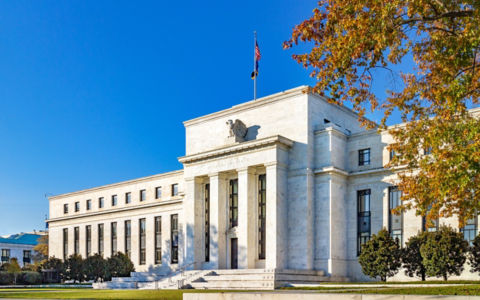
This could be a tentative sign that global investors may be reconsidering how they view the US. After all, why are so many of the world’s assets parked there? In my view, it is because the world’s largest economy offered growth, return and liquidity but also safety and credibility. Tariffs don't only hit growth in the short term; they also change how international investors think about what the US has to offer. How the US Federal Reserve (Fed) responds could be a critical part of this changing investor perception. I think that tariffs are putting the Fed in a difficult position. The growth shock may put pressure on policymakers to cut rates aggressively but that may raise demand and, with it, the impact of tariffs on prices, which would push up inflation.
From a global investor’s perspective, this would imply that the US no longer offers the same protection against rising inflation. If the Fed keeps rates elevated to combat above-target inflation, it will face increased political pressure that could undermine its credibility, which again is a negative for investors. If investors conclude the US is henceforth likely to offer less growth, less return and less safety, we could see a structural reversal of capital flows to the detriment of the US, which would also translate into a significantly lower dollar and a higher risk premium. Much could change — it is not inconceivable, for instance, that President Trump could end up unwinding many of these tariffs — but at the same time, it is hard to negate the sense of rupture. In my opinion, there is a real possibility that we may have witnessed the shotgun start for capital flowing out of the US.
The market reaction to date also suggests a historic shift in its perception of Europe and the euro area, in particular. Hitherto, in the event of a global shock, Europe always tended to be the weak spot, with recurring doubts about credit sustainability forcing the euro area into fiscal tightening. To date, we have not seen a repeat of that scenario. Instead, what we're seeing is a stronger euro and tight sovereign spreads. Investors appear to view Europe in a fundamentally different light since Germany agreed to a structural fiscal loosening. This means that Europe may finally be able to reposition policy pre-emptively and adopt a more pro-growth stance. I think this is an important development for investors to watch, especially if it were to coincide with a return of European investors’ capital from the US.

Expert
Practical portfolio considerations for a new economic age
Continue readingRapid Fire Questions with Ross Dilkes
Continue readingIs all that glitters still gold?
Continue readingChart in Focus: Is the Fed rate cut positive for risk?
Continue readingChart in Focus: What do higher long-end yields mean?
Continue readingChart in Focus: Fed rate cuts resume — What’s next for investors?
Continue readingRapid Fire Questions with Tim Manning
Continue readingBy
URL References
Related Insights
Practical portfolio considerations for a new economic age
Solutions Director Andrew Sharp Paul explores practical portfolio considerations for a new economic age, focusing on quality equities, discerning bonds, and local APAC opportunities.
Rapid Fire Questions with Ross Dilkes
In this edition of “Rapid Fire Questions,” fixed income portfolio manager Ross Dilkes shares his views on the Asia credit market—covering the macro outlook, China’s momentum, the most compelling opportunities across the region, and key risks shaping the next 12 months.
Is all that glitters still gold?
Gold has delivered impressive gains thus far in 2025, but what does that say about market risks and the recent strong returns of stocks? Multi-Asset Strategist Nanette Abuhoff Jacobson offers her take on the precious metal and the case for diversification in today’s market.
Chart in Focus: Is the Fed rate cut positive for risk?
In this edition of Chart in Focus, we examine how the Fed’s long-awaited interest rate cut may influence risk assets.
Chart in Focus: What do higher long-end yields mean?
Long-end yields have climbed on concerns over structural growth and fiscal expansion. In this edition of Chart in Focus, we explore how shifting yield curves are reshaping opportunities across asset classes.
Chart in Focus: Fed rate cuts resume — What’s next for investors?
In this edition of Chart in Focus, we explore the Fed’s return to rate cuts after a strategic pause. We examine how this move, alongside diverging central banks paths, could shape the outlook for risk assets.
Rapid Fire Questions with Tim Manning
In this edition of “Rapid Fire Questions,” equity portfolio manager Tim Manning offers his views on rates, fiscal policy, tariffs, and AI — and shares why he remains constructive on the US equity market.
By
FOMC: Cushioning the US labor market
Fixed Income Portfolio Manager Jeremy Forster analyzes the Fed's decision to cut interest rates at the September FOMC meeting.
Chart in Focus: Are today’s equity returns too high?
In this edition of Chart in Focus, we examine the strength of markets so far this year, placing it in historical context.
Chart in Focus: Where are rates headed?
In this edition of Chart in Focus, we take a look at where rates have been headed and potential implications moving forward.
Chart in Focus: Earnings upgrades fueled the recent US equity market rally
Where are earnings heading? In this edition of Chart in Focus, we address the recent uptick in earnings expectations and its potential impact on equity returns.
URL References
Related Insights
DISCLOSURE
This material and its contents may not be reproduced or distributed, in whole or in part, without the express written consent of Wellington Management. This document is intended for information purposes only. It is not an offer or a solicitation by anyone, to subscribe for shares in Wellington Management Funds (Luxembourg) III SICAV (the Fund). Nothing in this document should be interpreted as advice, nor is it a recommendation to buy or sell shares. Investment in the Fund may not be suitable for all investors. Any views expressed are those of the author at the time of writing and are subject to change without notice. Investors should carefully read the Key Facts Statement (KFS), Prospectus, and Hong Kong Covering Document for the Fund and the sub-fund(s) for details, including risk factors, before making an investment decision. Other relevant documents are the annual report (and semi-annual report).
© 2025 Morningstar, Inc. All Rights Reserved. The information contained herein: (1) is proprietary to Morningstar; (2) may not be copied or distributed; and (3) is not warranted to be accurate, complete or timely. Neither Morningstar nor its content providers are responsible for any damages or losses arising from any use of this information. The Overall Morningstar Rating for a fund is derived from a weighted average of the three, five, and ten year (if applicable) ratings, based on risk-adjusted return. Past performance is no guarantee of future results.
Issued by Wellington Management Hong Kong Limited. Investment involves risk. Past performance is not indicative of future performance. This document has not been reviewed by the Securities and Futures Commission of Hong Kong.
We seek to exceed the investment objectives and service expectations of our fund investors and their advisers worldwide
© Copyright 2025 Wellington Management Hong Kong Limited. All rights reserved.
WELLINGTON MANAGEMENT® is a registered service mark of Wellington Group Holdings LLP.
Wellington Management Hong Kong Limited 威靈頓管理香港有限公司 is a private company incorporated with limited liability in Hong Kong, with its address at 17/F Two International Finance Centre, 8 Finance Street, Central, Hong Kong. It is licensed and regulated by the Securities and Futures Commission of Hong Kong with CE Number AJB478.