Finland, Intermediary
Change



With over 30 years of experience analysing and investing in infrastructure, our team has never seen a better opportunity to invest. In many ways, we believe that the current investment opportunity within infrastructure is generational.
In 2026 and beyond, the attractiveness of this opportunity can be seen through four closely related lenses, which we illustrate in this piece through the energy theme, with a primary focus on electricity and natural gas. We acknowledge that geopolitical tensions — such as those sparked by recent conflict in the Middle East — have periodically exposed vulnerabilities in LNG shipping routes. We continue to monitor such volatility when it arises but see it as distinct from the long term case for gas infrastructure. Here are the four lenses we refer to:
- First, we see the broader structural growth opportunity as exceptional.
- Second, the risk/return trade-off has clearly improved, as returns are rising with no commensurate risk increase.
- Third, we believe valuations remain attractive, particularly considering the higher growth and return potential.
- Fourth, financing this growth has become easier, as private infrastructure is providing lower-cost capital to help fund publicly listed infrastructure’s massive growth.
Why is growth genuinely different this time?
We’re familiar with the energy “trilemma” that drives structural demand for infrastructure: energy needs to be reliable, affordable and sustainable. Today, that trilemma has become a “quadrilemma”. Energy still needs to be reliable, affordable and sustainable — but now power supply needs to grow to meet surging demand.
The energy transition continues to drive power demand, making electricity the fastest growing form of energy over the past decade and likely beyond. Currently, a new source of demand is emerging. Specifically, AI is causing electricity demand growth to be multiple times greater in developed markets than we observed in previous decades.
Meeting this demand has been complicated by a decade in which the developed world focused more on shutting down power plants than building new ones. Rapid growth in renewables has met some of this demand but has created the need for even more infrastructure (e.g., wires, battery storage and flexible/baseload generation). The increasing need for flexible and baseload generation is particularly evident in the improving near-term growth outlook for gas-fired generation and the medium-term growth outlook for nuclear power.
Power generation is only one component of meeting growing power demand. In much of the developed world — especially where renewables have scaled quickly — generation capacity has outpaced the grid’s ability to transmit and distribute power. At the same time, much of the grid is simply old. As such, the need for capital investment in developed market power grids now sits in the high-single-digit percentage range, approximately double historical levels.
Together, growth in power generation and power networks point to a sustained, long-term investment need, not just in 2026, but well into the coming decades.
How has the risk/reward trade-off changed?
We believe regulated utilities sit at the centre of today’s structural demand shift. There’s a growing understanding that utilities are essential for economic growth, whether to support AI-driven power demand, the energy transition or broader trends around reshoring. One consequence of this has been a more supportive regulatory environment.
The regulatory environment matters to investors because regulators are allowing utilities to earn higher returns. Over the past two years, regulators in the US and Europe have increased the returns that utilities are allowed to earn. Combined with clear, long dated regulatory frameworks, investors have unusually high visibility into future cash flows and returns.
Importantly, we believe that achieving these higher returns does not entail utilities taking on significant incremental risk. As a result, regulated utilities offer an opportunity to access higher growth through themes like AI or electrification — while avoiding much of the uncertainty that comes with them. AI provides a clear example. Increasingly, utilities and regulators are requiring hyperscalers to secure power supply though long-term agreements, priced at a premium (to protect residential consumers) and structured on a take-or-pay basis. In this way, utilities can shift the risk from themselves and consumers to the hyperscalers.
Aren’t investors having to overpay for higher growth and returns?
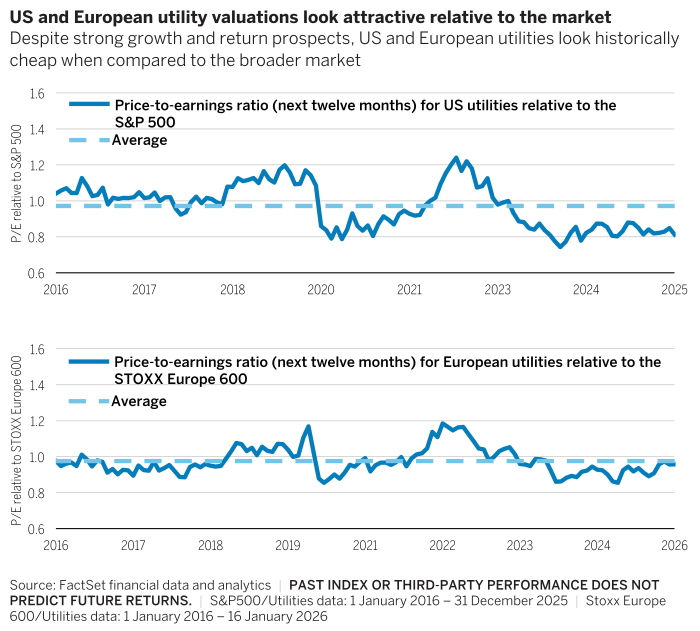
While valuations have bounced from their lows, utilities in both the US and Europe continue to trade at levels that we see as attractive relative to the demand growth backdrop, suggesting that much of this growth has yet to be fully reflected in prices.
Figure 1
Isn’t all that growth hard to finance?
Most of the infrastructure growth opportunities reside in publicly listed companies, and this requires significant outside capital. Traditional methods of raising capital (i.e., equity and bond issuance) are still being used, but a new form of low-cost financing has developed.
Private infrastructure has been very successful in raising capital but is relatively short on organic growth opportunities. As a result, private equity is increasingly looking to make investments in assets owned by publicly listed companies.
Hence a symbiotic relationship has started to develop between private and publicly listed infrastructure. Publicly listed infrastructure is providing the growth, while private infrastructure is providing the capital.
Importantly, we have observed that private infrastructure is paying higher valuations for these assets. We believe this supports the view that the publicly listed companies are attractively valued, particularly considering the growth potential they currently offer.
Positioning for growth in 2026 and beyond
The growth opportunity within infrastructure is significant — and in our view, underappreciated. For investors, the question is not whether this investment will take place, but how best to access it.
We believe listed infrastructure equities offer the most compelling way to access the infrastructure opportunity. These businesses sit at the centre of today’s demand shift and benefit from improving regulatory support. They also provide a way to participate in powerful growth themes such as electrification and AI without taking on the volatility typically associated with them.
With valuations still lagging the growth backdrop and private capital increasingly providing low-cost capital to public assets, we think the generational opportunity in listed infrastructure remains attractive, differentiated and under recognised.
Past performance does not predict future returns.
STOXX Ltd. (“STOXX”) is the source of STOXX Europe 600 Utilities and STOXX Europe 600 and the data comprised therein. STOXX has not been involved in any way in the creation of any reported information and does not give any warranty and excludes any liability whatsoever (whether in negligence or otherwise) – including without limitation for the accuracy, adequateness, correctness, completeness, timeliness, and fitness for any purpose – with respect to any reported information or in relation to any errors, omissions or interruptions in the STOXX Europe 600 Utilities and STOXX Europe 600 or its data. Any dissemination or further distribution of any such information pertaining to STOXX is prohibited.
The views expressed are those of the authors at the time of writing. Other teams may hold different views and make different investment decisions. The value of your investment may become worth more or less than at the time of original investment. While any third-party data used is considered reliable, its accuracy is not guaranteed. For professional, institutional or accredited investors only.