Finland, Intermediary
Change



Equities
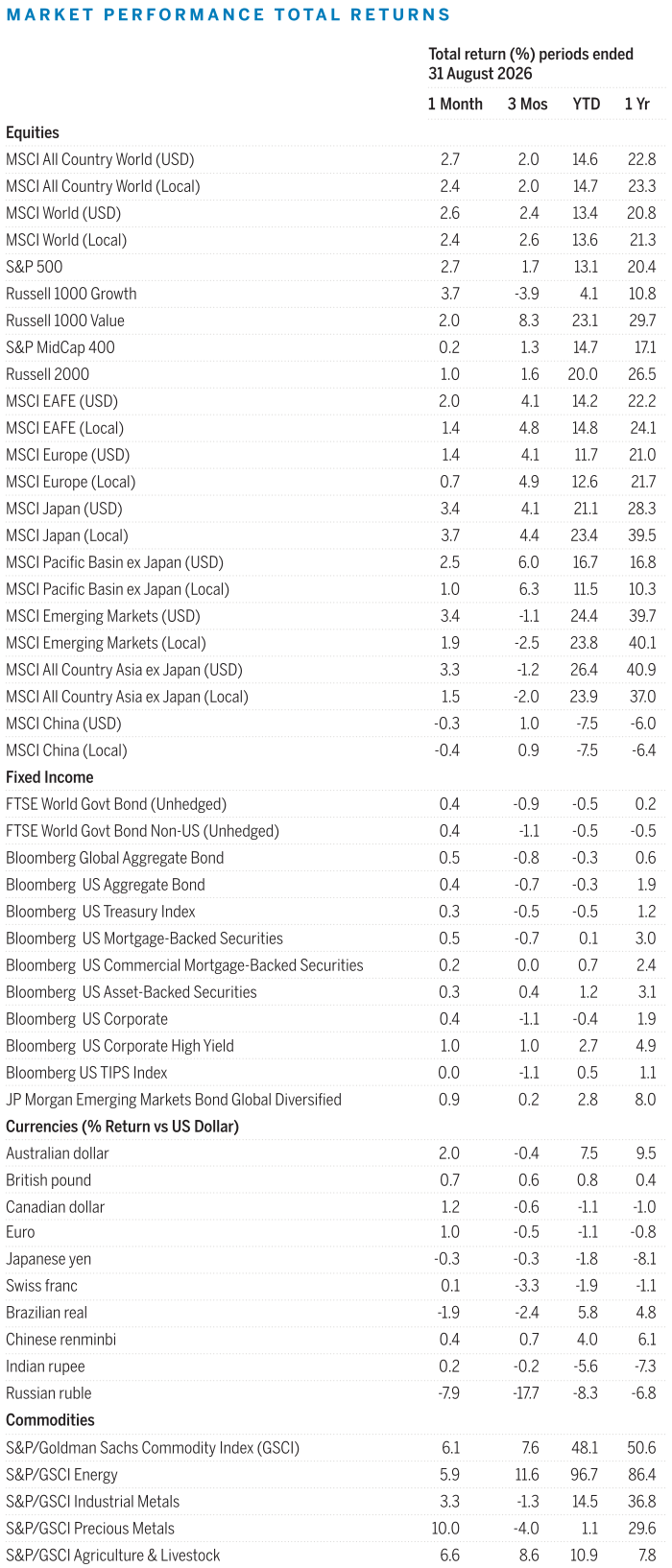
Global equities (+2.4%) advanced in August, extending year-to-date gains to 14.7%, as robust corporate earnings and generally constructive economic data outweighed persistent inflation, rising sovereign yields, and elevated geopolitical risk. Economic conditions varied across regions. In the US, activity was resilient but showed signs of moderation, as consumer spending remained supportive, even as labor-market data softened and second-quarter GDP growth slowed. Japan’s economy continued to expand at a moderate pace, although household spending remained under pressure. In Europe, services activity, business sentiment, and manufacturing strengthened, though overall economic growth was modest and consumer confidence weak. Conditions across Asia Pacific and emerging markets were mixed, with stronger exports and technology-related activity contrasting with weaker domestic demand in several economies. Central banks maintained a cautious stance as inflation pressures and elevated energy costs complicated the policy path, contributing to higher long-term yields and tighter financial conditions. Despite these headwinds, equity gains were broad-based, with technology rebounding from July weakness and energy supported by higher oil prices. Nevertheless, higher discount rates, geopolitical tensions, trade frictions, and uneven domestic demand tempered gains and contributed to continued dispersion across regions and sectors.
US
US equities (+2.7%) were broadly higher, led by a sharp rebound in technology stocks. However, August was a turbulent month, as 30-year Treasury yields rose to their highest level in nearly two decades on mounting concerns about inflation and the ballooning federal budget deficit. In July, headline and core Consumer Price Index inflation eased for the second consecutive month and were in line with forecasts, but renewed fighting between the US and Iran rekindled fears of an even more prolonged conflict and persistently higher inflation. The US Federal Reserve (Fed) left interest rates unchanged, although Fed Chair Kevin Warsh’s unexpectedly hawkish comments about the strength of the US economy, along with his emphasis on inflation risks and price stability, increased speculation that the Fed will raise interest rates in the coming months. The US Treasury announced plans to at least double its purchases of longer-term bonds to curb a sharp increase in borrowing costs. US corporate earnings and profits reached historic highs in a banner second-quarter earnings season. According to FactSet, 86% of companies in the S&P 500 Index reported better-than-expected earnings — the highest in five years. In aggregate, earnings were 26.5% above expectations, with 9 out of 11 sectors posting double-digit year-over-year growth in earnings and net profit margins.
Economic data released during the month was mixed. Nonfarm payrolls surprisingly fell by 23,000 in July, well below expectations for an 80,000 increase and following a sizable 103,000 downward revision to job growth in May and June. However, much of the recent decline stemmed from a seasonal drop in state and local education jobs, with many economists still seeing this as a stable “low-hire, low-fire” environment rather than a deteriorating labor market. Notably, the unemployment rate eased to 4.1% after hiring was hindered by another drop in the participation rate to its lowest level in over five years. In July, real personal spending was unchanged, while headline retail sales unexpectedly fell by 0.6% during the month — the first decline in nine months — as the fading impact of tax refunds and elevated inflation were headwinds to spending. The Conference Board’s Consumer Confidence Index modestly cooled to a seven-month low of 89.4 in August due to more pessimistic views of inflation and the labor market over the next six months. High mortgage rates, slowing income growth, and elevated inflation continued to weigh on the housing market, with new- and existing-home sales decreasing in July.
The manufacturing sector continued to expand at a stout pace; the Institute of Supply Management (ISM) Manufacturing Index registered 54.6 in August, down from a nearly four-year high of 55.6 in July. The services sector, which accounts for more than two-thirds of economic activity, continued to grow at a solid pace in July. The ISM Services Index inched up to 54.1, with accelerating new orders partially offset by a rise in input prices and a decline in employment. Despite elevated business uncertainty, July’s NFIB Small Business Optimism Index advanced to its best level in almost a year, as hiring plans were the highest since October 2022.
Within the S&P 500 Index (+2.7%), five of the 11 sectors posted positive results for the month. Energy was the best-performing sector. Information technology (+6.3%), led by software (+13.6%), and materials (+6.0%) also outperformed the index. Utilities (-4.8%) was the worst-performing sector, while industrials (-2.6%) and real estate (-1.8%) also underperformed.
Europe
European equities (+0.7%) rose in August, supported by robust second-quarter earnings and continued positive momentum in eurozone business activity. A faster expansion in the manufacturing sector, particularly in Germany, helped the S&P Global Flash Eurozone Composite PMI edge up to 52.1 from 52.0 in July. Alongside an increase in output, new orders continued to rise amid the first expansion in new export orders in four-and-a-half years. Overall, German output increased modestly, while French business activity declined further. Against a resilient European economic backdrop, the central banks of Norway and Sweden kept interest rates unchanged. However, upward price pressures from energy price shocks and the adverse weather-related impact on food supplies posed inflation risks for the European economy, with annual eurozone headline inflation accelerating to 3.3% in August. The European Central Bank (ECB) is widely anticipated to raise interest rates in September, for the second time this year, to contain price pressures caused by the Iran war, although members of the ECB indicated that a potential hike is not expected to mark the start of a sustained tightening cycle. According to LSEG, second-quarter earnings for companies in the STOXX 600 Index are forecast to increase by 23.9% from a year earlier.
The S&P Global Eurozone Manufacturing PMI increased to 52.7 in August as factory output growth accelerated to a four-and-a-half-year high. The S&P Global Flash Eurozone Composite PMI revealed that services sector activity expanded modestly, with the pace of growth unchanged from July. A slower rise in input costs and output prices curbed inflation across both manufacturing and services. The European Commission’s Economic Sentiment Indicator rose to 98.4 in August; industry confidence improved, while consumer confidence remained broadly stable against a backdrop of subdued consumer spending and weaker spending intentions.
Germany (+2.9%) saw a significant improvement in manufacturing conditions in August, as a solid and accelerated rise in new orders drove the strongest production growth since January 2022. Additionally, the ZEW Indicator of Economic Sentiment rose more than expected to its highest level since February, suggesting that confidence in the German economy is strengthening despite ongoing geopolitical risks. In the UK (+0.0%), the economy grew 0.3% in June and 0.4% in the second quarter, supported by the services sector. In August, the S&P Global Flash UK PMI Composite Output Index expanded at the fastest pace since April, as services activity accelerated at the strongest rate since February. Annual headline inflation rose to 2.9% in July, in line with forecasts, mainly reflecting the increase in the energy price cap. This helped to reinforce expectations that the Bank of England will keep interest rates unchanged in September.
Pacific Basin
Pacific Basin equities (+2.8%) rose over the period. In Japan (+3.7%), the yen traded near its lowest level in more than three decades and remained volatile as the effects of a joint US-Japan currency intervention faded. Pressure built for a Bank of Japan (BOJ) interest-rate hike as early as September amid concerns that further intervention would be ineffective without coordinated monetary policy tightening. In line with market expectations, minutes from the BOJ’s July meeting were hawkish, with policymakers weighing faster or larger rate increases as underlying inflation neared the bank’s 2% target. Still, mixed economic data continued to complicate the path toward normalization. Solid wage growth and resilient exports strengthened the case for a rate hike, but weaker-than-expected annualized second-quarter GDP growth of 1.1% and a seventh consecutive monthly decline in household spending underscored fragile domestic demand amid persistent inflation. Core inflation accelerated to 1.8% in July as higher oil prices and a weaker yen lifted input costs, reinforcing expectations for a September rate increase.
In Australia (+0.4%), the Reserve Bank of Australia (RBA) held its cash rate at 4.35% for a second consecutive meeting but maintained a hawkish tone, warning that elevated energy prices and persistent inflation could warrant further tightening. The board projected that core inflation would remain above its 2% – 3% target until mid-2027 before easing to 2.5% in early 2028. Second-quarter GDP was better than expected, growing 0.4% from the prior quarter and 2.1% from a year earlier, but the RBA anticipates relatively subdued economic growth in 2026 amid the view that high inflation will dampen consumer spending and a projection for slightly higher unemployment. Core inflation accelerated at a surprisingly strong 3.6% rate in July, while household spending increased much more than forecast at 1.1%, prompting markets to reconsider expectations for an extended rate pause. However, an unexpected rise in July unemployment and a weakening housing market may limit the scope for further tightening.
In Singapore (+4.7%), the government raised its 2026 growth forecast to 4.5% – 5.5% after second-quarter GDP expanded at an upwardly revised 5.9% year-over-year pace and 1.4% quarter over quarter. AI-led manufacturing and trade demand supported growth and helped offset spillovers from the Middle East conflict. While the rosier growth outlook could add to inflation pressures, the central bank left its 1.5% – 2.5% inflation forecast intact and kept its policy stance unchanged. Even so, price pressures became more apparent as core inflation rose to a nearly two-year high of 2% in July, driven by higher utility and transportation costs.
In Hong Kong (-0.4%), the government raised its 2026 GDP growth forecast to 3.5% – 4.5% after strong exports, resilient domestic demand, and buoyant financial markets drove economic growth up 5.1% in the first half of the year. Inflation moderated to 1.7% in July, while unemployment held steady at 3.7%. However, home prices fell 0.5%, ending a 13-month rally as tighter mainland capital controls weighed on transactions and market sentiment.
Emerging markets
Emerging markets (EM) equities (+1.9%) ended the month higher. Europe, the Middle East, and Africa (EMEA) led the gains, followed by Asia, while Latin America was flat.
In EMEA (+5.4%), Saudi Arabia’s (+6.0%) PMI eased slightly to 53.1 in July but expanded for the fourth straight month, with the non-oil private sector continuing to grow on resilient output and new orders. In contrast, the oil sector remained under pressure amid regional shipping disruptions and lower export volumes. South Africa’s (+8.6%) economy remained resilient but uneven amid a more challenging global environment. Annual consumer inflation declined for the first time in five months, to 4.3% in July, while the manufacturing PMI fell to 45.8 in August — its lowest level in 2026 — reflecting subdued domestic demand and business confidence.
In Asia (+1.6%), China’s (-0.4%) economy remained under pressure from weak consumer spending, slowing investment activity, and rising unemployment in July. Deflation concerns resurfaced after CPI inflation cooled more than expected to 0.5% year over year in July, below 1% for the first time since January. The government unveiled its first-ever national five-year plan specifically dedicated to bolstering consumption, targeting ¥60 trillion (US$8.3 trillion) in total retail sales of consumer goods by 2030. The initiative is a key part of the broader push to rebalance the economy toward domestic demand-driven growth. In August, manufacturing conditions improved modestly, with the official manufacturing PMI rising to 49.8 from 49.2 in July, as both new export orders and overall new orders returned to expansionary territory. Taiwan’s (+4.5%) economy continued to benefit from strong demand for semiconductors and AI-related technologies, prompting the country’s statistics agency to raise its 2026 GDP growth forecast to 11.05%, from 9.64% in May. Export growth remained strong, and the S&P Global Taiwan Manufacturing PMI expanded at a solid pace, advancing to 54.7 in August and marking the ninth straight month of growth. South Korea’s (+1.7%) exports surged to US$98.26 billion in August, rising 68.7% from a year earlier and marking 15 consecutive months of export growth, thanks to formidable global technology demand. The Bank of Korea sharply upgraded its 2026 economic growth forecast to 3.3% and delivered its second consecutive 25 bps interest-rate hike in response to above-target inflation and persistent financial stability risks.
In Latin America (0.0%), Brazil’s (+0.4%) central bank cut interest rates by 25 bps for the fourth consecutive time as inflation cooled and as second-quarter GDP growth sharply slowed to 0.5% quarter over quarter, down from 1.1% in the first quarter. Still-elevated borrowing costs curbed business investment and household consumption against a backdrop of fading short-term government stimulus. Mexico’s (-1.9%) central bank signaled a prolonged pause in interest-rate cuts given the uncertain global economic backdrop and lingering inflation risks. Annual inflation accelerated to 3.26% in the first half of August, up from 3.10% a month earlier but still within the central bank’s target range.
Fixed Income
Global sovereign yields were mixed but generally higher in August as persistent inflation, elevated energy prices, and fiscal concerns kept pressure on rates. With few major central bank decisions during the month, markets focused on incoming data and the outlook for further policy tightening. Despite higher yields and ongoing geopolitical uncertainty, most fixed income sectors generated positive excess returns. According to Bloomberg, the US Aggregate Index returned 0.39% for the month, outperforming duration-equivalent Treasuries by 0.09%, while the Global Aggregate Index returned 0.10% in US dollar-hedged terms, outperforming duration-equivalent government bonds by 0.04%.
Global sovereign yields generally moved higher in August as persistent inflation, fiscal concerns, and expectations for further policy tightening weighed on bond markets. In the US, the Treasury curve flattened as Fed Chair Warsh’s hawkish Jackson Hole remarks pushed front-end yields higher, while a brief rally in longer-dated Treasuries following an expansion of the Treasury’s buyback program largely reversed. In Europe, bund yields rose amid resilient economic activity and firmer inflation signals, while gilt yields were comparatively stable. Japanese government bond yields also moved higher and approached multi-decade highs, as expectations for a September BOJ rate hike strengthened. EM rates were more mixed, with South African yields declining amid softer domestic conditions and Malaysian yields rising alongside broader global rate pressures.
US investment-grade corporate bonds generated positive total and excess returns in August, with financials, industrials, and utilities outperforming duration-equivalent Treasuries. High yield also advanced and outperformed Treasuries as spreads tightened, with B rated bonds leading BB and CCC rated issues. Asset managers, pharmaceuticals, and transportation were among the strongest-performing sectors, while wirelines, property and casualty insurance, and electric utilities lagged. Global credit also outperformed duration-equivalent government bonds as investment-grade spreads remained broadly stable. US dollar- and sterling-denominated corporate bonds posted positive total returns, while euro-denominated credit declined, although all three markets generated positive excess returns. Within EM, local-currency debt outperformed external debt, supported by currency appreciation and favorable local-rate moves, while tighter sovereign spreads aided external debt returns.
Currencies
The US dollar weakened broadly against major currencies in August, although Fed Chair Warsh’s hawkish remarks provided some support late in the month. The Norwegian krone, Australian dollar, and Canadian dollar strengthened, while the euro advanced amid firmer inflation data and expectations for tighter monetary policy. In contrast, the Japanese yen weakened modestly, giving back part of its earlier intervention-driven appreciation as higher US yields and persistent interest-rate differentials weighed on the currency. EM currencies generally appreciated, led by the South Korean won, while the South African rand also advanced. The Brazilian real, Colombian peso, and Turkish lira ended the month lower.
Commodities
Commodities (+6.1%) extended their gains in August, with all four major sectors advancing.
Energy (+5.9%) rose as continued disruption to Middle Eastern energy supplies and shipping flows supported prices. Heating oil (+11.0%) and gas oil (+9.2%) led gains, with reduced traffic through the Strait of Hormuz tightening middle-distillate supplies and lifting freight costs, while gasoline (+8.1%) benefited from seasonal demand and refinery constraints. Crude oil (+4.3%) advanced as disruptions to Gulf exports sustained a geopolitical supply premium, outweighing softer global demand expectations. Natural gas (+4.9%) also gained thanks to late-summer cooling demand and stronger liquefied natural gas exports, which offset rising US production.
Industrial metals (+3.3%) were led higher by zinc (+7.3%), which surged on tight inventories and continued supply constraints. Copper (+4.5%) rose to record levels as prospects for additional US tariffs encouraged accelerated shipments into the US, reducing availability elsewhere and amplifying concerns about constrained mine supply. Aluminum (+2.1%) and lead (+1.5%) also gained, while nickel (-2.4%) declined as continued growth in Indonesian production reinforced oversupply concerns.
Precious metals (+10.0%) rallied sharply. Silver (+15.0%) outperformed amid perceived safe-haven demand, a weaker US dollar, and continued industrial consumption, while gold (+9.5%) benefited from geopolitical uncertainty, concerns over US fiscal deficits, and lower yields earlier in the month. Both metals remained supported by heightened demand for stores of value despite some late-month pressure due to more hawkish Fed interest-rate expectations.
Agriculture & livestock (+6.6%) were bolstered by weather and supply disruptions, which drove several agricultural commodities sharply higher. Cocoa (+23.6%) and sugar (+21.9%) surged on deteriorating production outlooks in key growing regions, while wheat (+17.5%) reached a three-year high as adverse weather and disruptions to Black Sea exports tightened global supply expectations. Lean hogs (-1.1%) declined amid ample pork supplies and uncertain export demand, while feeder cattle (-5.0%) and live cattle (-6.1%) fell as improving supply expectations were reinforced by the late-August phased reopening of Mexican cattle imports to the US.
The views expressed are those of the authors at the time of writing. Other teams may hold different views and make different investment decisions. The value of your investment may become worth more or less than at the time of original investment. While any third-party data used is considered reliable, its accuracy is not guaranteed. For professional, institutional or accredited investors only.