1. Equities: consider quality as an anchor
While quality has long been a cornerstone of equity investing, recent performance has been more challenged, prompting questions around quality’s role in portfolios. In our view, this reflects the need to reassess the definition of quality in today’s environment rather than a change in its underlying merits.
Traditional, static definitions tend to rely on backward-looking metrics that may no longer capture the characteristics capable of driving resilience and growth. Instead, we believe quality should be viewed through a more forward-looking and dynamic lens. One way to frame this is to think of quality as a characteristic that determines whether companies can convert growth inflections into sustained positive outcomes. These inflections tend to be most effectively captured by companies able to demonstrate strong control over key operating drivers, a solid track record from management and balance sheet resilience.
Recent market dynamics are reinforcing this shift. Quality growth companies, traditionally viewed as market leaders, no longer appear able to justify their high valuations in the eyes of the market given increased margin pressures and earnings downgrades. Conversely, a broader set of companies, including those historically seen as more cyclical, have shown improving fundamentals, with stronger free cash flow generation, higher returns on capital and more resilient growth profiles. In this context, quality has not disappeared; rather, its definition has evolved.
We believe capturing quality today requires looking beyond traditional classifications, recognising that new sources of durable growth and financial strength are emerging across a wider opportunity set. This evolution, in our view, reinforces the case for an active approach that has the flexibility to adapt the definition of quality as market leadership shifts — while remaining anchored in companies with resilient, compounding fundamentals.
2. Listed infrastructure: bolster exposure to structural trends
A well-anchored equity portfolio can be enhanced by thoughtful exposure to secular trends. Listed infrastructure stands out here by offering an attractive conduit to the generational themes of AI, energy transition and security. The well known energy “trilemma” — or the need to balance reliability, affordability and sustainability — has become more complex in recent years, evolving into a “quadrilemma”. Energy still needs to be reliable, affordable and sustainable — but power supply now needs to grow to meet surging demand. AI has emerged as another source of demand — causing electricity demand growth to be multiple times greater in developed markets than we observed in previous decades.
Yet power generation is only one component of meeting growing power demand. In much of the developed world — especially where renewables have scaled quickly — generation capacity has outpaced the grid’s ability to transmit and distribute power. Together, growth in power generation and power networks point to a sustained, long-term investment need, not just in 2026, but well into the coming decades.
We believe regulated utilities sit at the centre of today’s structural demand shift. Supported by an improving regulatory backdrop, they provide exposure to powerful generational growth themes such as electrification and AI without taking on the volatility typically associated with these areas.
3. Fixed income: adopt a more deliberate playbook
Fixed income faces a more complex backdrop today than it has in the past, but it remains a core component of a diversified portfolio. Deglobalisation, uneven inflation dynamics and growing concerns about debt sustainability — exacerbated by the latest geopolitical tensions in the Middle East — are contributing to greater divergence in central bank policy and economic trajectories.
This has important implications for fixed income investors. Today, it’s not simply about holding bonds to complement equities; investors need to take a more deliberate approach to building the fixed income component of their portfolios. Flexibility and security selection are paramount — a dynamic that, in our view, lends itself to an active approach aimed at capturing opportunities created by dispersion and divergence across regions and sectors.
In this environment, investment-grade credit can play a diversifying role. Because these bonds are issued by financially strong companies, default risk has historically tended to stay low, even during downturns, and price moves are usually less severe than in riskier areas of the credit market.
As well as potentially protecting portfolios during market sell-offs, active bond managers focused on both price and income can seek to take advantage of spread widening by buying fundamentally sound bonds at lower prices than they believe they are worth. This approach can lead to strong returns when markets stabilise and spreads trend back towards their previous tighter levels. More broadly, emphasising stable cash flows, strong fundamentals and favouring attractive entry points created by technical pressure rather than deteriorating credit quality may help investors navigate markets during periods of stress.
4. Diversification: seek returns independent of the broader market
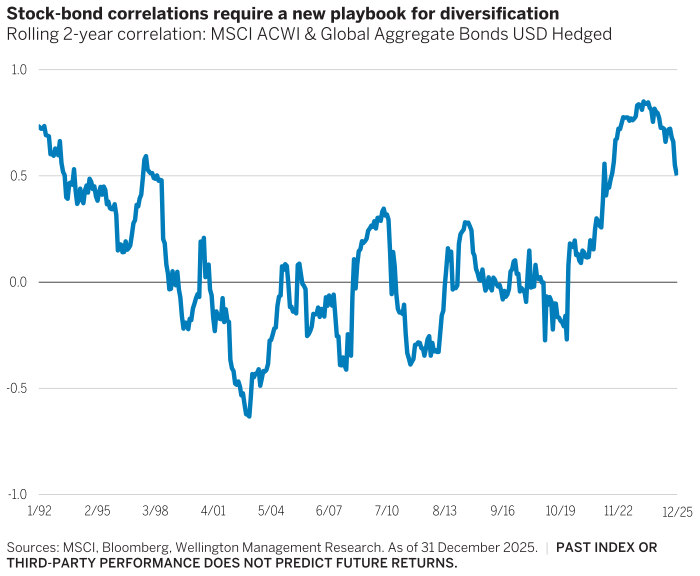
Historically, investors have relied on a combination of equities and bonds to deliver diversification, with broad market exposures and asset allocation doing much of the heavy lifting. This approach worked well when equities and bonds were consistently negatively correlated. However, this relationship has become less reliable of late (Figure 1).