




- Investment Director, Hedge Fund Investor Relations
Explore our insights
Asset class
Formats
2026 Midyear Investment Outlook


2026 Midyear Investment Outlook
The views expressed are those of the authors at the time of writing. Other teams may hold different views and make different investment decisions. The value of your investment may become worth more or less than at the time of original investment. While any third-party data used is considered reliable, its accuracy is not guaranteed. For professional, institutional or accredited investors only.
Driven by their attractive risk and return profile in recent years, interest in multi-strategy hedge funds continues to grow. So, amid all this attention, what should potential investors know about these approaches?
In this article, we briefly cover what multi-strategy approaches do, outline how and why they’ve been successful historically, and share a framework for how to incorporate these strategies in different portfolios.
Multi-strategy approaches are designed with the goal of delivering a consistent return outcome irrespective of underlying economic and financial market conditions. This means that whether equities or bonds go up or down in price, a modern multi-strategy fund seeks to remain immune to those fluctuations and deliver a positive and consistent performance outcome over time. So how does this work in practice?
We believe the key to success lies in the power of diversification. Often referred to as “the only free lunch in investing,” diversification in a multi-strategy approach can be attained by allocating to a wide collection of independent, specialized trading strategies that seek to generate profits in different ways. This could mean investing in distinct asset classes, using systematic or fundamental investment processes, or trading with different time horizons. By combining a range of these unique strategies and tightly managing their aggregate risk, multi-strategy funds have the potential to provide considerable portfolio-level diversification.
We believe multi-strategy funds that seek to provide an all-weather profile are particularly important in today’s persistent economic and geopolitical uncertainty. Elevated inflation, high levels of debt, and regional conflicts are among the macro trends that suggest we may continue to experience heightened volatility in financial assets for years to come. As shown in Figure 1, multi-strategy approaches have been a clear standout over the recent volatile period when compared to a traditional 60/40 asset allocation.
Figure 1
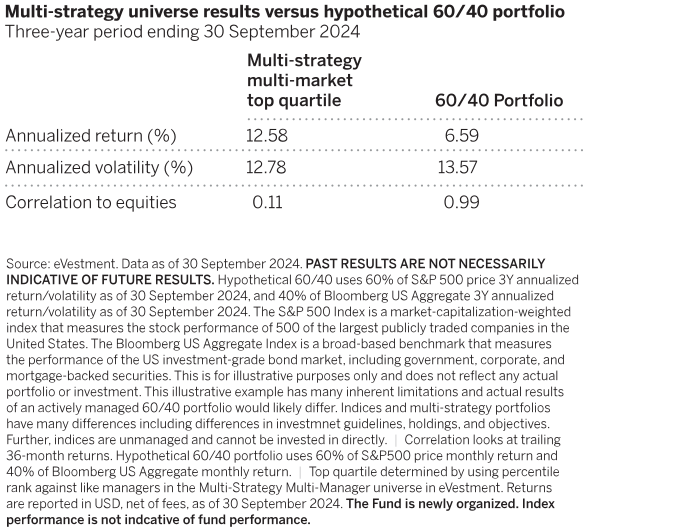
The profile highlighted above can potentially have significant utility within a broader portfolio. This is especially relevant in periods when both stocks and bonds struggle simultaneously, as they have at times from 2021 – 2024. For investors considering these allocations, we see two potential applications for a multi-strategy portfolio:
We believe adding a multi-strategy fund to an existing portfolio of equities and fixed income has the potential to both increase return and reduce risk. In both scenarios, this provides the potential to improve outcomes for clients over the long term.
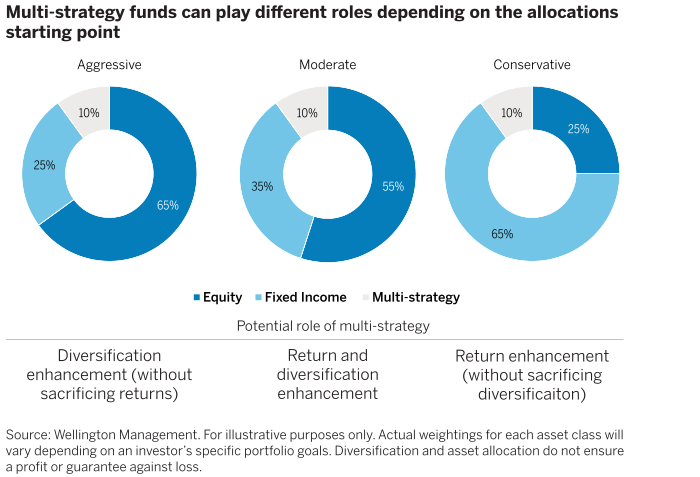
So how should investors think about an allocation in the context of their existing portfolio? An important starting point is to evaluate which lever(s) — return enhancement and/or diversification enhancement — you need a multi-strategy investment to help pull. For example, aggressively tilted portfolios (those with considerably more equities than fixed income) may identify the need for more diversification without greatly sacrificing return potential (Figure 2) and thus fund from equities. Alternatively, conservative portfolios (those with more fixed income than equities) may desire to increase the return of the portfolio without losing the embedded diversification so might allocate from their fixed income assets.
Figure 2
Unlike some traditional investments, multi-strategy funds are generally not expected to experience cyclical highs and lows the way that stocks and bonds do. To the contrary, they are typically designed with the goal of remaining immune, or uncorrelated, to whether stocks and bonds rise/fall. Thus, we believe it can be both difficult and unwise to “time” an investment in a multi-strategy fund. Waiting for an ideal entry point may also come at an opportunity cost given the potential benefits noted above and the possibility of higher volatility in today’s environment.
We believe that, arguably, the need for and value of diversified investment options has never been higher. Elevated equity valuations, sticky inflation, and declining cash yields are all factors that may challenge today’s investment playbook and justify seeking diversification outside of stocks and bonds. Given their potential structural market independence and ability to pivot across asset classes as opportunities arise, we believe that multi-strategy approaches are a compelling allocation for investors to consider.