- Fixed Income Strategist
Skip to main content
- Funds
- Capabilities
- Insights
- About Us
FEATURED EQUITY FUNDS
FEATURED FIXED INCOME FUNDS

Asset classes

Singapore, Individual
Changechevron_rightFEATURED EQUITY FUNDS
FEATURED FIXED INCOME FUNDS
Asset classes
The views expressed are those of the authors at the time of writing. Other teams may hold different views and make different investment decisions. The value of your investment may become worth more or less than at the time of original investment. While any third-party data used is considered reliable, its accuracy is not guaranteed.
Today’s market participants often lament that credit spreads are too compressed. Indeed, in many cases, spreads — having reached the top percentile in historical tightness across some sectors — may offer little upside potential. However, several disparate factors tend to drive total returns in fixed income and explain why spreads could remain in this lower range for some time.
Focusing too narrowly on spreads and awaiting a mean reversion toward more attractive levels could cause investors waiting on the sidelines to forgo some compelling investment opportunities. Investors should be aware of several key factors that may drive their fixed income returns in the current environment:
1. Spread dispersion
Despite tight spreads across some sectors at the index level, dispersion is still fairly wide in spreads among different sectors and individual issuers. And there’s no shortage of potential drivers of spread volatility, including diverging central bank monetary policy, continued geopolitical conflict, and volatile US fiscal policy. Further dispersion among credit sectors would present more attractive entry points to add risk, in our view.
In fact, certain spread sectors, such as bank loans, collateralized loan obligations (CLOs), and commercial mortgage-backed securities (CMBS) remain attractive from a longer-term spread perspective. Many of these asset classes can be accessed through either standalone investments or multi-asset credit strategies.
2. Elevated yields
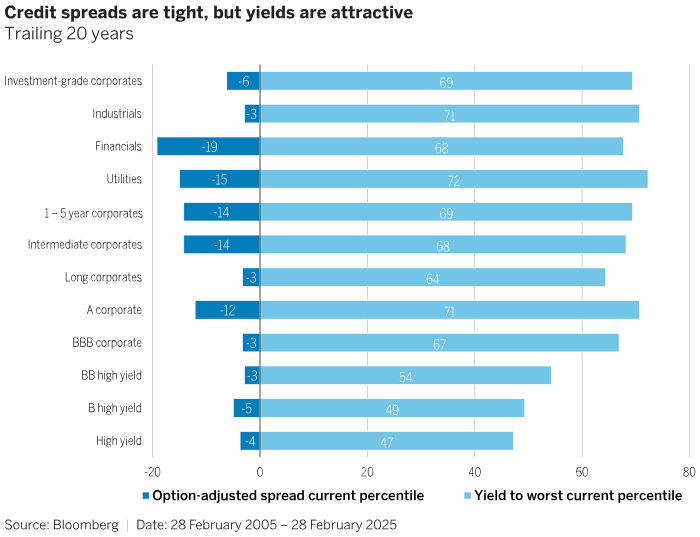
Yields remain near the high end of the range, and look reasonably attractive from a longer-term, historical-percentage basis. And given the relative flatness of the yield curve, fixed income investors don’t need to take on significant duration risk to find attractive yield opportunities. Figure 1 shows that while the historical spread percentile across credit segments ranks at the tightest extremes, yields look much more attractive.
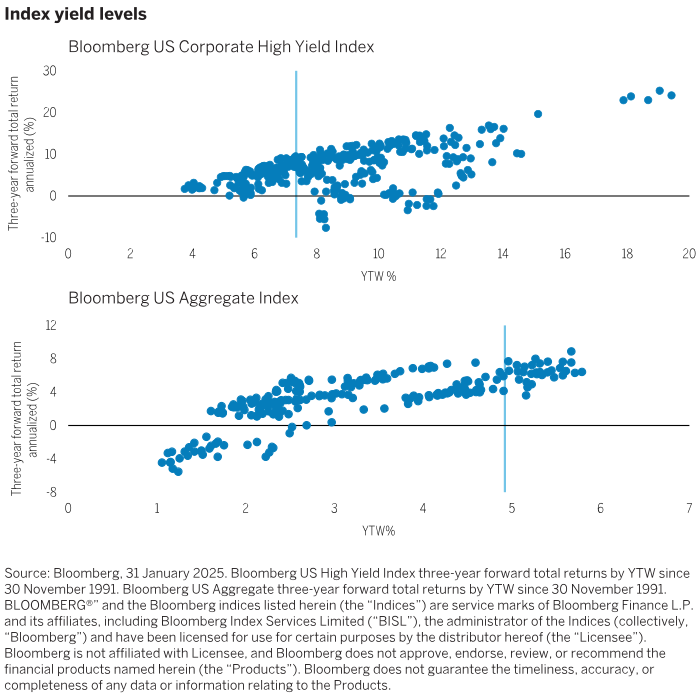
Importantly, one of the single most significant drivers of expected returns for a fixed income portfolio is the starting yield. Figure 2 depicts the ending yield-to-worsts (YTWs), or the lowest potential yield that an issuer can pay on a bond without defaulting, of several fixed income indices on a historical basis. Each dot represents monthly observations of YTW and the Y axes show the corresponding annualized return over the ensuing three years. The blue bars represent the index yield levels as of 31 January 2025. Note the general upward sloping shape of returns versus starting yields.
3. The “risk-off” factor in yields today
When interest rates were low and approaching the zero lower bound, the recessionary risk mitigation of the underlying Treasury rates in credit was relatively low, unless one assumed that interest rates could move into negative territory. In today’s elevated yield backdrop, the underlying Treasury yield can act as more of a potential “shock absorber” through risk-off cycles that move spreads wider.
4. Added value through active management?
Finally, if yield alone isn’t a significant inducement, flexible total return fixed income strategies can toggle risk on and off, depending on the manager’s assessment of relative valuations and return skew. In our view, attractiveness of valuations may continue to diverge across fixed income sectors, creating potential opportunities for dynamic strategies that can take advantage of security or sectoral dislocations.
Given the uncertainty of the current rate cycle — a dynamic compounded by persistent geopolitical risks — we believe a prudent approach to fixed income allocations may be maintaining a benchmark-agnostic approach with flexibility to pursue security- or sector-dislocation-driven opportunities as they arise.

Experts
Related funds
Wellington Credit Total Return Fund
A long-only cash and bond fund seeking long-term total returns by investing primarily in US Dollar-denominated treasuries, corporate bonds and emerging markets issuers.
Wellington Credit Income Fund
A multi-sector credit fund seeking attractive long-term total returns and consistent income through active sector rotation
Rapid fire questions with Jeremy Butterworth on 2026 credit markets
Investment Strategist Jeremy Butterworth discusses why credit markets have remained resilient despite shifting rate expectations, where dispersion is creating opportunities for active investors, and why Asia continues to offer a compelling credit opportunity set.
Resilient growth, rising risks: Investing through the energy shock
Macro Strategist Eoin O’Callaghan explores the drivers of resilient growth amid the continued energy shock and discusses why investors need to keep a close eye on evolving macro conditions.
Income investing in the Warsh Fed era: What investors should consider
How should income investors be positioned for a Warsh-led Fed? Our experts believe it begins by rethinking fundamentals, and being more deliberate and adaptive.
Multiple authors
European high yield: time for selectivity
Portfolio Managers Konstantin Leidman and Thomas Kelly, and Investment Director Jennifer Martin discuss how European high-yield investors should rethink their approach in response to historically tight spreads.
Multiple authors
September FOMC: Doves capitulate
For the first time in over three years, the Fed raised the target rate range to 3.75%-4.00% in September. Our team looks at what's driving the shift and what it means going forward.
AI capex and the new credit cycle
Fixed Income Portfolio Managers Alyssa Irving and Liz Kleinerman, and Head of Investment Grade Private Credit Emeka Onukwugha explore the emergence of an AI investment cycle in credit markets.
Multiple authors
Band-aids, bazookas, and boomerangs: Equity investing in a volatile US rate regime
With fiscal pressures and Treasury-market fragilities keeping bond yields volatile, Macro Strategist Juhi Dhawan outlines implications for equity investors.
High asset prices, not low interest rates, are driving inflation
Wealth distribution in the US has rendered the Federal Reserve’s usual tools less effective. The Fed will need to address asset prices head-on in creative ways if it is going to return inflation to target.
By
How AI is impacting the high yield market
Fixed Income Portfolio Manager Blake Huynh examines how AI is reshaping the high-yield market using the latest issuance data. He explores what this transformation may mean for investors.
By
2026 midyear outlook: Time to rethink EM debt
Our expert argues that emerging market debt may merit a fresh look as stronger fundamentals, credible policymaking, and attractive yields challenge outdated assumptions about the asset class.
Warsh’s first FOMC: We have a task force for that
Our experts highlight new task forces, examine evolving inflation and labor dynamics, and contend that the Fed soon may need to choose between growth support and price stability.
URL References
Related Insights
Past results are not necessarily indicative of future results and an investment can lose value. Funds returns are shown net of fees. Source: Wellington Management
© 2026 Morningstar, Inc. All Rights Reserved. The information contained herein: (1) is proprietary to Morningstar; (2) may not be copied or distributed; and (3) is not warranted to be accurate, complete or timely. Neither Morningstar nor its content providers are responsible for any damages or losses arising from any use of this information. The Overall Morningstar Rating for a fund is derived from a weighted average of the three, five, and ten year (if applicable) ratings, based on risk-adjusted return. Past performance is no guarantee of future results.
The content within this page is issued by Wellington Management Singapore Pte Ltd (UEN: 201415544E) (WMS). This advertisement or publication has not been reviewed by the Monetary Authority of Singapore. Information contained on this website is provided for information purposes and does not constitute financial advice or recommendation in any security including but not limited to, share in the funds and is prepared without regard to the specific objectives, financial situation or needs of any particular person.
Investment in the funds described on this website carries a substantial degree of risk and places an investor’s capital at risk. The price and value of investments is not guaranteed. The value of the shares of the funds and the income accruing to them, if any, and may fall or rise. An investor may not get back the original amount invested and an investor may lose all of their investment. Investment in the funds described on this website is not suitable for all investors. Investors should read the prospectus and the Product Highlights Sheet of the respective fund and seek financial advice before deciding whether to purchase shares in any fund. Past performance or any economic trends or forecast, are not necessarily indicative of future performance. Some of the funds described on this website may use or invest in financial derivative instruments for portfolio management and hedging purposes. Investments in the funds are subject to investment risks, including the possible loss of the principal amount invested. None of the funds listed on this website guarantees distributions and distributions may fluctuate and may be paid out of capital. Past distributions are not necessarily indicative of future trends, which may be lower. Please note that payment of distributions out of capital effectively amounts to a return or withdrawal of the principal amount invested or of net capital gains attributable to that principal amount. Actual distribution of income, net capital gains and/or capital will be at the manager’s absolute discretion. Payments on dividends may result in a reduction of NAV per share of the funds. The preceding paragraph is only applicable if the fund intends to pay dividends/ distributions. Performance with preliminary charge (sales charge) is calculated on a NAV to NAV basis, net of 5% preliminary charge (initial sales charge). Unless stated otherwise data is as at previous month end.
Subscriptions may only be made on the basis of the latest prospectus and Product Highlights Sheet, and they can be obtained from WMS or fund distributors upon request.
This material may not be reproduced or distributed, in whole or in part, without the express written consent of Wellington Management.
We seek to exceed the investment objectives and service expectations of our fund investors and their advisers worldwide
© Copyright 2026 Wellington Management Singapore Pte. Ltd. All rights reserved.
WELLINGTON MANAGEMENT FUNDS ® is a registered service mark of Wellington Group Holdings LLP.
Wellington Management Singapore Pte. Ltd., a private limited company incorporated in the Republic of Singapore. Address: 8 Marina Boulevard, Tower 1 #03-01 Marina Bay Financial Centre 018981. Licensed and regulated by the Monetary Authority of Singapore.