United Kingdom, Professional
Change




Key points
- Along with a solid global economic backdrop and a weaker US dollar, emerging market (EM) equities may benefit from improved earnings and relatively attractive valuations.
- A range of countries may benefit from structural forces such as a commodities supercycle, the AI infrastructure buildout, and new trade agreements.
- Cracks in US exceptionalism could open opportunities for emerging markets.
- EM equities may be especially well-suited for active management.
Following their stellar performance in 2025, I think EM equities have more room to run. In fact, a number of factors have lined up to make them my highest-conviction view across asset classes.
There’s been a lot of focus on two reasons for optimism: 1) the healthy global backdrop of good growth, contained inflation, fiscal stimulus, and Fed easing; and 2) the potential for more weakening of the US dollar, which would strengthen EM currencies and add return in US-dollar terms. I agree with both points, but I also think there are some less obvious reasons to favor EM equities in 2026:
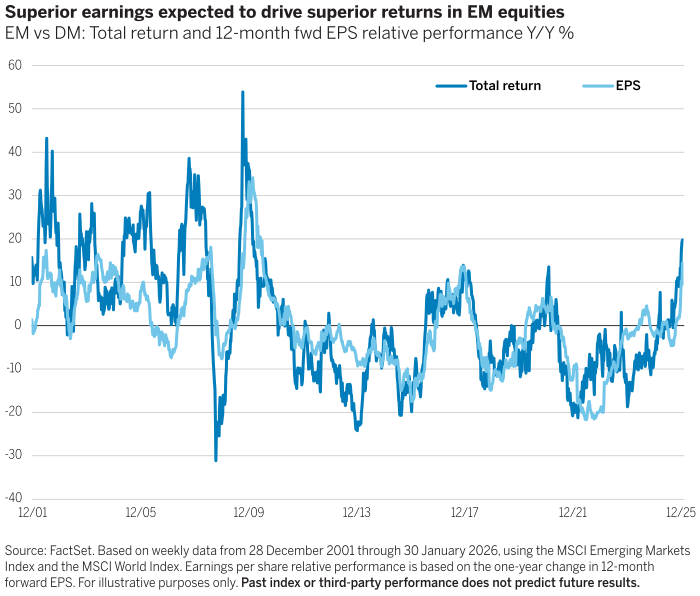
1. Earnings — For the first time since 2021, earnings revisions are in positive territory for the four largest markets in the MSCI EM benchmark: China, India, South Korea, and Taiwan. Earnings are, in my view, the most important gauge of equity performance (Figure 1).
Figure 1
2. Valuations — Based on average 12-month forward price-to-earnings ratios over one- and 10-year periods, EM equities are cheaper than the US, Europe, and Japan. Europe and Japan have recently moved to rich levels, joining the US.1
3. Commodity exporters — Strong demand and high prices for industrial metals like copper, nickel, and lithium, as well as precious metals, are benefiting many EM commodity exporters in Latin America and Africa and improving their fiscal health. Experts at our firm believe the AI infrastructure buildout is driving a commodities supercycle.
4. Asia and AI exposure — Asian EM equities should be among the biggest beneficiaries of AI-related capital expenditures, given their strong position in the AI supply chain for memory and semiconductors and attractive valuations relative to US peers. For example, Taiwan is dominant in computer chips, with strong demand expected through 2030. South Korea is also a huge player in memory and chips.
5. Corporate governance — Some EM governments are making progress driving policies aimed at improving corporate governance and shareholder returns. South Korea stands out in this respect.
6. New trade agreements — Amid the fracturing of global economic ties, countries are seeking new trading relationships to secure supply chains and reduce dependence on the US. Among those making headlines are deals between Europe and the Mercosur countries of South America; Europe and India; and Canada and China.
7. India — India’s economy is expected to grow by more than 10% this year on a nominal basis, driven by normalizing inflation, pro-consumption policies instituted last year (cuts in income taxes, goods and services taxes, and interest rates), and reduced regulation.2 Fiscal consolidation has cut the budget deficit by more than half, and the cheaper currency has helped exports. President Trump’s recent reduction in tariffs is an additional plus. Finally, earnings are expected to recover after a weak patch.
8. Latin America — Strong currencies have helped bring down inflation in Latin America, giving central banks scope to cut rates and ease financial conditions. Politics are also moving rightward in many countries, a market-friendly development.
9. China — China continues to deal with the repercussions of its real estate slump, but some positive government measures should help bring supply and demand into better balance. The anti-involution campaign is addressing manufacturing overcapacity, and policymakers appear committed to adding fiscal stimulus and helping households. In addition, China’s technology sector is driving innovation and may be a source of diversification when it comes to AI exposure.
10. US exceptionalism intact but also waning — While the US retains its reputation for exceptionalism in many areas (economic growth, technology, regulatory flexibility, innovation), cracks have emerged (institutional integrity, central bank independence, fiscal sustainability), which I think should narrow the gap between the US and other countries and benefit emerging markets.
Investment implications
Consider adding (or adding to) EM equities — I expect equity market opportunities to continue broadening both within and outside US equities. Within US equities, this rotation is supported by improved earnings outside of megacap tech stocks. However, I think investors should be looking outside of US equities, and especially at EM equities, given higher earnings potential, relatively attractive valuations, and the other factors discussed above.
Be active in emerging markets — I believe emerging markets are well-suited to active management due to the expansive set of companies, lack of concentration of EM indices in just a few companies (unlike the US), and relative inefficiency of the markets (e.g., less analyst coverage than developed markets).
Explore a diversified approach — Of course, emerging markets involve more risk than developed markets, so sizing this allocation appropriately and seeking a diversified approach is key. With a wide and diverse universe of companies and industries across EM countries, I believe a bottom-up approach that is not dependent on country bets is the best way to deliver consistent alpha.
1Sources: Datastream, MSCI, IBES. As of 30 January 2026. | 2Source: Bloomberg Q4 2026 consensus estimate.
The views expressed are those of the author at the time of writing. Other teams may hold different views and make different investment decisions. The value of your investment may become worth more or less than at the time of original investment. While any third-party data used is considered reliable, its accuracy is not guaranteed. For professional, institutional or accredited investors only.