Germany (Deutschland), Institutional

Changechevron_right

The case for securitized credit in a multi-asset credit strategy

7 min read
2027-05-31
Archived info
Archived pieces remain available on the site. Please consider the publish date while reading these older pieces.
Open paint cans filled with various colors
Kyra Fecteau, CFA, Fixed Income Portfolio Manager
Open paint cans filled with various colors

Key points

  • In a market where corporate credit spreads are near historical tights, we believe securitized credit stands out as an area that may offer both diversification and a mispriced credit opportunity within a multi-asset credit (MAC) strategy.
  • Uneven economic growth has created dispersion among sectors, industries, and companies ― a potentially attractive opportunity for active managers to harness alpha from security selection.

Within a MAC strategy, the ability to allocate dynamically to securitized credit alongside high-yield bonds and bank loans allows investors to access differentiated return drivers while reducing reliance on traditional corporate credit beta. Securitized investments cover a wide range of underlying assets and risks (consumer, commercial real estate, residential mortgages, and leveraged loans), which means diversification within the sector can enhance alpha. Securitized credit can also provide diversification to corporate risk because it’s subject to different risk drivers, such as consumer behavior, housing markets, and timing of cash flows, which aren’t closely tied to company fundamentals. In the current environment, we believe this flexibility is critical. We are also seeing a gradual blurring of the lines between public and private securitized markets, which, over time, may further expand the opportunity set for flexible multi-asset credit investors.

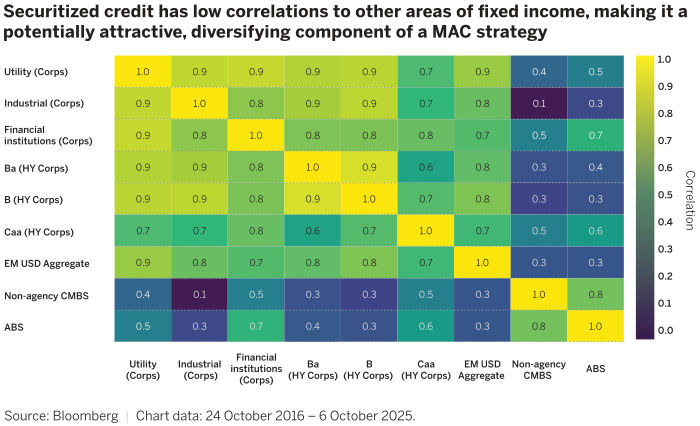
Unlike corporate credit, securitized assets’ fundamentals are tied directly to collateral performance of the underlying loans, like consumer loans or mortgages to residential homes or commercial real estate. As such, securitized credit isn’t strongly correlated to these other asset classes, and it may offer attractive diversification benefits versus pure corporate spread beta (Figure 1). Generally, the complexity premium from the breadth, fragmentation, and structural features in securitized credit means the asset class may offer better yields too over a market cycle.

Figure 1

Securitized credit has low correlations to other areas of fixed income, making it a potentially attractive, diversifying component of a MAC strategy

But the sector is not without risk. In times of market or fundamental stress, drawdowns in this space can be large, but so can recoveries. So, an active approach, accompanied by specialization, expertise, and adequate resources, is arguably essential within this space.

The K-shaped economy

Despite policy disruptions, attention-grabbing headlines (namely in AI), and mixed data signals over recent months, we believe the fundamental backdrop in the US is generally strong and will be supportive for risk asset performance. The mixed data signals point to uneven economic growth, which will be exacerbated by recent developments in the Middle East and rising energy costs. Uneven economic growth has created dispersion among sectors, industries, and companies, which, in our view, supports the case for a MAC approach in fixed income.

This type of economic backdrop can be described as “K-shaped,” meaning some parts of the economy are experiencing strong growth while others are declining (the performance of different parts of the economy diverges like the arms of the letter K). We believe this uneven growth dynamic is most acute in consumer health and the housing market ― two major risk factors for securitized credit investing.

Consumer fundamentals
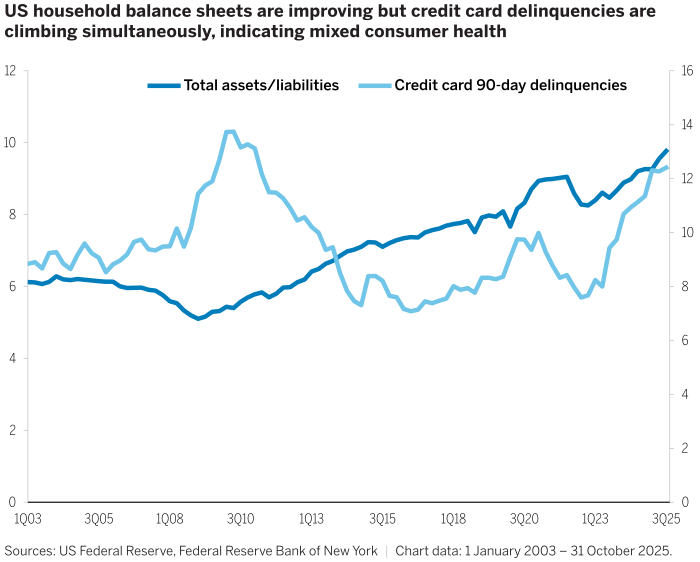
The US consumer continues to demonstrate strength, as evidenced by robust household balance sheets (debt relative to elevated levels of liquid assets) (Figure 2). In aggregate, consumer credit utilization is low relative to history. While the savings rate suggests that consumers are preparing for tougher times, We’d argue this is a false indicator because the way we capture the savings rate is fundamentally flawed in that it doesn’t include income earned from investments. This interest income shouldn’t be ignored, since both higher interest rates and the buildup of assets in money market accounts to all-time highs make this a meaningful source of support for the consumer.

However, when you look deeper at consumer health, the picture is more nuanced. Despite robust household balance sheets in aggregate, credit card delinquencies are rising, suggesting some consumers are struggling (Figure 2). Inflation is still a headwind, especially more recently. But fiscal stimulus in the form of larger tax refunds and smaller tax liabilities in the US has been a tailwind to offset rising prices at the pump. The recent rise in US asset prices (equities and homes) has supported many consumers, but those without invested savings or assets haven’t fared as well, and their credit availability might be limited ― creating dispersion in credit performance as a result.

Figure 2

US household balance sheets are improving and credit card delinquencies are climbing simultaneously, indicating mixed consumer health

Housing
As alluded to above, the US housing market tells a similar story, with homeowners faring better than non-homeowners or renters. An overwhelming majority of homeowners have experienced a tremendous amount of equity gains over the last five years (+50%) and were also shielded from much of the run up in inflation because most of the mortgage market is “locked in” to historically low 30-year fixed-rate mortgages. On the other hand, shelter inflation has been a strain on non-homeowners’ household balance sheets through higher rents and higher home prices. The increase in house prices has stretched affordability to historically low levels, all but stalling housing activity in the US. While the administration has suggested ideas to fix affordability, our belief is that more accommodative monetary policy, mortgage bond buybacks, and prohibition on institutional home ownership will only change affordability at the margin and could potentially increase home prices further as it spurs more incremental demand.

Investment implications

In general, demand for assets is high. The tremendous amount of wealth that sits in cash in US consumers’ money market accounts will eventually be moved into the market if interest rates go lower. Also, the fact that the population is skewing older suggests a potential increase in demand for bond investments. All this points to a ceiling on spread widening.

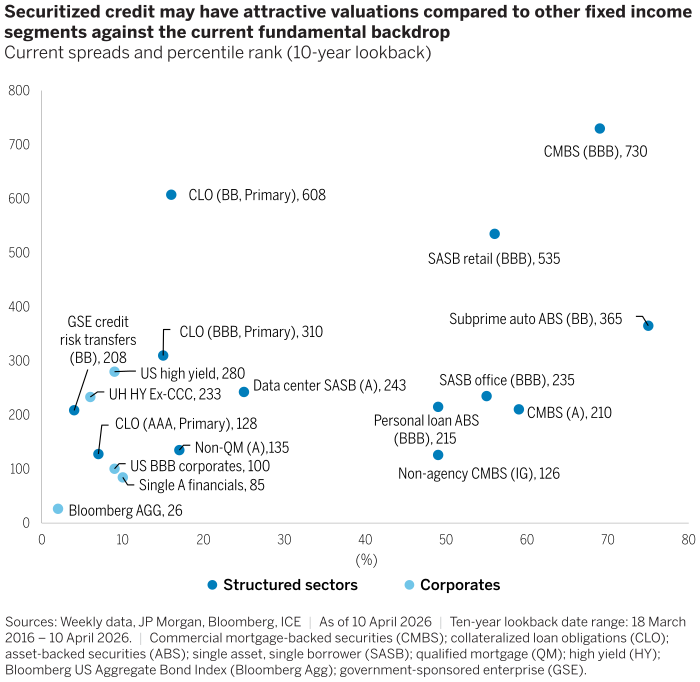
But, unlike other sectors where spread levels are as tight as they’ve ever been, there is still more room for securitized credit spread compression in 2026 (Figure 3). Securitized credit spreads are wider relative to history (on a 10-year lookback). Corporates are closer to all-time tights. And the uneven growth in the economy has created attractive opportunities to invest in specific cohorts of sectors or specific names. Given this context, investment themes we’re watching include the following:

  • With the bifurcated story in the housing market, we see a stronger case for seasoned residential mortgage credit, where strong borrower equity and structural protections may provide a meaningful cushion against downside risk.
  • In commercial real estate, it may be beneficial to express a view on a healthy consumer in areas like luxury hotels and high-quality and/or grocery-anchored retail. Trophy office properties could be a way to express a view on a fundamentally sound economy.
  • Consider exercising caution on other consumer risk collateralized by loans to lower-quality borrowers who have come under pressure.
  • There will be winners and losers in collateralized loan obligations as the K-shaped economy extends to areas of the economy impacted by AI. Spreads are starting to reflect this, but patience is warranted.

Figure 3

Securitized credit may have attractive valuations compared to other fixed income segments against the current fundamental backdrop

While valuations across many fixed income sectors have compressed, we believe the opportunity set in credit hasn’t disappeared — it’s evolved. In today’s environment, return potential is increasingly driven by dispersion across collateral types, capital structures, and borrower cohorts, rather than broad market beta.

In our view, securitized credit exemplifies this shift. Its reliance on underlying collateral, particularly consumer and housing fundamentals, creates differentiated risk and return drivers that are less correlated with traditional corporate credit. This not only provides potential diversification benefits but also opens the door to security-level opportunities that may not be reflected in index-level valuations.

Within a MAC strategy, the ability to allocate actively across sectors and lean into certain areas (like securitized credit) when relative value is compelling are key drivers of potential outperformance. As the credit cycle becomes more uneven and dislocations more episodic, we believe this flexibility, combined with deep sector expertise, will be increasingly important in delivering resilient income and risk-adjusted returns over time.

The views expressed are those of the author at the time of writing. Other teams may hold different views and make different investment decisions. The value of your investment may become worth more or less than at the time of original investment. While any third-party data used is considered reliable, its accuracy is not guaranteed. For professional, institutional or accredited investors only.

Expert

Get our latest market insights straight to your inbox.

Read more from our experts