2026 Investment Outlook

Practical portfolio considerations for a new economic age

Andrew Sharp-Paul, Solutions Director
5 min read
2026-12-31
Archived info
Archived pieces remain available on the site. Please consider the publish date while reading these older pieces.
Advised Retail multi asset

The views expressed are those of the author at the time of writing. Other teams may hold different views and make different investment decisions. The value of your investment may become worth more or less than at the time of original investment. While any third-party data used is considered reliable, its accuracy is not guaranteed. For professional, institutional, or accredited investors only.

If investors were unsure whether a new global economic regime was upon us at the beginning of 2025, we expect they’re sure now. The year saw an arguably unusual mix of strong global equity performance and uncertainty surrounding international trade policies, questions about the fiscal health of the world’s largest economy, the US, and geopolitical instability.

How do investors make sense of equity markets’ upward march against a backdrop of deglobalization, volatility, and endless chatter about AI? By tuning out the noise and focusing on fundamentals. For investors in Asia, we believe there are three ways to achieve this:

1. Consider quality equities
The landscape for equities has evolved since the early years following the global financial crisis. Then, growth was high and inflation was low. Now, we’re operating in a more volatile environment with a higher cost of capital. In this type of world, company performance is a survival-of-the-fittest endeavor.

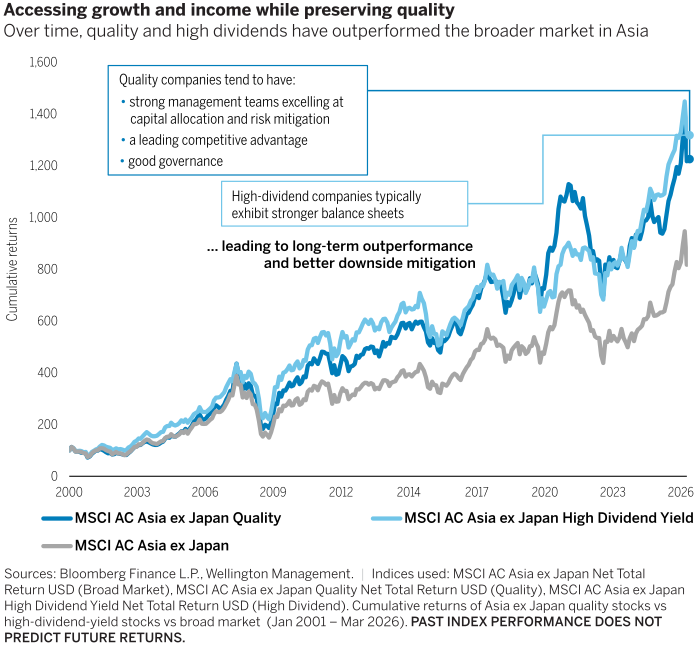
Figure 1

Line chart illustrating MSCI World Quality Index outperforming the broader MSCI All-Country World Index over time.

So, who’s the fittest? In our view, high-quality companies are most likely to deliver alpha to investors. What constitutes high quality? High return on equity, low leverage, and stable earnings, to name a few characteristics. These types of stocks tend to be more resilient during volatile markets and are capable of providing potentially compelling returns regardless of broader market performance.

Quality isn’t only helpful in navigating the changes already underway; it could also be useful in the face of future market shifts. For example, the US equity market has experienced a strong run of outperformance that shows no signs of slowing anytime soon. However, the longer this market marches on, the closer it may get to the end of its run. Should the US equity market falter, an emphasis on quality, strong stock selection, and risk management are likely to help investors weather the shift.

2. Be discerning in bonds
Fixed income faces some challenges in the current market environment but it’s still a critical component of a diversified investment portfolio. Today, it’s not about just having a bond allocation to complement equities — it’s about having a thoughtful bond allocation.

During the era of globalization, many government bonds the world over marched in comfortable lockstep. Investors could “set it and forget it” among these relatively safe-haven investments. What’s more, credit spreads broadly tightened during this period thanks to generally looser central bank policies and lower interest rates.

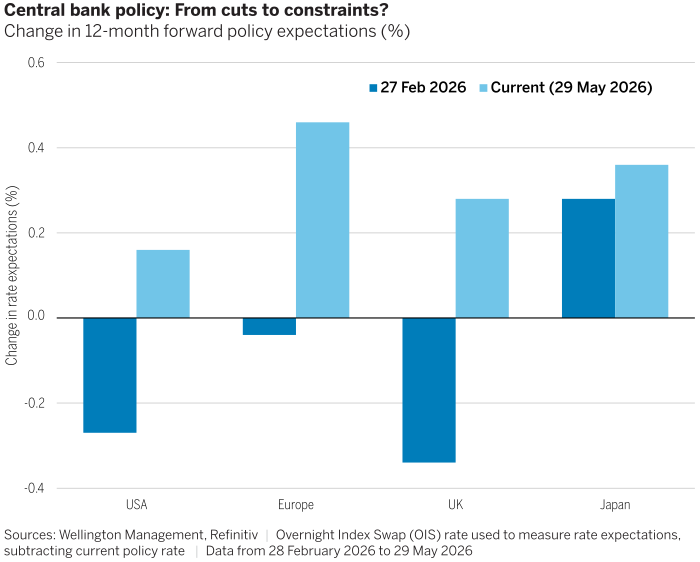
Today, deglobalization is on the upswing. Global central bank policies are increasingly divergent; the days of “easy money” in the form of low interest rates globally and one-way spread tightening may have run their course. Against this backdrop, flexibility and security selection are paramount — a dynamic that lends itself to an active approach, which is by nature more adaptable than a passive one. In an age when delivering attractive returns is likely to hinge on being selective, active managers with strong research capabilities may have an edge in seeking to capitalize on regional divergence to uncover differentiated opportunities.

This said, while we encourage investors to approach government bonds with a more critical eye than they have in the past, we don’t advocate throwing the baby out with the bathwater. In our view, plenty of government bonds remain compelling fixed income opportunities. For example, even though US Treasuries may have come under some pressure, we think the depth and liquidity of the US Treasury market makes it an enduring asset class.

On the corporate side, high yield may benefit from the same dispersion dynamics we see among government bonds across regions, sectors, and issuers. This asset class is sometimes overlooked, but we believe it offers a blend of growth potential and risk mitigation that can help investors round out their portfolios.

In all corners of the fixed income market, going forward, it’s likely to be more important than in recent history to be discerning about one’s investments.

3. In APAC, think local
APAC markets have become more stable of late, making the investment opportunity more attractive. The fundamentals of many Asia-based companies have improved in recent years and, today, the region is home to several world-class enterprises. Add to this picture improving corporate governance and attention to shareholder returns, and the investment potential only becomes more compelling, particularly within the dividend income space. As Figure 2 illustrates, dividends have played a more important role in total returns in Asian markets over time. We anticipate continued upside potential in dividend income, which is increasingly viewed as an essential component of an investment portfolio.

Figure 2

Line chart demonstrating the increasing role of dividends in total returns, with dividends representing 65% of total returns, compared to price, which represents 35% of total returns, as of month end September 2025.

What’s more, Asian credit is one of the fastest-growing segments of emerging market (EM) fixed income. Though the asset class has seen its fair share of difficulties — most recently in the form of US tariffs — we believe it has the depth and diversity necessary to become a core, stand-alone allocation in investment portfolios, especially for Asia-based investors. Historically, Asian credit has provided attractive yields for a lower-duration asset class, with better risk-adjusted outcomes over time compared to US investment-grade and broader EM investment-grade credit (Figure 3).

Figure 3

Bar chart comparing volatility and returns among Asia credit, US investment-grade corporates, and EM investment-grade credit.

Investment implications: A case for active management

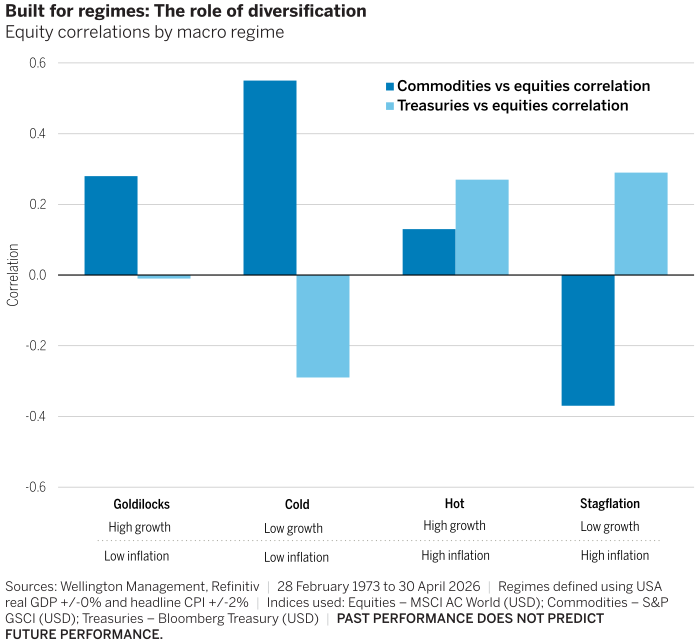
In a world marked by change and uncertainty, investors may benefit from a global and total-return mindset. We believe there’s merit in the notion of choosing growth opportunities with strong, quality fundamentals and the potential for longevity while maintaining income-generating strategies to help provide downside mitigation. The bottom line: In this new environment, it’s best to be prepared and pragmatic.

Active management could be helpful here. Active managers are more likely to have the experience, research, and flexibility necessary to differentiate between the challenges and opportunities in this market environment than passive alternatives. This may be an edge for investors seeking to capitalize on the three considerations outlined above.

Expert

Related insights

Showing of Insights Posts
Article
5 min
Archived info
Archived pieces remain available on the site. Please consider the publish date while reading these older pieces.

Private credit outlook for 2026: 5 key trends

Continue reading
event
5 min
Article
2026-12-31
Archived info
Archived pieces remain available on the site. Please consider the publish date while reading these older pieces.
Article
14 min
Archived info
Archived pieces remain available on the site. Please consider the publish date while reading these older pieces.

The rising tide of AI: How it could lift US productivity, growth, and profits

Continue reading
event
14 min
Article
2026-12-31
Archived info
Archived pieces remain available on the site. Please consider the publish date while reading these older pieces.
Article
16 min
Archived info
Archived pieces remain available on the site. Please consider the publish date while reading these older pieces.

Are hedge funds the missing ingredient?

Continue reading
event
16 min
Article
2026-12-31
Archived info
Archived pieces remain available on the site. Please consider the publish date while reading these older pieces.
Article
Archived info
Archived pieces remain available on the site. Please consider the publish date while reading these older pieces.

Opportunity ahead: Optimism or illusion?

Continue reading
event
Article
2026-11-30
Archived info
Archived pieces remain available on the site. Please consider the publish date while reading these older pieces.
Article
18 min
Archived info
Archived pieces remain available on the site. Please consider the publish date while reading these older pieces.

Monthly Market Review — October 2025

Continue reading
event
18 min
Article
2026-11-20
Archived info
Archived pieces remain available on the site. Please consider the publish date while reading these older pieces.
Video
3 min
Archived info
Archived pieces remain available on the site. Please consider the publish date while reading these older pieces.

Rapid Fire Questions with Ross Dilkes

Continue reading
event
3 min
Video
2026-11-29
Archived info
Archived pieces remain available on the site. Please consider the publish date while reading these older pieces.
Article
8 min
Archived info
Archived pieces remain available on the site. Please consider the publish date while reading these older pieces.

Investing in 2026: prepare for inflationary growth

Continue reading
event
8 min
Article
2026-11-15
Archived info
Archived pieces remain available on the site. Please consider the publish date while reading these older pieces.

Read next