FEATURED EQUITY FUNDS
FEATURED FIXED INCOME FUNDS

Asset classes

FEATURED EQUITY FUNDS
FEATURED FIXED INCOME FUNDS
Asset classes
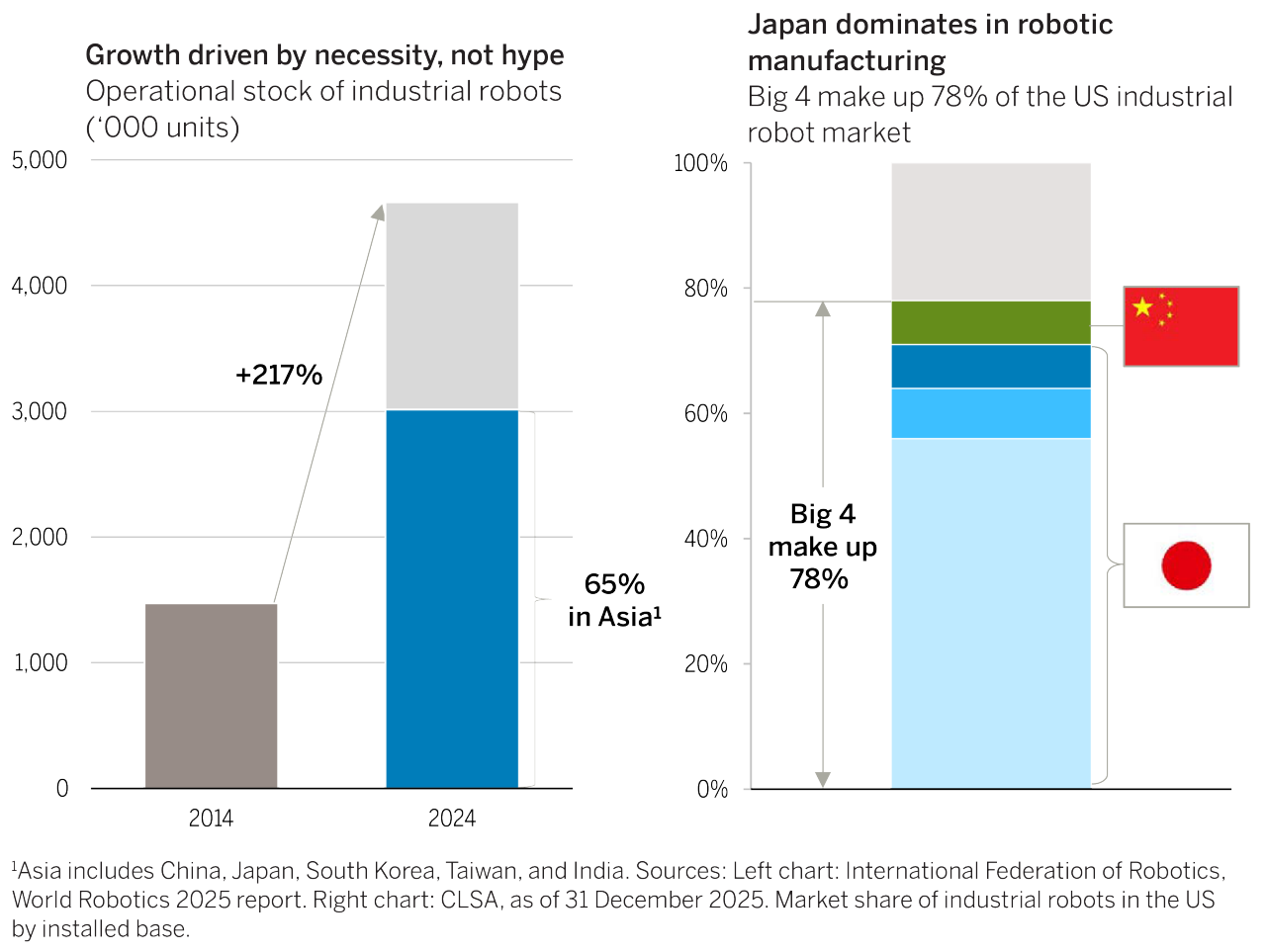
Robotics is moving from concept to necessity as manufacturers confront labor scarcity, reshoring pressure, and rising demands for precision and efficiency. Developed markets need automation to offset labor shortages and improve cost competitiveness, while China’s shrinking workforce points to rising demand for labor replacement, echoing trends already visible in South Korea and Japan. Reflecting these structural shifts, the operational stock of industrial robots has doubled over the past decade, with Asia dominating both demand and supply (Figure 1).
Figure 1
We see attractive opportunities in companies benefiting from real-world demand, evidenced by rapid revenue growth and strengthening margins. Demand for factory automation is rising across electric vehicles, electronics, and precision manufacturing, driven by supply chain localization in high-cost labor markets such as the US and by aging workforces globally.
By contrast, while humanoid robotics continues to capture headlines — and we see potential in parts of the enabling supply chain — many end applications remain early-stage, with limited visibility on scalable or profitable deployment.
Physical AI — AI applied to machines operating in real-world environments — is expanding the capabilities of automation and robotics while helping reduce costs. It enables more complex tasks, such as assembling moving parts without halting production lines, and supports the creation of digital manufacturing sites, where simulations can reduce trial periods, shorten delivery times, and improve efficiency in real-world launches. In doing so, AI adds a structural growth driver to what has historically been a cyclical industry.
Automation exhibits a favorable industry structure: high concentration, long product life cycles, high-margin service and software ecosystems. Together with high switching costs created by deep integration within factory production systems, these characteristics support durable customer relationships and help sustain margins.
Japan stands out as a key player. The country is home to multiple leaders, including within machine vision — the sensors enabling a robot to “see” and interact with the physical world. This is a critical enabling layer for robotics, quality control, traceability, and AI-enabled manufacturing. The market leader in this space benefits from accelerating revenues and gross margins that continue to rise, having been above 80% for a decade1. Improving governance and returns to shareholders provide an additional tailwind.
With structural demand accelerating and AI broadening the scope of what automation can achieve, Asia’s automation investment case is only strengthening.
1Source: Wellington Management and company financial statements as of April 2026.

The views expressed are those of the authors at the time of writing. Other teams may hold different views and make different investment decisions. The value of your investment may become worth more or less than at the time of original investment. While any third-party data used is considered reliable, its accuracy is not guaranteed.
Expert

Contributors


Related Funds

Wellington Asia Technology Fund
Asian equity fund aiming to invest in what we believe are the best-run Asian companies powering the exponential growth of the multi-year tech cycle
Past results are not necessarily indicative of future results and an investment can lose value. Funds returns are shown net of fees. Source: Wellington Management
© 2026 Morningstar, Inc. All Rights Reserved. The information contained herein: (1) is proprietary to Morningstar; (2) may not be copied or distributed; and (3) is not warranted to be accurate, complete or timely. Neither Morningstar nor its content providers are responsible for any damages or losses arising from any use of this information. The Overall Morningstar Rating for a fund is derived from a weighted average of the three, five, and ten year (if applicable) ratings, based on risk-adjusted return. Past performance is no guarantee of future results.
The content within this page is issued by Wellington Management Singapore Pte Ltd (UEN: 201415544E) (WMS). This advertisement or publication has not been reviewed by the Monetary Authority of Singapore. Information contained on this website is provided for information purposes and does not constitute financial advice or recommendation in any security including but not limited to, share in the funds and is prepared without regard to the specific objectives, financial situation or needs of any particular person.
Investment in the funds described on this website carries a substantial degree of risk and places an investor’s capital at risk. The price and value of investments is not guaranteed. The value of the shares of the funds and the income accruing to them, if any, and may fall or rise. An investor may not get back the original amount invested and an investor may lose all of their investment. Investment in the funds described on this website is not suitable for all investors. Investors should read the prospectus and the Product Highlights Sheet of the respective fund and seek financial advice before deciding whether to purchase shares in any fund. Past performance or any economic trends or forecast, are not necessarily indicative of future performance. Some of the funds described on this website may use or invest in financial derivative instruments for portfolio management and hedging purposes. Investments in the funds are subject to investment risks, including the possible loss of the principal amount invested. None of the funds listed on this website guarantees distributions and distributions may fluctuate and may be paid out of capital. Past distributions are not necessarily indicative of future trends, which may be lower. Please note that payment of distributions out of capital effectively amounts to a return or withdrawal of the principal amount invested or of net capital gains attributable to that principal amount. Actual distribution of income, net capital gains and/or capital will be at the manager’s absolute discretion. Payments on dividends may result in a reduction of NAV per share of the funds. The preceding paragraph is only applicable if the fund intends to pay dividends/ distributions. Performance with preliminary charge (sales charge) is calculated on a NAV to NAV basis, net of 5% preliminary charge (initial sales charge). Unless stated otherwise data is as at previous month end.
Subscriptions may only be made on the basis of the latest prospectus and Product Highlights Sheet, and they can be obtained from WMS or fund distributors upon request.
This material may not be reproduced or distributed, in whole or in part, without the express written consent of Wellington Management.