Luxembourg, Institutional
Change




In our view, it may be a good time to revisit the role of global government bonds in multi-asset portfolios, despite the long-running dominance of risk assets over fixed income, concerns over American fiscal sustainability, and waning US exceptionalism.
Why? High-yield bonds typically compensate investors more generously than government bonds for taking on a higher level of credit risk. Developed government bonds are traditionally presumed to have minimal credit risk, but they are subject to duration risk, and don’t historically offer the same income levels high-yield bonds are capable of. But right now, because spreads are tight, this dynamic may have leveled out. Both types of fixed income still play important roles in a portfolio, but the balance is worth examining, given current conditions.
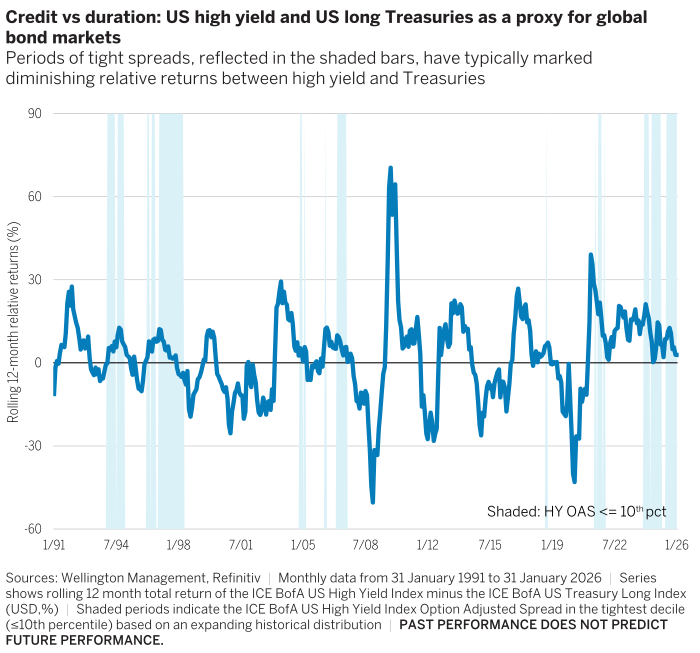
Consider the US high-yield and US long Treasury markets as a proxy for the broader, global fixed income landscape. Although high yield has outperformed Treasuries for much of the cycle, periods of historically tight spreads, like we’ve seen recently, have typically marked diminishing relative returns as spread compression is largely realized (Figure 1).
Figure 1
Plus, although inflation is higher than in the pre-COVID period, it has cooled. This, paired with higher yields, has restored Treasuries’ defensive value in growth scares and equity drawdowns, which could be useful in the current macroeconomic landscape, which is characterized by higher structural volatility than in years past.
Investment implications
What does this dynamic mean for investors?
- Consider pairing duration with other types of investments. Although lower inflation and higher yields may improve government bonds’ downside protection, reinflation risk remains. If inflation ticks up, government bonds may not be as attractive; real assets, floating-rate credit, or diversifying alpha could be useful complements.
- Be selective in fixed income, perhaps with a quality bias. High yield remains appealing for its income potential, with all-in yields still compelling relative to history. However, with spreads near historically tight levels, total return upside from further compression appears limited. So, there’s a case to be made for being judicious in fixed income, with a bias toward quality.
- Pursue downside protection. While we remain constructive on equities, today’s valuation landscape is demanding. Prudent investors may aim to incorporate strong potential downside protection in their portfolios and developed government bonds may fit the bill.
What we’re watching
We’re keeping an eye on a few market dynamics that could shift this outlook.
- Inflation drivers. Things like tariffs, energy prices, and labor costs could alter the inflation outlook, which weighs on the effectiveness of duration as a diversifier.
- Fiscal sustainability and term-premium pressures. Persistent deficits and rising debt supply test confidence in developed market sovereign markets. To this point, these concerns haven’t affected government bonds yet, but should that change, the environment would be less supportive of the asset class.
- Credit supply and demand. Elevated corporate issuance from AI demand could be a catalyst for spread widening and potential headwind for credit.
The bottom line: We believe it may be an opportune moment for investors to reexamine their fixed income allocations and consider the role of government bonds.
The views expressed are those of the authors at the time of writing. Other teams may hold different views and make different investment decisions. The value of your investment may become worth more or less than at the time of original investment. While any third-party data used is considered reliable, its accuracy is not guaranteed. For professional, institutional or accredited investors only.