


- Fixed Income Portfolio Manager
Luxembourg, Institutional
ChangeThe views expressed are those of the authors at the time of writing. Other teams may hold different views and make different investment decisions. The value of your investment may become worth more or less than at the time of original investment. While any third-party data used is considered reliable, its accuracy is not guaranteed. For professional, institutional, or accredited investors only.
This is an excerpt from our Investment Outlook, in which specialists from across our investment platform share insights on the economic and market forces that we expect to influence portfolios.
Credit investors face a conundrum. On the one hand, the backdrop for credit remains attractive thanks to fiscal tailwinds, accommodative central bank policy and strong demand for the asset class. A surge in AI investment could support continued economic growth, while stubborn inflation is likely to limit policymakers’ ability to cut rates further, keeping yields relatively high in 2026.
On the flip side, valuations across most sectors are now rich, and volatility is conspicuously low. Credit remains vulnerable to potential repricing. And while investors are still being handsomely rewarded for holding credit, the easy opportunities have largely been captured. The beta wave has been ridden.
We expect 2026 to be another year of overall positive total returns but the conundrum is real. Optimising exposure to the asset class amid potentially major shifts will, in our view, involve greater selectivity and discipline. In the sections that follow, we outline the key forces shaping a rapidly changing opportunity set and share our approach to portfolio positioning for the year ahead.
As the cycle matures, the nuances of corporate behaviour and balance sheet discipline become even more important. Robust balance sheets and easy access to capital may increasingly tempt management teams to adopt more aggressive capital allocation techniques, be it through M&A, buybacks or higher gearing, in turn driving greater bond issuance as companies seek to finance transactions.
We are closely monitoring the potential for more aggressive balance sheet management, particularly among higher-quality issuers. At tight valuations, we are comfortable reducing exposure to these issuers, with a view to adding at more attractive entry points.
Rising dispersion across sectors and regions also underscores the importance of security selection in this environment. We think deep, fundamental research and a disciplined approach will be essential to protect capital and capture relative value as the cycle evolves.
The surge in AI-driven capital expenditure is not only transforming the real economy but also reshaping the global credit landscape. We are witnessing a meaningful deepening of credit markets, with new issuers and innovative financing structures. The composition of the universe is evolving rapidly, as public and private credit increasingly shoulder the burden of financing large-scale infrastructure and technology investments. This trend is blurring the lines between corporate and project finance and introducing new complexities for credit analysis.
These developments undoubtedly bring new risks, such as the lack of clarity on the durability of AI-related investments and the many challenges associated with novel deal structures. However, they also create a broader and richer opportunity set for active, research-driven investors who have the cross-asset-class expertise to decipher this growing bond complexity and identify which projects and issuers are likely to deliver sustainable cash flows and which may struggle as the cycle evolves.
Investment-grade (IG) markets have been a key source of funding to date, with global convertible bonds and private credit serving as the two other main avenues. By contrast, AI issuance in the US high-yield market stands at only roughly 2% and we are currently cautious on many of those issuers as we believe that the rapid build-up in capacity could lead to oversupply, downgrades and, potentially, defaults. For both investment-grade and high-yield investors, such a wave of fallen angels could ultimately provide an opportunity for alpha generation through careful security selection.
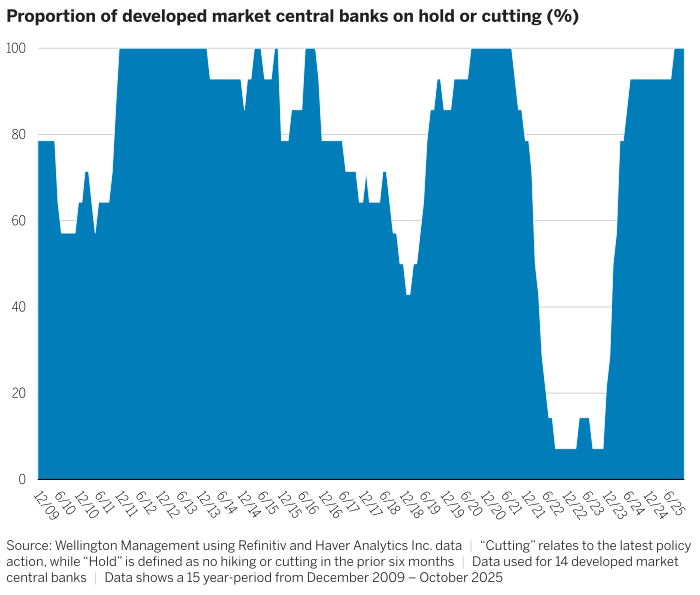
The interplay between the economic and credit cycles is set to define the year ahead. While we are not yet calling a turn in the credit cycle, diverging monetary policy paths, fiscal sustainability concerns and a renewed focus on lending standards all have the potential to trigger pockets of volatility and repricing in public credit markets. Central banks may turn out to be a key source of volatility. As Figure 1 highlights, the number of global rate cuts has already been exceptionally high, and if policymakers reduce rates further despite persistent inflation and strong nominal growth, we could see abrupt market repricing as investors demand higher risk premia.
Figure 1
Given these risks to the economic cycle, we acknowledge that certain areas of the credit market offer limited compensation. For example, we continue to observe a lack of dispersion in the pricing of cyclical versus non-cyclical issuers. With minimal-to-no spread give-up, we have rotated portfolios into areas of the market where we hold higher conviction. Within IG portfolios, we continue to favour sectors and issuers with resilient fundamentals and identifiable positive catalysts, such as European REITs, select utilities and the large “money-centre” banks. Within high-yield portfolios, we remain positive on issuers with strong competitive barriers to entry, in sectors and countries where we do not see an increased risk of defaults, such as packaging companies and software service providers.
For investors, vigilance will be key — not just in monitoring the top-down macro backdrop, but also in understanding how these forces filter through to credit fundamentals and financial conditions. Flexibility and readiness to adjust exposures quickly will be essential to charting periods of dislocation and capturing emerging opportunities.
We believe the 2026 credit market will reward patience, precision and a sceptical eye. While broad valuations may on the face of it seem less compelling, disciplined research continues to reveal attractive opportunities. Structural tailwinds should keep the environment relatively stable, while AI-related financing is broadening the opportunity set, but stretched valuations and macro uncertainty demand discipline and caution. We enter 2026 with a clear focus: to seek out durable value, manage risk with care and remain agile as the cycle unfolds.
Experts


Related funds

Euro Credit ESG Fund
An actively managed euro corporate bond fund with a repeatable ESG framework.
Euro High Yield Bond Fund
Fixed income fund investing primarily in Euro-denominated high-yield bonds, seeking investment opportunities in out-of-favour areas of the market.