



- Investment Director
Latin America, Intermediary
Change
Historically, access to the private companies driving innovation like AI, cybersecurity, automation, and blockchain has been limited primarily to institutions. Today, this is changing. Evolution in vehicles such as evergreen funds and the growth of a more robust secondaries market are reshaping the venture capital (VC) and growth equity landscape, which has come to represent about 20% of the broader private equity ecosystem.1 These developments are opening the door to fresh approaches in private equity that expand access to today’s innovators and offer investors new opportunities for long-term return generation and portfolio diversification.
This piece examines how private companies, fundraising, and asset owners are evolving amid this rapid growth and explains how evergreen funds in VC and growth equity could represent the next evolution in the space.
As private capital has become more plentiful, the timing and scale of companies transitioning from private to public has changed, creating meaningful ripple effects in both public and private markets.
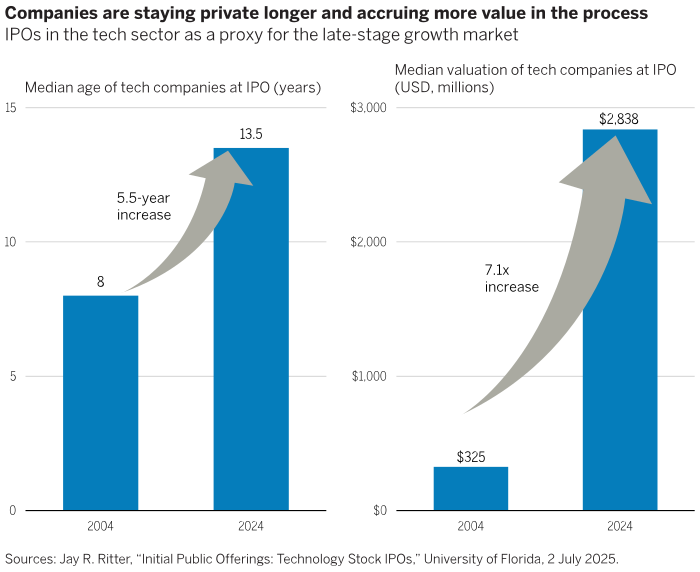
First, companies are staying private for longer. The median time from first funding to initial public offering (IPO) has increased, from roughly 5.5 years in 2016 to 7.5 in 2024.2 Why? With more capital available in the growth equity market, companies now have the flexibility to delay listing (perhaps even indefinitely). Today there are three private companies with an enterprise value of more than US$100 billion,3 and many more showing the potential for similar mega-cap valuations. In the past, businesses of this scale would have opted to list publicly long before they reached these valuations. Today, they may not have to.
Second, companies are entering the public market differently than they have in the past (Figure 1). In part because they are staying private longer, companies are often larger when they enter the public market. Because of this shift, newly minted public companies are also usually slower growing since listing typically occurs once top-line growth has moderated and the companies have become more profitable and stable. In fact, revenue growth at the time of IPO for VC businesses in recent years has been below 10%, compared to 26% on average from 2010 – 2013.
Figure 1
This means many companies are experiencing more of their growth while still private than during the post-listing phase — an opportunity investors with access to private markets may not want to miss. And while those investors with access to private markets have historically been strictly institutional, today, a broader group comprises this category.
Following a much-hyped tech cycle in 2021, private-market valuations have reset and dynamics have shifted, particularly among the VC and growth equity spaces. Fundraising from institutional investors, such as pensions and endowments, has slowed dramatically because many are at or above their target allocations to the asset class. A severe drought in exits across private markets exacerbated this issue, as did a multiyear slowdown in IPOs from 2022 until recently. It’s worth noting that we’re optimistic about the recent uptick in IPO activity and hopeful it’s only going to pick up further. As a result, fundraising in traditional channels has been difficult both for VC and growth incumbents and new entrants.
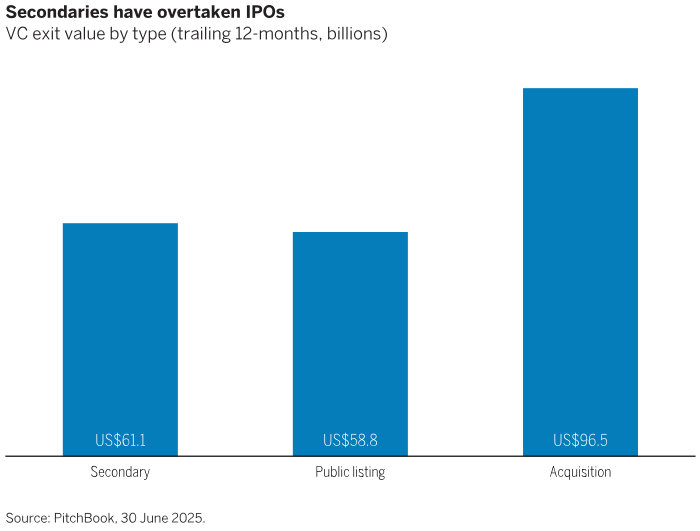
However, these challenges have created unique opportunities. Valuations have come back down to earth from the irrationally elevated levels of 2021 (with the notable exception of AI), and many growth businesses are starved for capital. At the same time, allocators and general partners, badly in need of distributions from their private-market investments, have looked increasingly to the secondary market to offload individual assets or fund stakes. In fact, US VC secondaries recently beat IPO exits for the first time driven by private-first strategies, tenders, and SPV growth (Figure 2). This combination of more attractive entry valuation rounds for direct company investments and a higher volume of secondary selling creates opportunities for flexible pools of capital.
Figure 2
Amid the changes to the journey from private to public and the evolving fundraising environment, another private-market trend is making headlines: the rise of evergreen funds.
Evergreen funds, which first emerged more than a decade ago in the US, are a type of open-ended mutual fund offering individual investors — not just institutions — access to private markets. They are perpetual, meaning they have no fixed end date, and capital is immediately invested at the current net asset value. Evergreen funds also tend to have lower investment minimums, simpler tax reporting, higher levels of diversification, and more control over liquidity than traditional private partnerships, removing many of the inconveniences typically associated with accessing private markets.
In our view, evergreen funds are likely to become more popular in the coming years given the scale of the private wealth market. In fact, as of year-end 2024, there were US$427 billion in wealth-focused evergreen funds, a figure that’s projected to swell to more than US$1 trillion by the end of the decade.4 Asset managers fundraising for private investments are now more likely than ever to turn to this audience, who is just beginning to invest in private markets, particularly as traditional sources of capital in the institutional market remain constrained and overallocated.
Though these vehicles aren’t new, they have historically focused on real estate and private credit. As they increasingly provide access to a broader swath of the private investment universe, we see greater potential uptake across the diverse wealth channel. This may be especially true of the VC and growth equity spaces, which are underrepresented and overlooked in today’s private-market evergreen fund landscape. Although venture and growth represent about 20% of the private equity market, they represent only 0.3% of wealth-focused private-market evergreens. 5
We believe the convergence of these trends will likely bolster the case for accessing VC and growth equity private markets through evergreen funds. We’d even go so far as to say that given the growing importance of this ecosystem and a trend toward specialization in the wealth market, the continued expansion of evergreen funds into the VC and growth equity spaces appears to be a natural next step. This evolution comes at an interesting point in time in the aftermath of the 2022 market reset, with a broad opportunity set in VC and growth across both direct company investments and secondaries, many at more attractive valuations. In our view, this creates a compelling opportunity for an expanding set of asset owners to access this important segment of private markets.
1 Preqin, “Preqin Benchmarks: Private Markets Performance Data Q1 2025,” 31 December 2024. | 2 CBI Insights, “State of Venture,” 31 December 2024. | 3 Ibid. | 4 Pitchbook, “2029 Private Market Horizons,” 1 May 2025. | 5 CBI Insights, “State of Venture,” 31 December 2024.
The views expressed are those of the author at the time of writing. Other teams may hold different views and make different investment decisions. The value of your investment may become worth more or less than at the time of original investment. While any third-party data used is considered reliable, its accuracy is not guaranteed. For professional, institutional or accredited investors only.
Experts