During the past decade, private equity secondary transactions, or the transfer of a private equity commitment from one investor to another, have become more popular, to the potential benefit of investors and fund managers alike.
We view this as a boon to the private-market ecosystem for two reasons:
- Firms investing in secondaries can help provide liquidity to private-market fund investors, or limited partners (LPs).
- They can also provide capital to private-market fund managers, or general partners (GPs), seeking to maximize asset value.
In this piece, we explore these two critical functions and unpack the potential benefits of secondaries investment, which can be useful across asset classes, but may be particularly valuable in the venture and growth space.
Secondaries as a growing liquidity solution
Secondaries can be a useful infusion of liquidity in private markets, an otherwise relatively illiquid area of the market. In fact, while private funds have several potential advantages over their public counterparts (including higher return potential with lower volatility1), for many, the primary drawback is their illiquidity.
Closed-end private funds, which account for the majority of the private fund universe, don’t have a liquidity mechanism. Unlike in public markets, in this space, there’s no organized exchange where one investor can transfer an interest in a fund to another investor.
LPs typically enter private fund commitments with the intent to stay invested for an extended period of time. This is usually a condition of committing to the fund. However, there are several reasons an LP might want to exit earlier — portfolio rebalancing, regulatory changes, liquidity pressures. This can create a problem because if an LP would like to exit their interest, they must find a replacement LP to assume their commitment.
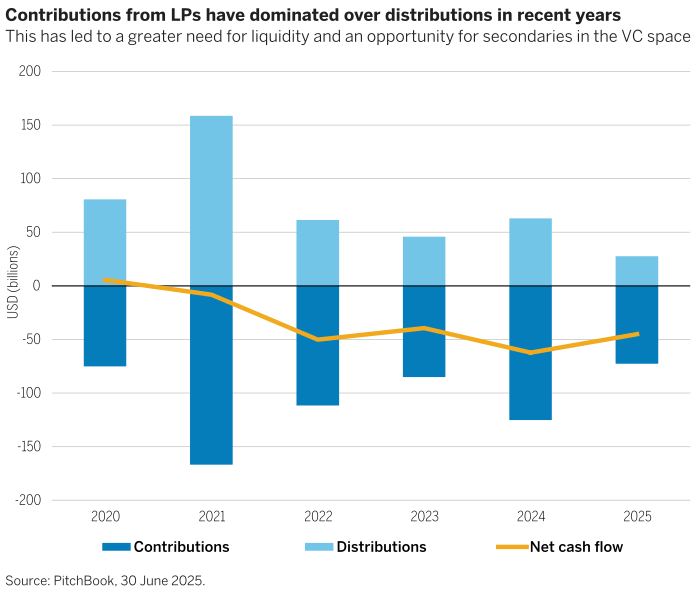
Secondary investors may represent a solution. In the absence of an open market exchange typically found with publicly traded securities, these secondary investors can negotiate and transact with the LP seeking liquidity by purchasing the commitment to the private fund in exchange for cash. What’s more, within the VC space, in recent years, there’s been a dearth of exits. This has led to contributions from LPs meaningfully outweighing distributions to LPs. Secondaries could provide the liquidity this space lacks (Figure 1).