Denmark, Intermediary
Change




The IPO market is showing early signs of strong issuance in 2026, but the activity is being driven by a small number of the largest and most mature private companies rather than by broad issuance. We believe this handful of scaled, AI-driven businesses preparing to access public markets represent more than individual liquidity events. In our view, they may act as catalysts for distributed paid-in capital (DPI), public-market sector formation, and IPO decision making for the next round of late-stage private companies.
The key question is whether these IPOs are outliers or if they can restore confidence and capital flow across the broader venture ecosystem. In this piece, we explore the latter scenario, diving into the three domains outlined above.
Why this next wave of IPOs matters beyond valuation
Based on current estimates, just the three largest private companies publicly planning for IPO in 2026 seem poised to introduce close to US$4 trillion in incremental public market capitalization.1 Critically, their current ownership is concentrated among venture and growth investors, positioning these IPOs as meaningful liquidity events for both segments of the private market. After all, while founders remain sizeable shareholders and there is other dilution from corporate investors in some instances, that US$4 trillion represents more than 15x the venture capital invested in these companies.2 After a prolonged period of limited distributions, even partial realizations could improve LP confidence, support fundraising cycles, and reset expectations around exit timing.
In our view, these IPOs are therefore best understood as system-level liquidity events, not simply pricing milestones for these individual companies. DPI has been the missing link in the broader venture recovery (Figure 1), despite continued growth in reported valuations.
Figure 1
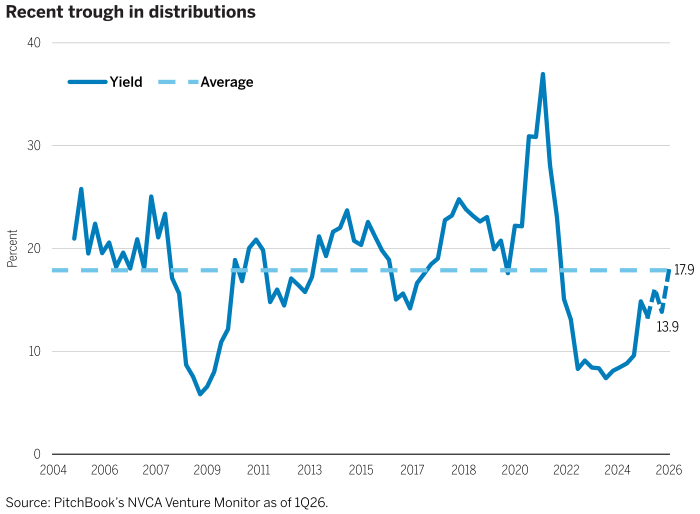
These events could provide a pathway to convert unrealized gains into cash distributions and thereby drive:
- Increased LP willingness to recommit capital
- Reduced dependence on secondary liquidity solutions
- Greater flexibility in exit pacing for GPs
Notably, realized DPI depends not just on initial issuance but on post-IPO execution, lockups, and market absorption. Below, we outline why we’re optimistic about these factors. Overall, we think this limited number of large exits has the potential to have an outsized impact on capital recycling.
Public markets are structurally underweight pure AI and high growth
In our view, these listings are likely to have an equivalently large effect on public markets. Public equity markets have limited exposure to scaled, pure-play AI businesses, particularly those with direct revenue exposure to AI adoption. Many of the fastest-growing companies have remained private longer than in prior cycles, creating a gap between private market innovation and public market access. This has resulted in both persistent demand from public investors for high-growth assets as well as a potential willingness to absorb large, complex IPOs. This next wave of IPOs could help establish a distinct AI segment within public markets and enable more precise thematic allocations across the AI value chain. We expect that these IPOs could therefore see persistent demand driven by this structural underexposure to AI growth, rather than short-term market conditions.
These potential listings may also benefit from structural factors, including early index eligibility and benchmark inclusion, the corresponding passive investment flows tied to major indices, and limited initial float relative to demand. Those dynamics can support early trading stability, increase liquidity and visibility, and accelerate institutional participation.
Critically, these technical factors may influence short-term outcomes, while longer-term performance remains dependent on each company’s distinct fundamentals.
Implications for IPO decision making
The next potential tier of companies, expected to enter the market with the US$5 billion to US$75 billion valuation range, will likely depend on aftermarket performance of these early IPOs, stability in valuation expectations, and sustained investor demand. In our view, strong early outcomes would provide top-down support for broader issuance, but weak outcomes could reinforce the need for selectivity and delay pipelines.
This initial wave will likely set the conditions for public market access. In our view, there are a few key takeaways for companies, GPs, and LPs from today’s environment regardless:
For companies:
- Continued emphasis on scale, durability, and public market readiness
- Increased use of dual-track IPO and M&A strategies
For GPs:
- More selective approach to exit timing
- Ongoing reassessment of public versus private liquidity options
For LPs:
- Improved visibility on liquidity timelines
- The need to distinguish between IPO activity and realized DPI
Bottom line on today’s IPO market inflection
The IPO market seems ready to reopen, but through a narrow group of large, high-quality private companies aligned primarily with the AI megatrend. These transactions are likely to influence liquidity, capital recycling, and public market structure more than headline valuations alone. The critical test is whether this cohort can restore confidence and enable a broader set of companies to access public markets over time.
At the same time, we believe venture capital and growth equity exposure will still be important for allocators hoping to benefit not just from this first wave of AI innovation, but from future waves as well.
1Based on the aggregate expected market capitalization of the top three largest private companies anticipated to IPO in 2026. Based on Wellington analysis as of April 2026. | 2Calculated dividing the aggregate expected market capitalization of the top three largest private companies anticipated to IPO in 2026 by their aggregate venture capital invested. Based on PitchBook data as of April 2026.
The views expressed are those of the authors at the time of writing. Other teams may hold different views and make different investment decisions. The value of your investment may become worth more or less than at the time of original investment. While any third-party data used is considered reliable, its accuracy is not guaranteed. For professional, institutional or accredited investors only.
Experts

- Head of Late-Stage Growth

- Investment Director, Private Investment Capital Formation