Denmark, Institutional

Changechevron_right
menu
search

Reinforcing core equity: The fundamental third pillar

5 min read
2027-03-31
Archived info
Archived pieces remain available on the site. Please consider the publish date while reading these older pieces.
1441911601
Andrew Sharp-Paul, Solutions Director, APAC
1441911601

Allocators are rethinking their core equity exposure. In the years following the global financial crisis (GFC), a powerful tailwind from falling discount rates and rising equity multiples meant beta did most of the work. It was enough to lean largely on passive strategies, with some quantitative strategies also playing an essential role in the pursuit of scalable alpha. But regime shifts, index concentration, macro volatility and bouts of factor stress have exposed the limits of relying only on passive and quantitative approaches for core equity risk, and many asset owners are shifting from asking how much active risk to take to asking what kind of active risk they want – and who controls it.

This is the context for what we believe should be a more deliberate, three-pillar approach to core equity: keep beta efficient, source alpha from multiple engines, and design the mix to behave well through different market and alpha environments. The first pillar is efficient beta: broad, cost-efficient market exposure. The second pillar is quantitative equity: scalable systematic breadth. And the third pillar, in our view, should be a redesigned fundamental approach that we refer to as disciplined fundamental core.

As we explain in this paper, we define disciplined fundamental core strategies as having market-like beta (≈1.0), modest tracking error (<4% p.a.), and high idiosyncratic alpha (>70%). If designed and managed skillfully, we think disciplined fundamental core strategies can deliver bottom-up, explainable stock selection within a disciplined risk profile, and serve as an effective complement to passive efficiency and quant breadth. Importantly, when quant and disciplined fundamental are combined – even in a simple 50/50 blend – we believe allocators can materially improve the left-tail and overall portfolio efficiency without changing the core risk focus (market-like beta and a tight tracking-error budget).

Pillar 1: The rise of passive: Structural appeal through simplicity

Passive investing has transformed core equity. It remains structurally attractive because it:

  • Delivers broad market exposure efficiently and quickly.
  • Has been, and may continue to be, rewarded in a post-GFC regime as falling market breadth and an extended cycle has challenged some active managers.
  • Simplifies oversight, with fewer manager decisions, transparent exposures, and low headline fees.

But passive is not always risk-free. Certain implementation techniques (sampling/optimisation) can create non-trivial tracking differences, and market-cap weighting can concentrate exposure in the market’s winners – amplifying momentum, valuation, and thematic concentration. Passive follows leadership until it changes; it does not re-balance away from crowded outcomes on its own.

Pillar 2: The quantitative role: Breadth and risk discipline

Quantitative equity has become a natural core complement to passive.

Quant can be highly scalable and customisable for allocator constraints. It tends to be valued because it offers:

  • Systematic breadth: diversified alpha across many signals, stocks, and sectors/regions.
  • Portfolio risk control: explicit constraints, repeatability, and disciplined implementation.
  • Participation in supportive environments: the ability to harvest small edges efficiently when signals work.

Like any style, quant can face periods of headwind when common exposures are crowded or when historical relationships are disrupted. That is not unique to systematic strategies – discretionary portfolios can crowd into similar factor and positioning risks as well. The practical lesson is not to replace quant, but to embrace its role and pair it with a genuinely different alpha engine.

Pillar 3: Enter disciplined fundamental core: Intentional idiosyncratic risk

For many allocators, traditional "core" fundamental strategies have been an uneven building block. Common pain points include:

  • Style and factor drift (cyclical behaviour that surprises when a strategy is expected to be neutral).
  • Tracking risk that moves outside the range assumed in portfolio construction.
  • Rigid structures that make benchmark alignment, exclusions, and risk objectives hard to implement.
  • The potential to take the “wrong kind” of uncompensated risk (e.g., underweight mega cap names) rather than risk that is associated with the manager’s edge (or compensated risk).

Disciplined fundamental core strategies address these issues by starting with the core mandate - benchmark alignment and risk profile – and then harvesting stock-specific alpha inside that frame. The defining characteristics are consistent with a true core building block:

  • Market-like beta (approximately 1.0).
  • Modest tracking error (typically below 4% p.a.).
  • A high share of idiosyncratic risk (predominantly stock-specific, not factor tilts).

The advantage fundamental brings is not "more active risk" – it is different active risk: bottom-up, explainable decisions that can behave differently when systematic factors are under stress.

Why is this important from an allocator’s perspective? The real challenge with traditional fundamental core equity strategies has been less about sourcing alpha and more about governing how it is delivered. In many instances – particularly in open architecture allocator frameworks – three key decisions don’t always speak well to one another: security selection, portfolio construction, and allocator-level portfolio design. The investment manager naturally prioritises stock selection, with portfolio construction often treated as a secondary concern. The allocator is left with an imperfect building block and the need to optimise exposures after the fact.

A more robust model is to design alpha and risk together: draw on fundamental insights (potentially from multiple sources) while expressing them through a single, disciplined portfolio-construction framework that stays true to the benchmark and the allocator’s constraints. Where an off-the-shelf strategy achieves this, it can be a clean solution; where it doesn’t – because of customisation needs, capacity, or cost – an integrated, tailored implementation becomes the practical alternative.

Practical approaches to disciplined fundamental core

Disciplined fundamental core can be implemented in several ways, depending on governance, complexity tolerance, and objectives:

  • Integrated long-only core: managed directly against the allocator’s benchmark with disciplined risk constraints and stock-specific conviction.
  • Disciplined extended core (e.g., 130/30): the same integrated process, with controlled leverage/shorting to expand the opportunity set while keeping a core footprint.
  • Portable fundamental alpha: separates alpha and beta, keeping index exposure via overlays while sourcing idiosyncratic excess returns from less efficient market segments.
  • Alpha capture: an integrated, risk-managed “best-ideas” portfolio that extracts and reassembles highest-conviction fundamental insights from multiple managers into one benchmark-aware, tightly risk-controlled (and customisable) core implementation.

Across all these options, the real differentiator is not the toolset itself but the degree of integration: how well aligned the alpha engine is with the allocator’s benchmark, exclusions, and risk budget via disciplined portfolio construction. Underpinning all of this is a focus on risk as an objective, not an outcome.

Practical advice for allocators: What changes when you blend quant and fundamental?

Analysis of the last 15 years across global equity "core" strategies reinforces a consistent result: active quant and fundamental behave like different alpha engines even inside a tight risk budget. Blending the two can improve outcomes without requiring a change in the 'core' risk label.

Key takeaways from the analysis:

  • The structural reason blending helps is genuine diversification, via low correlations and alpha behaviour, not just averaging. Three-year rolling excess-return correlations are high within style (fundamental ≈ 0.75; quant ≈ 0.93) but materially lower across styles (average fundamental-quant correlation ≈ 0.40).
  • The blend does not rely on the ability to "call" regimes. It dampens drawdowns in weak environments while still participating strongly when conditions favour a single technique.
  • The largest real-world benefit shows up in the tails: blending truncates the worst rolling periods without giving up long-run participation.
  • The outcome improves without having to take more active risk. In other words, higher-quality outcomes, not a different risk category.

Evidence in three simple exhibits (global equities):

This analysis screens the global equity strategy universe to include only those managers with an average rolling three-year tracking error of 4% p.a. or less, measured relative to the MSCI All Country World Index over the observation period. The objective is to focus on strategies operating within a clearly defined core, benchmark-aware risk budget, across both quantitative and fundamental approaches. Higher-tracking-error strategies are excluded, as they would not fit within the framework outlined in this paper.

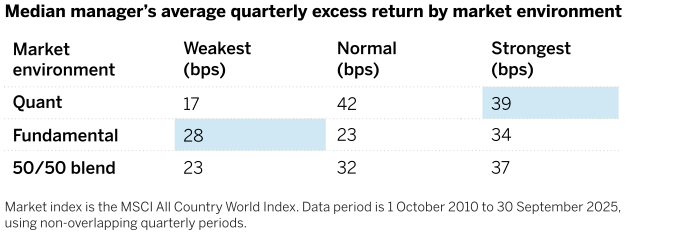
Exhibit 1 examines the alpha behaviour of these lower-tracking-error managers across different market environments, defined as weakest, normal, and strongest. Weakest markets correspond to the bottom 10% of quarterly index returns, strongest markets correspond to the top 10% of quarterly index returns, and the remaining 80% is classified as normal. Over the 15-year sample period, fundamental managers have tended to deliver more alpha during weaker market quarters (the left tail), while quantitative managers have generated stronger excess returns in normal and strong environments (the right tail). A simple 50/50 blend meaningfully narrows the dispersion of outcomes across regimes, smoothing performance through the cycle.

Exhibit 1

Table showing median manager’s average quarterly excess return by market environment

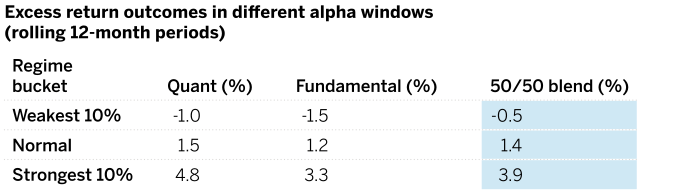
Exhibits 2 and 3 apply a different lens, analysing excess returns through style-specific alpha windows – periods when each approach has performed at its strongest and weakest. In Exhibit 2, when the median quant manager experienced its weakest decile of rolling 12-month excess return periods, the average outcome was -1.0%. For the median fundamental manager, the corresponding figure was -1.5%. The blended portfolio meaningfully improves these weakest outcomes, averaging just -0.5%, while still retaining substantial participation in the strongest environments – without requiring any forecasting of future regimes.

Exhibit 2

Table showing rolling 12-month excess return outcomes in different alpha windows for each style

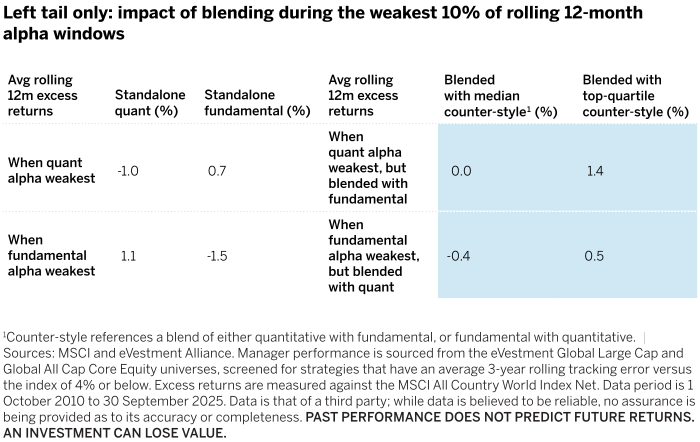
Exhibit 3 focuses explicitly on the left tail. When quant has experienced its weakest excess return periods, fundamental managers have typically delivered positive alpha, and vice versa. This asymmetric behaviour highlights a key result: the diversification benefit of integration is most powerful in stress environments. Blending quant and fundamental approaches can materially truncate prolonged periods of weak excess returns (“excess-return winters”), with strong manager selection further amplifying this effect.

Exhibit 3

Table showing left tail only - impact of blending during the weakest 10% of rolling 12-month alpha windows

Portfolio construction: Blending the three pillars.

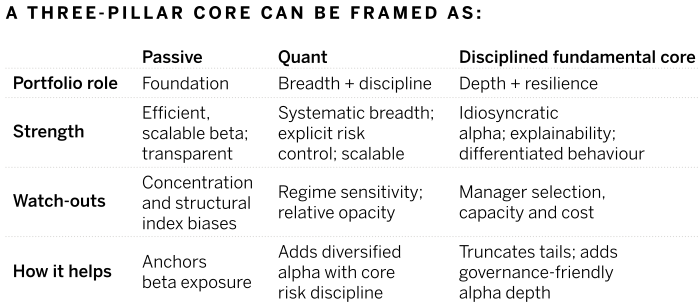
A resilient core equity programme is not a binary choice between passive and active. It is a design problem: what exposures do you want, how should they behave, and what do you want to happen in the tails? The analysis above used a simple 50/50 split between quant and fundamental but the precise exposures for each allocator will depend on multiple factors. However, even at different weights, the benefit of blending persists.

Table showing potential strengths, benefits and weaknesses for each of the three pillars

Blending these pillars creates diversification across types of active risk, not just amounts of active risk. The objective is precision: aligning each source of risk with a clear purpose – and improving the payoff shape without drifting away from a core mandate.

The three-pillar advantage

As the opportunity set broadens and outcomes diverge across companies, the case for a more intentional core equity design becomes stronger. Within a disciplined risk budget, portfolios can benefit from combining the efficiency of passive with complementary alpha engines. Quant brings systematic breadth and portfolio risk control; redesigned fundamental brings idiosyncratic depth and resilience. Together – even in a simple 50/50 blend – they can meaningfully improve left-tail outcomes and overall consistency while preserving the defining characteristics of a core allocation.

1Counter-style references a blend of either quantitative with fundamental, or fundamental with quantitative.

The views expressed are those of the author at the time of writing. Other teams may hold different views and make different investment decisions. The value of your investment may become worth more or less than at the time of original investment. While any third-party data used is considered reliable, its accuracy is not guaranteed. For professional, institutional or accredited investors only.

Expert

Get our latest market insights straight to your inbox.

Read more from our experts