Denmark, Institutional

Changechevron_right
menu
search

INSURANCE ASSET ALLOCATION OUTLOOK: Q2 2026

Focus on flexibility, selectivity, and income

13 min read
2027-05-31
Archived info
Archived pieces remain available on the site. Please consider the publish date while reading these older pieces.
Multiple authors
multi asset outlook

Key points:

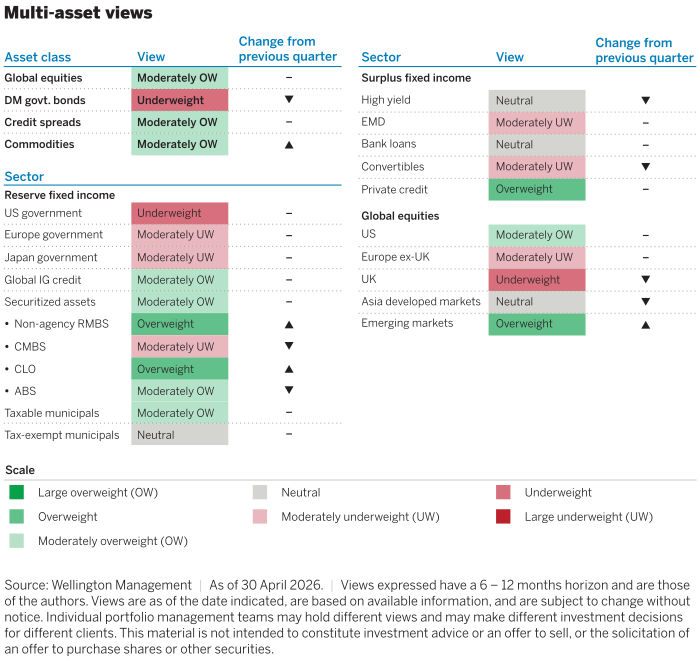
  • We continue to expect a late-cycle but resilient US economic expansion. Inflation dynamics are still challenging but contained. Beyond the near-term cycle, AI and productivity remain critical medium-term supports.
  • We believe insurers should remain selectively risk-on in this late‑cycle environment.
  • In fixed income, we think portfolios should stay focused on maximizing dependable income through securitized credit and selective investment‑grade exposure, complemented by measured beta in durable sectors.
  • We have a slight overweight view on global equities given that fundamentals were strong heading into the conflict and are likely to provide some buffer.
Multi-asset views

Overview

We continue to expect a late-cycle but resilient US economic expansion, with growth slowing toward trend but remaining positive. Energy remains an important swing factor, acting as a tax on activity rather than a shock, though any geopolitical de-escalation could reduce near-term tail risks. Beneath stable headline data, the expansion shows signs of increasing fragility, with margin pressure outside the largest companies, more selective capital spending decisions, and pockets of strain in small business conditions. At the same time, AI-driven capital expenditures and ongoing labor scarcity are providing a meaningful offset, helping prevent a near-term downturn and keeping recession risk low for now.

Inflation dynamics remain challenging but contained. Core inflation has proven sticky, reflecting tight labor supply and services pressures, even as wage growth remains relatively well behaved. Against this backdrop, the US Federal Reserve remains on hold, prioritizing clearer evidence of disinflation or labor market softening before easing policy. As a result, we expect interest rates to remain largely rangebound with a modest downside bias. Meaningful declines would require either a sharper growth slowdown or more convincing progress on inflation, while upside risks are constrained unless inflation accelerates materially.

Labor market dynamics continue to play a central role in the US economic outlook. While employment growth and income gains are moderating, structural labor supply constraints persist, supporting consumption and limiting downside risks. The balance between slowing demand and tight labor availability underscores a key theme for insurers. The cycle is aging, but not yet breaking, with outcomes increasingly dependent on the duration and transmission of current pressures rather than point-in-time data releases.

Beyond the near-term cycle, AI and productivity remain critical medium-term supports. AI-related investment has become a narrow but powerful pillar for growth, helping sustain capital spending even as other areas show caution. The durability of these productivity gains, and whether capex broadens beyond AI, will be an important determinant of whether growth stabilizes or slips closer to recessionary conditions over time. For now, we think this backdrop supports a selective, income-focused approach, emphasizing resilience and flexibility rather than reliance on further valuation expansion.

Fixed income

We believe insurers should remain selectively risk-on in this late‑cycle environment. While US growth is slowing toward trend, it remains broadly positive. Therefore, we think insurers should prioritize high‑quality income while preserving flexibility to adjust risk should valuations improve.

With credit valuations broadly tight and limited scope for further spread compression, we continue to favor carry, structure, and diversification over a pure spread‑tightening bet. We think securitized assets remain well positioned to anchor portfolio income, while investment‑grade corporate exposure should be highly selective and biased toward stronger balance sheets, particularly in the front and intermediate parts of the curve.

A few sector-specific thoughts to share:

  • Corporates — We maintain a modest overweight view on financials and utilities, while keeping an underweight view on industrials. Across corporates, we prefer short to intermediate maturities that offer more attractive carry and rolldown.
  • Securitized credit — Our preferred tilts are toward CLOs, ABS, and RMBS to potentially preserve carry and lower idiosyncratic exposure amid expected increases in M&A/LBO activity.
  • High yield and bank loans — We maintain a measured and defensive posture. While fundamentals remain stable, valuations offer poor asymmetry this late in the cycle. We favor migrating up in quality, emphasizing BB exposure and securitized substitutes where possible, while remaining cautious on bank loans given increasing bifurcation and refinancing risk, particularly in software‑heavy issuers.

On a risk‑adjusted basis, return opportunities remain limited, reinforcing our preference for keeping active risk near the lower end of historical ranges. We believe this disciplined approach can continue to deliver incremental income versus benchmarks without compromising portfolio stability.

At the same time, we are mindful of downside risks. Growth is increasingly dependent on a narrow set of supports, particularly AI‑driven capital expenditures. A meaningful slowdown in this investment cycle or a sustained energy shock could weigh on margins, labor conditions, and risk sentiment, potentially leading to wider credit spreads and lower rates. In such an environment, we think a quality bias and modest duration cushion should help enhance portfolio resilience and protect capital.

Overall, we believe portfolios should remain focused on maximizing dependable income through securitized credit and selective investment‑grade exposure, complemented by measured beta in durable sectors. This balanced stance is designed to support book yield and capital efficiency while preserving flexibility to add risk should valuations become more compelling.

Investment-grade private credit

We view investment-grade private credit as an attractive allocation in the current environment, with illiquidity premiums elevated relative to history and increasing diversification in deal types as the market continues to evolve. While recent headlines have focused on risks in parts of the private credit market, we believe these pressures are concentrated in more levered, below-investment-grade segments, particularly those with greater exposure to software and more aggressive capital structures.

By contrast, investment-grade private credit is typically oriented toward higher-quality issuers with more stable cash-flow profiles, potentially offering greater downside resilience if credit conditions weaken.

Deal flow remains diversified across sectors including industrials, utilities, financials, and select areas such as infrastructure and asset-based finance, which we believe supports a broad opportunity set and allows for greater selectivity in deployment.

Equities

We began 2026 with expectations of double-digit earnings growth, a broadening economic recovery, and limited valuation downside given that central banks were easing or on hold. Then came the war in the Middle East. We see some risk that markets are not pricing in the possibility of a more prolonged conflict and its economic spillover effects. At the same time, we recognize that global markets entered the crisis with a healthy earnings buffer (quite different from the weakening in earnings leading into last year’s tariff shock) and that we could just as well see a de-escalation in the conflict. On balance, our assessment of the potential outcomes leaves us with a small overweight view on equities over a 12-month horizon.

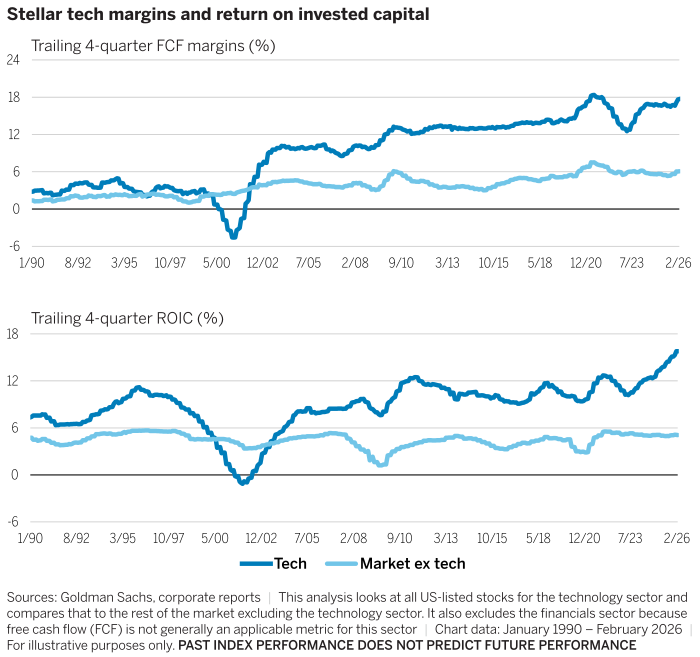
The durability of the broadening earnings picture we saw emerging last year will depend on whether input costs ramp up because of the energy shock, and whether cyclicals face meaningful demand headwinds if the cycle comes under pressure. That said, we expect earnings to remain a modest tailwind — particularly for the US and emerging markets (EMs). While higher energy costs will pressure margins in some sectors, we continue to expect a positive earnings trajectory in both regions. In the US, the AI innovation theme remains intact (Figure 1) despite some risks to the supply chain (e.g., a helium shortage). In EM, Asia plays a critical role in AI infrastructure through semiconductors and memory.

Figure 1

Stellar tech margins and return on invested capital

As we’ve seen in prior shocks, markets tend to front-load a repricing of valuations before meaningful earnings downgrades come through. Through the end of March, the decline in the 12-month forward PE on global equities was similar in magnitude to the adjustment following Liberation Day. While there may be earnings downgrades to come, the price adjustment is close to the average for conflicts historically, but not at the extremes of major energy shocks such as the Ukraine war in 2022 and the Iraq war in 1990. On the sentiment and positioning side, a fair amount of adjustment has occurred, but not a full capitulation.

Again, we are balancing out these competing elements to arrive at our slight equity overweight. Given volatility related to the conflict, we would need to see a further downside adjustment or upside catalysts relating to a resolution of the conflict before we would take a stronger overweight view.

On a regional basis, we have an overweight view on EM against the UK. Overall, AI-demand visibility remains strong through 2027, and as noted, emerging markets in Asia are critical to the AI supply chain. China’s resilience during the conflict has also stood out. The country’s energy stockpiles and diversified energy sources have helped, and there are policy levers available to help smooth any negative effects — even as recent activity data has surprised on the upside.

We have moved to a small overweight view on the US against Eurozone equities. This largely reflects a gap between relative earnings fundamentals and relative price performance, with this gap favoring the US in our view. Relative sentiment captured in investment surveys is also more positive on Europe than on the US and may be due for a reversal. Meanwhile, US mega-cap tech companies have seen a big adjustment in relative valuations, making them attractive again from a PE perspective. Both the UK and Europe ex-UK suffer from a weak earnings outlook, though the UK’s relatively high exposure to the energy sector provides some offset.

Commodities
Prior to the war, we maintained a modest underweight view on oil, but the hostilities and the surge in oil prices led to a considerable widening of possible outcomes for the asset class with the skew toward the higher end. That heightened uncertainty, combined with exceedingly high costs associated with rolling positions at the front end of the curve, rendered the risk/reward profile of our underweight view untenable, and we shifted to a neutral view.

Meanwhile, we used the recent sell-off in gold to introduce a slight overweight view. While there has been some clearing out of long positioning in gold since the war began, leaving it to behave like a risk asset, we believe the fundamental case for the precious metal, including strong long-term demand potential and diversification away from the US dollar, remains intact.

The biggest risk to our long-term bull thesis for gold is the possibility that central banks will become net sellers due to capital needs from the war. This keeps us from moving to a larger overweight view, despite the potential we see for significant excess returns relative to cash. Importantly, we’d push back against the idea that gold is an inflation hedge, as correlations here are weak or nonexistent. The primary long-term relationships are negative correlations to the US dollar and real yields. We don’t see significant upside emerging in either, but a fundamental reengagement with a bull case in the dollar is an additional risk.

Regulatory developments
In the US, as part of the ongoing CLO C-1 factor modeling project, the NAIC’s Risk-Based Capital Investment Risk and Evaluation Working Group conducted a conference call on April 10 for the American Academy of Actuaries to present their analysis on the residual. Their analysis showed that while the losses vary depending on the accounting methodology used (the allowable earned yield (AEY) method or a practical expedient method), they have not found support to change the RBC factor for like insurers from the current 45%. As of this writing, their analysis was scheduled to be exposed for public comment and further discussed on May 6.

For the debt tranches, final factors are still expected to be available later this quarter, absent any significant change requests from the regulators. We believe the end state of this study will result in very modest capital charges for senior-most tranches and increases in capital charges for thinner mezzanine tranches. This reflects cliff risk for those tranches during correlated default and loss periods.

In Europe, the European Commission published Commission Delegated Regulation (EU) 2026/269 in the Official Journal on 18 February 2026, amending Delegated Regulation (EU) 2015/35. While the substance of these changes had already been developed and agreed as part of the Solvency II Review in 2024 – 2025, this publication marks the point at which the updates become final and legally binding. The regulation includes revisions across a wide range of areas, including adjustments to spread risk calibrations for securitizations (both STS and non-STS), a reduction in the correlation between spread risk and interest-rate risk within the SCR market-risk module, updates to the interest-rate risk model, and changes to the volatility adjustment, among other modifications. Most of these changes are expected to apply from January 2027, following the agreed implementation timeline.

The views expressed are those of the authors at the time of writing. Other teams may hold different views and make different investment decisions. The value of your investment may become worth more or less than at the time of original investment. While any third-party data used is considered reliable, its accuracy is not guaranteed. For professional, institutional or accredited investors only.

Experts

Get our latest market insights straight to your inbox.

Read more from our experts