


- Director of Value Creation
Denmark, Institutional
ChangeThe views expressed are those of the authors at the time of writing. Other teams may hold different views and make different investment decisions. The value of your investment may become worth more or less than at the time of original investment. While any third-party data used is considered reliable, its accuracy is not guaranteed. For professional, institutional, or accredited investors only.
This is an introduction to our Private Investments Value Creation Team’s Human Capital Management (HCM) Toolkit, which is exclusively available to our portfolio companies.
2025’s “job hugging” replaced “quiet quitting” on the long list of job market buzz phrases in recent years. Despite the cozy name, this trend reflects employees feeling stuck in their current roles in today’s slowing labor market, which is driving down productivity at the expense of employers. In fact, global employee engagement saw the largest year-over-year decline since the COVID-19 lockdowns, falling to 21%.1
Critically, this backdrop of declining engagement and rising burnout is combining with the perhaps surprising fact that the competition for top talent remains as challenging as ever. In 2025, roughly 45% of job seekers still received multiple job offers in 2025, over one-third backed out of previously accepted offers,2 and 17% of new hires left their role within the first year.3
While the overall labor market softened in 2025, almost two-thirds of HR leaders say they expect competition for top talent to increase in the face of factors like federal tariff policies and rising economic uncertainty.2
The enduring complexity of hiring and retaining the best talent (even in today’s cooled market) is why strategic human capital management is essential for private companies in every environment.
In this paper, we explore why we think it matters for private companies and offer four focus areas that can help portfolio companies navigate evolving employee needs, regulatory changes, and investor expectations in their effort to optimally manage human capital.
Human capital is a key lever for private companies seeking an edge amidst ever-increasing competition and uncertainty. Since 2018, the number of private equity-owned portfolio companies with a Chief Human Resources Officer (or a similarly formal HR partner) has risen from near zero to over 50%. In the same period, involuntary CEO turnover declined by almost 20%. Importantly, companies with formal HR leadership are ~1.75 times more likely to assess their senior talent development capabilities as excellent.4
Retention can have a big impact on the bottom line as companies spend 50% – 200% of an employee’s annual salary replacing them,5 with technical roles (a common need for many private companies) skewing to the high end of that scale. In addition, private companies often have fewer employees, meaning a higher percentage of projects, customers, and colleagues may be directly impacted by individual departures. For private companies seeking to reduce burn rates and maintain steady growth, these replacement costs can be an outsized burden compared to public-market peers.
Private companies with robust HCM practices may also be better prepared to meet institutional investor expectations as they enter the public markets. Though total HCM-related shareholder proposals continued to decline in 2025, major public asset managers such as BlackRock and State Street remain clear in their expectation that companies provide consistent and detailed disclosure on HCM-related factors. This is driven by these large investors’ understanding that effective HCM “contributes to business continuity, innovation, and long-term value creation.”6
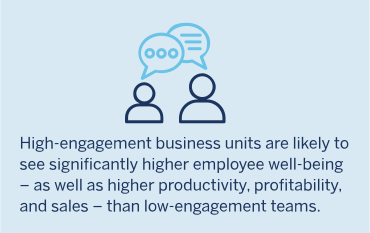
Data supports our view that HCM is as much about opportunity as risk. A recent survey of more than three million workers found highly engaged employees achieved, among other positive outcomes, 18% higher sales productivity and 23% higher organization profitability. These same employees had 78% fewer absences and produced 32% fewer quality errors.7
As the market embraces AI’s potential to enhance productivity, innovation, and profitability, we believe the significance of corporate culture and HCM will only grow. After all, research indicates that robust workforce initiatives and talent development are essential ingredients for effectively adopting new technologies.
Notably, though the dominant workforce narrative is that AI will replace jobs, our recent survey of our portfolio companies highlighted that 50% expect headcounts to stay flat (and that roles may change rather than be eliminated). We anticipate that strong HCM practices will differentiate companies that successfully harness AI's advantages from those that face challenges in its implementation.
Private companies may better mitigate economic risks, enhance organizational resilience, and prepare for public markets by strengthening their HCM practices. To do so, we encourage them to focus on four main areas.
Recruiting, hiring, and onboarding
We believe companies can avoid future HCM challenges by implementing sound practices before employees sign their offers. Companies should be able to articulate hiring goals tied to specific growth and corporate objectives and should clearly define recruiting processes and standards to meet those objectives. This can help create a consistent, transparent process that can scale with growth. This practice should also be matched with analytics to improve the recruitment process over time. We believe this enables companies to be judicious in their hiring to avoid unnecessary onboarding expenses and the potential for cyclical layoffs such as those faced by the tech sector today.
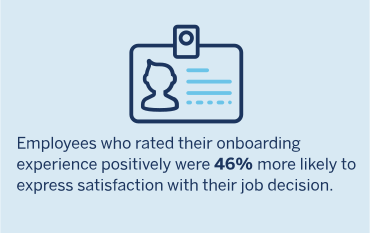
Successfully onboarding new employees can be a cornerstone of long-term employee success. Ideal onboarding experiences can increase employee engagement by 135%, but only 12% of employees strongly agree their organization has effective onboarding processes.8 We recommend that companies develop role-specific onboarding plans for all employees, including highly coordinated first weeks on the job and longer-term plans to take employees through their first three to six months.
Employee development and engagement
US employee engagement declined from the prior year to just 31% in 2024. Meanwhile, employees reporting they were actively disengaged increased slightly to 17%.1 Low engagement is a real cost to organizations. A study of S&P 500 companies showed that low employee engagement reduced productivity by 6% and cost the median company US$91 million annually.9
We recommend that companies create and maintain clear strategies for employee development and engagement. Instead of using a “one-size-fits-all” approach, these should map out specific skill gaps that will emerge as the organization scales, identify the employees who can be developed to fill them, and tailor those employees’ goals accordingly. These can include using frameworks such as SMART Goals to guide development and offering resources such as tuition reimbursement and educational partnerships to support required learnings. Combining a strategically integrated development plan with formalized assessment and promotion criteria can help foster transparency. We also recommend regularly conducting employee engagement surveys (at least annually) to proactively identify improvement opportunities across areas such as job satisfaction and benefits. Transparent employee feedback and organizational responsiveness can lead to higher retention rates, lower absenteeism, improved productivity, better customer service, and enhanced morale.10
Inclusive culture
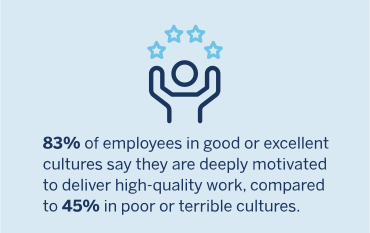
Engagement drives employee productivity, but culture drives employee engagement. In a recent survey, 82% of respondents said that culture positively impacted their organization’s employee engagement, and 81% said it helped their individual motivation.11 Critically, cultural deterioration can increase turnover by up to 35% and reduce a company’s ability to attract and retain talent by a similar magnitude.11
Culture can also be a major consideration in evaluating M&A opportunities. A survey of corporate CFOs revealed over 50% would not make an offer to a company they viewed as a bad cultural fit, while another one third said they would discount their price by up to 20%.12 We therefore believe it is critical to establish a company’s culture early on as part of its growth strategy.
While culture can refer to a broad set of beliefs and behaviors, we view a company’s purpose and values as core to its culture. Purpose and values can unify employees around a common mission and help companies endure periods of disruption. A strong sense of belonging and inclusion within a company makes workers more engaged, innovative, and productive.13 Conversely, employees that do not feel heard or treated fairly may avoid or quit a company unless it can create a space for them to feel valued. Rather than broad, programmatic approaches, companies can support this by promoting transparency, consistent feedback, and clear avenues for employees to voice complaints. Companies should train employees, and particularly managers, to listen for commonalities instead of differences while simultaneously assuring inclusivity is embedded across company operations — from recruiting and internal communications to public marketing.
Compensation and benefits
Compensation and benefits are perennial focus areas that can differentiate companies in a competitive labor market and drive employee engagement. Employees receiving 10+ benefits from their company are approximately 25% more likely to say they’re thriving in their current role and feel a strong sense of belonging to their organization than employees receiving only 4 or fewer benefits.14 We suggest that companies establish a compensation and benefits philosophy early on to guide their decisions. We also recommend implementing practices such as defined compensation bands to support pay transparency as expectations continue to expand at the state and local level. Fourteen states have enacted pay transparency laws, and 10 more have introduced legislation.15
In addition, we believe it is important that company leadership consider the full “benefits stack” and distinguish between “core” and “nice-to-have” benefits. Early-stage private companies may prioritize “core” benefits, but it may be worth monitoring today’s changing employee preferences to understand what that constitutes. For example, while flexible work opportunities continue to remain a significant benefit, a recent survey showed that comprehensive health care is now considered the most important benefit to employees.16 Finally, we recommend that as private companies evolve, they revisit benefits regularly to ensure offerings align to the needs of their current workforce. Employees who feel their benefits are personalized to fit their life needs are 3.5 times likelier to report trusting their employer.17
We believe HCM is an increasingly critical factor for private companies given the current market environment, shifting labor pool preferences, the potential impact of AI, and evolving investor and regulatory expectations. In our view, companies that think holistically and strategically about HCM practices may be best positioned to attract and retain top talent as well as to navigate future periods of uncertainty and disruption.
Below we share nine common questions investors might ask when assessing your company’s approach to human capital management. Preparing to answer these questions can help you develop clarity around your HCM practices and reveal areas of uncertainty, risk, and opportunity.
Employee recruitment, engagement, and retention
1. What strategies does your company employ to attract, recruit, and retain qualified candidates?
2. Do you conduct employee engagement surveys to track and measure employee satisfaction? If so, how responsive are employees and what have you learned?
3. What strategies does your company use to minimize turnover and its associated cost and disruption to your business?
Inclusive culture
4. What do you think are the strongest aspects of your company’s culture? What is one area you would like to improve?
5. What policies or practices do you maintain to help prevent discrimination against employees, particularly related to promotion and compensation?
6. What is your company’s philosophy and approach on DEI?
Compensation and benefits
7. What are the key drivers of your company’s performance? Are those reflected in your compensation program?
8. How do you assess and benchmark your compensation and benefits relative to your market and peers?
9. Are your employee benefits offerings a differentiator when competing for talent?
1Source: Gallup, “State of the Global Workplace,” 2025 report. | 2Source: HR Dive, 20 June 2025 | 3Source: HR Executive, “Why new hire retention should be on everyone’s dashboard in 2025,” 18 November 2024. | 4Source: Alix Partners, “Tenth Annual PE Leadership Survey,” 2025. | 5Source: HR Morning, “The real cost of employee turnover now,” 23 April 2025. | 6Source: BlackRock Investment Stewardship, “Proxy voting guidelines for Benchmark Policies – US Securities,” January 2025. | 7Source: Gallup, “The Q12: The World’s Leading Employee Engagement Survey.” | 8Source: “The Formula for Employee Engagement,” O.C. Tanner. As of May 2024. | 9Source: McKinsey & Company, “Increasing your return on talent,” April 2024. | 10Source: LinkedIn, “2019 Workplace Learning Report.” | 11Source: Redgrave, “The state of workplace culture in 2025,” 17 March 2025. | 12Source: Wiley Online Library, “Corporate culture in a new era: Views from the C-suite.” Graham, Grennan, Harvey, Rajgopal. | 13Source: The Harvard Business Review, “The power of small acts of inclusion.” Muragishi, Aguilar, Carr, and Walton, 24 December 2024. | 14Source: Mercer Marsh Benefits. “Smarter benefits, stronger workforce.” 2025. | 15Source: Paycor, “2025 Pay Transparency Laws by State,” 31 March 2025. | 16Source: Forbes, “Employee Benefits in 2024: The Ultimate Guide.” | 17Source: Forbes, “When benefits work, so do people,” 20 October 2025.