


- Fixed Income Portfolio Manager
Formats
2026 Midyear Investment Outlook

2026 Midyear Investment Outlook
The views expressed are those of the author at the time of writing. Other teams may hold different views and make different investment decisions. The value of your investment may become worth more or less than at the time of original investment. While any third-party data used is considered reliable, its accuracy is not guaranteed. For professional, institutional, or accredited investors only.
Long-dated bonds have experienced poor performance for a decade and a half, failing to deliver positive real (inflation-adjusted) returns or effective diversification during market downturns. However, the current attractive valuations on long bonds suggest the potential to regain their role as a diversifier against stock market volatility. While many point to inflation fears, deficit spending, reduced savings, and the coming AI productivity boom as reasons for elevated forward yields, I believe there are flaws in each of these arguments. In my view, long-maturity bonds could once again become negatively correlated with stock returns, warranting renewed attention from asset allocators.
The Bloomberg Aggregate Index (Agg), the benchmark for the US bond market, has had a rough 15 years. Relative to inflation, the Agg has not generated a real (inflation-adjusted) return since early 2010, representing a lost decade and a half for fixed income. More recently, since the bond market’s peak in August 2020 during the COVID-19 shutdowns, the S&P 500 has increased by almost 100%.
Bonds have also done a poor job of protecting capital in downturns, including the stock sell-off during the rate-hiking cycle of 2022, the Silicon Valley Bank crisis of 2023, and tariff worries in early 2025. As a result, many investors have given up on longer-maturity fixed income, pushing forward yields higher (Figure 1).
Figure 1
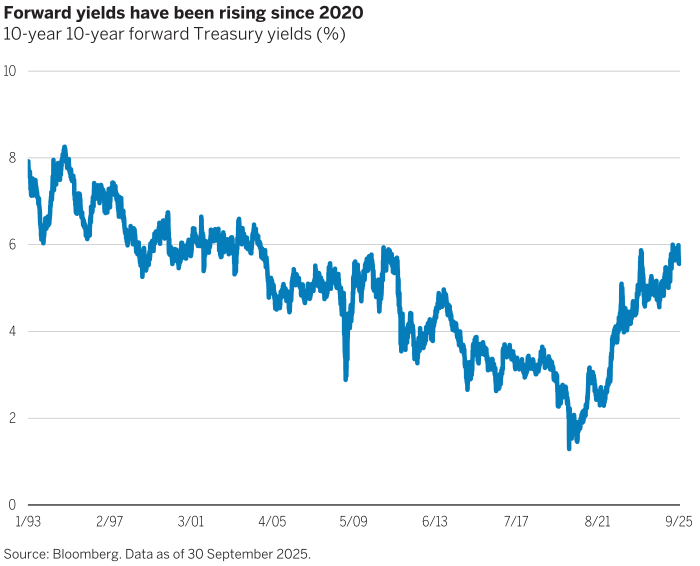
Bond forwards represent expectations about future yields. If a 20-year bond yields 5% and a 10-year bond yields 4%, the implied 10y10y forward yield (the 10-year yield, 10 years in the future) could be closer to 6%, depending on certain assumptions. During the second 10-year period, higher yields are needed to achieve the average over the entire period. Current forward US Treasury 10y 10y yields are at 5.6% as of 30 September 2025, a level not seen since the early 2000s.
Although market watchers commonly cite several reasons for elevated long bond yields, I see problems with each of them.
Inflation fears? Today’s breakeven suggests otherwise
The most oft-cited reason for high yields at the long end of the curve is that the bond market is pricing in fear of inflation. However, a quick look at the difference between 30-year Treasuries and 30-year Treasury Inflation-Protected Securities (TIPS) — or breakevens — suggests that the market is assuming muted inflation. The 30-year breakeven is currently at 2.25% as of 30 September, similar to pre-COVID-era inflation pricing and much lower than the years prior to the global financial crisis. This indicates that, for now at least, the bond market is not worried about the emergence of substantial inflation.
Deficit spending? The link to higher yields is unclear
Another common argument for high future bond yields is the worry about the economic impact of issuing more bonds due to substantial government deficit spending. To understand this market concern, we can look at the difference between long-term Treasury yields and similar rates tied to the US Federal Reserve (Fed), known as the swap spread. This spread reflects concerns about future bond issuance, meaning Treasury yields should rise compared to Fed pricing when there is anxiety about bond supply. This happened during the tariff fears in April when long-dated swap spreads nearly reached -100 basis points (bps). Currently, they are at -80 bps, not significantly different from before the 2024 election and resulting one-party US rule. Additionally, countries with the steepest yield curves, like Australia, are close to running budget surpluses and have low government debt. This suggests that the steepness of global yield curves is not linked to excessive government spending.
Savings reductions? Investors don’t seem all that concerned
The argument for higher forward yields I am most sympathetic to is falling savings, but there are even flaws with this. One reason why the bond curve was flat in the mid-2000s was because of China’s focus on investment over consumption, which generated excess savings. The resulting capital was then deployed into US assets, which prevented rapid appreciation of the renminbi. The Trump administration is now aiming to reduce these imbalances through tariffs and encourage fiscal spending in China, Europe, and elsewhere.
Spending, of course, increases consumption and reduces saving, and should imply less capital flowing into US assets. The impact on US Treasury yields should be muted, however, given the long-running decline in foreign ownership of Treasuries: 51% in 2012 to 30% in 2025.1 Instead, non-US investment flows have gone to either US stocks or credit markets. With the S&P 500 near-historic highs (signaling strong investor confidence) and credit spreads near historic lows (signaling scant risk premia), it is hard to argue that markets are overly concerned about falling capital inflows caused by savings reductions.
AI productivity boom? It could underwhelm markets
In my view, the main reason why long-term yields remain stubbornly high is because the market is pricing in an AI-driven productivity boom. When investment is high relative to savings, rates tend to rise. At the same time, higher productivity tends to lead to growth without inflation. This would explain the low level of long-dated breakevens and scant investor concern over government spending, particularly if real growth offsets concern about fiscal deficits.
This narrative also impacts short-term interest rates. The market is currently pricing a Fed Funds rate of 3.13% in two years, implying a 100-bps reduction. That expectation aligns with the Fed potentially shifting focus from inflation to addressing labor market weakness due to AI-related layoffs. As a result, investors have crowded into short-term credit investments, taking advantage of an accommodative Fed and strong stock market performance.
But these expectations are already priced in, meaning several factors could lead to a different outcome for bonds. For example, what if AI investment stalls amid diminishing returns from new large language model (LLM) innovation? Or what if AI reduces employment more than it increases productivity, meaning lower economic growth? Finally, what if AI investment drives commodity prices higher, as with electricity costs, and inflation again becomes a bigger immediate concern for the Fed?
The point is that the “Goldilocks” narrative for AI is already reflected in the price of stocks and short-term credit securities. If the actual benefits of AI fall short of lofty expectations, risk markets could stumble and the yield curve could flatten. In that scenario, long-duration bonds might once again exhibit a negative correlation to stocks, helping to diversify and stabilize an investment portfolio.
1 “Foreign holdings of federal debt,” Congress.gov.