






- Lead Client Services Writer
Switzerland, Institutional
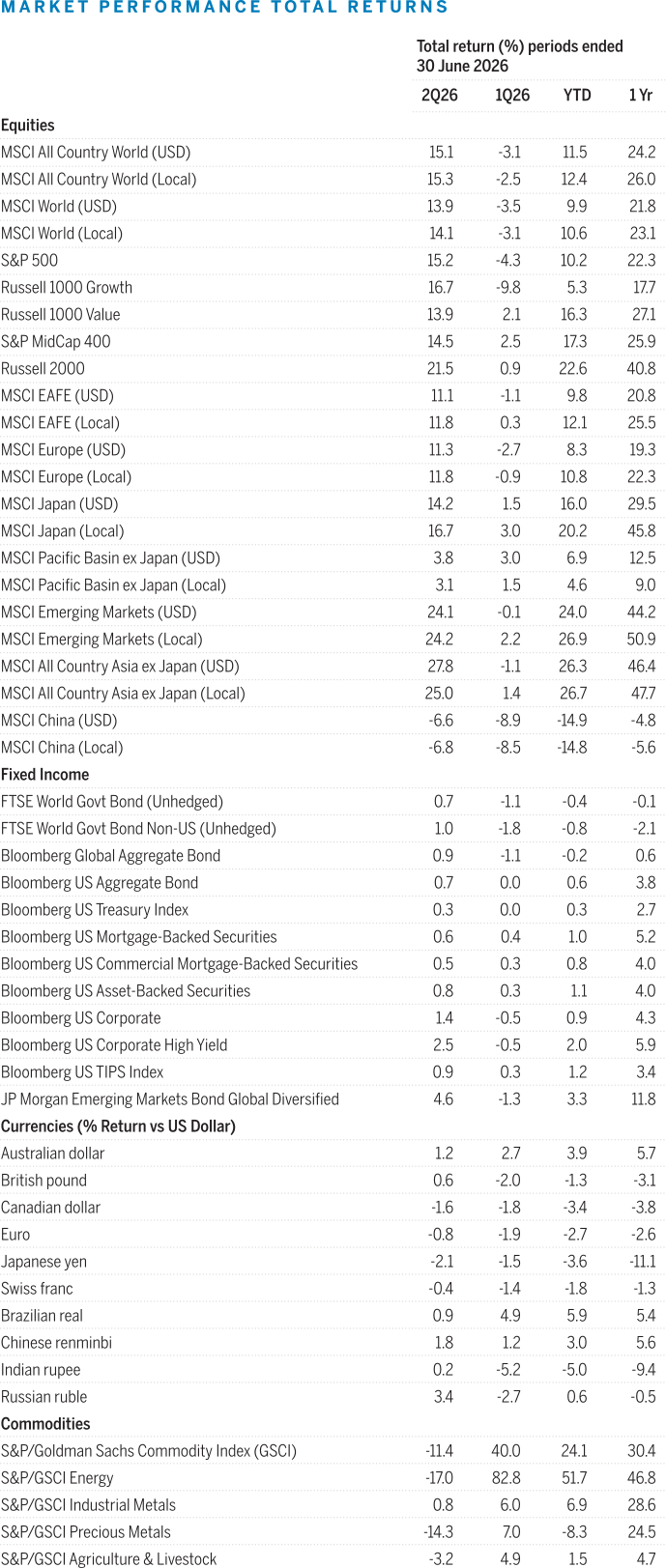
ChangeGlobal equities (+15.3%) rebounded sharply in the second quarter, supported by a recovery in risk appetite, robust corporate earnings, and continued investment in AI-related infrastructure. Gains were the largest in April and May before performance ebbed in June, as easing energy prices and tentative progress toward a peace settlement between the US and Iran helped offset concerns around high valuations, elevated inflation, and divergent central bank policy. Market leadership also evolved over the quarter, with technology and AI-linked companies leading early in the quarter before performance broadened to other areas of the market in June, including the beneficiaries of the AI capital-spending cycle. The macro backdrop remained uneven. The Iran conflict continued to weigh on energy markets, shipping, insurance, and input costs, complicating policy decisions as softer consumption in some regions contrasted with persistent inflation risks and resilient AI-related investment. Policy paths diverged, with the European Central Bank (ECB) and Bank of Japan (BOJ) raising rates in June, the Reserve Bank of Australia (RBA) tightening in May before holding steady in June, and the US Federal Reserve (Fed) and Bank of England (BOE) leaving rates unchanged. Regional dispersion persisted, with uneven Chinese economic activity, softer momentum in parts of Europe and the UK, and volatility across Asian technology shares. Capital-market activity began to revive, with SpaceX’s public offering and several large private companies preparing to list, suggesting that risk appetite was broadening despite lingering economic and policy uncertainty.
Global fixed income markets delivered positive returns as easing geopolitical tensions, resilient economic growth, and supportive market technicals offset concerns around inflation and central bank policy. Commodities (-11.4%) fell in the second quarter, with energy, precious metals, and agriculture & livestock detracting from performance. Industrial metals contributed positively to returns.
United States
US equities (+15.2%) delivered their highest quarterly return in six years, registering a 10.2% gain year to date. Despite anxiety about the inflationary impacts of the US-Iran conflict and the prospect of higher interest rates, equity markets were propelled to a series of record highs by robust corporate earnings, elevated earnings-growth expectations, solid economic data, and massive demand for AI. Exceptionally strong technology sector performance led growth stocks to outperform their value counterparts over the quarter, even after the Magnificent Seven stocks shed more than US$2.2 trillion of value in June on a substantial rotation away from AI hyperscalers to chipmakers and other companies benefiting from the huge amounts of AI spending. However, the Fed’s hawkish change in interest-rate expectations bolstered the performance of economically sensitive sectors of the economy in June, benefiting small-cap and value-oriented stocks. In Kevin Warsh’s first meeting as Fed chair, the Federal Open Market Committee (FOMC) left interest rates unchanged in June. Quarterly economic projections revealed that 9 of 19 Fed officials anticipate at least one interest-rate hike this year, marking a decisive shift from March “dot plot” projections, which signaled one rate cut in 2026. This change reflected highly elevated headline and core inflation and a hotter-than-expected economy, underscored by resilient consumer spending and a surge in job growth during the quarter.
Economic data released during the quarter revealed that the economy was on a very solid footing. Higher-than-anticipated and accelerating job growth during the quarter offered hope that the labor market may be breaking out of a prolonged period of lackluster hiring. Jobless claims remained historically low, and the unemployment rate was steady at 4.3% over the quarter. Despite lackluster consumer confidence and the spending strains from a three-year high in inflation, consumer outlays in May were bolstered by a pickup in hiring, elevated tax refunds, and favorable wealth effects from higher stock prices. Headline retail sales and consumer spending accelerated 0.9% and 0.7%, respectively, after both measures grew 0.4% in April. The housing market’s critical spring homebuying was bogged down by stubbornly high mortgage rates and affordability constraints, dampening hopes of a recovery from a lengthy period of depressed sales. In June, the manufacturing sector expanded for the sixth consecutive month, while the services sector expanded at a healthy pace in May and at the fastest rate in three months on a surge in new orders and broad-based growth across sectors. The NFIB Small Business Optimism Index was relatively soft, reflecting above-average economic uncertainty, intensifying price increases, supply chain disruptions, and weak expectations for capital expenditures.
Within the S&P 500 Index (+15.2%), 9 of the 11 sectors posted negative results for the quarter. Information technology (+31.8%) was the best-performing sector, led by semiconductors and semiconductor equipment (+49.7%). Industrials (+14.8%) and consumer discretionary (+9.3%) also registered strong results. By contrast, energy (-13.6%) was the worst-performing sector followed by utilities (-0.5%) and consumer staples (+0.3%), which also underperformed.
Europe
European equities (+11.8%) rose sharply, even as a surge in energy prices weighed on European economies and caused eurozone business activity to contract for the first time in 16 months. In its Spring 2026 Economic Forecast, the European Commission cut its eurozone economic growth projection to 0.9% from 1.2% and raised its inflation forecast to 3.0% from 1.9%, warning that the global energy shock was undermining consumer confidence, softening investment demand, and curbing the outlook for household spending and exports. The European Parliament approved a long-delayed trade deal with the US, averting threats of 25% US tariffs on European cars. European lawmakers agreed to remove levies on US industrial goods and some agriculture products in exchange for a 15% US tariff cap on most European exports. Trade relations with China remained strained as the European Commission prepared tougher measures to address a widening trade deficit with China. The S&P Global Flash Eurozone Composite Purchasing Managers’ Index (PMI) rose to 49.5 in June, indicating only a slight downturn in private sector activity. In response to inflation pressures from the energy shock, the ECB hiked interest rates for the first time since 2023. However, ECB President Christine Lagarde indicated that the central bank’s response to inflation would be less aggressive than in 2022 – 2023 amid signs of moderating economic momentum in the second quarter, a decline in oil prices, and lower-than-expected annual eurozone headline inflation of 2.8% in June. Norway’s central bank raised interest rates due to elevated inflation, while policy rates in the UK and Sweden were unchanged. According to LSEG, first-quarter earnings for companies in the STOXX 600 Index are forecast to increase by 11.8% from a year earlier.
In June, the S&P Global Eurozone Manufacturing PMI declined to a four-month low of 51.4 but remained in expansionary territory for a fifth consecutive month as factory production growth quickened. The S&P Global Flash Eurozone Composite PMI revealed that services sector activity improved in June but continued to contract modestly for the third consecutive month. A slower increase in input costs and output prices curbed inflation across both manufacturing and services. The European Commission’s Economic Sentiment Indicator increased noticeably to 95.0 in June; both industry and consumer confidence rebounded.
Germany’s (+9.5%) first-quarter GDP grew at a faster-than-anticipated quarterly pace of 0.3%, supported by increased private and government consumption and higher exports. However, higher energy prices and inflation strained the economy and led the German Council of Economic Experts to cut its 2026 economic growth forecast to 0.5%, from 0.9%. Encouragingly, a sharp rebound in the ZEW Indicator of Economic Sentiment in June reflected greater optimism that reduced tensions in the Middle East will ease inflationary pressures on Germany’s industrial base and households. In the UK (+3.4%), Prime Minister Sir Keir Starmer’s resignation after significant Labour Party losses in May elections prompted political uncertainty and raised concerns about fiscal policy, public investment, and the government’s economic programme. The UK economy contracted 0.1% in April due in part to the impact of the war in Iran, while the S&P Global Flash UK PMI Composite Output Index declined in June for the second straight month, as a sharper decline in services activity offset an improvement in manufacturing output. Annual headline inflation unexpectedly held steady at 2.8% in May, easing the pressure on the Bank of England to raise interest rates against a backdrop of weak economic growth.
Pacific Basin
Pacific Basin equities (+12.3%), ended the quarter higher as sentiment improved on a more supportive global policy backdrop and easing Iran-related geopolitical concerns. In Japan (+16.7%), the BOJ maintained a hawkish bias throughout the quarter, warning of a cloudier economic outlook amid concerns that higher oil prices could lift inflation expectations and constrain economic growth. These risks reinforced the BOJ’s data-dependent approach to policy normalization, although mixed economic readings complicated the path toward higher interest rates. Upside inflation risks from a weak yen, the energy supply shock, solid exports, and resilient wage growth supported the case for further normalization, while lackluster household spending and downwardly revised first-quarter annualized GDP growth of 1.8% highlighted underlying fragility in the economy. In June, the BOJ raised interest rates by 25 basis points (bps) to 1.0% — the highest since 1995 — and considered pausing its Japanese government bond purchasing in 2027 to help stabilize long-term yields. However, policymakers offered little guidance on the timing of their next move on interest rates, leaving market expectations centered on another rate hike later in 2026. Prime Minister Sanae Takaichi’s cabinet approved a ¥3.1 trillion (US$19.4 billion) package to cushion households from inflationary pressures linked to the spike in energy costs from the US-Iran conflict.
In Australia (+3.9%), the Reserve Bank of Australia (RBA) delivered its third consecutive 25 bps rate hike, lifting the cash rate to 4.35%, as persistent inflation pressures, a sharp rise in fuel costs, and a still-tight labor market supported a more restrictive policy stance. However, policymakers held rates steady in June, as slower-than-expected first-quarter GDP growth and expectations for further weakening in second-quarter GDP underscored mounting pressure on household spending and the housing market. Although headline inflation eased to 4.0% in May on temporary fuel excise relief, trimmed-mean inflation accelerated to 3.6%, reinforcing the central bank’s hawkish policy stance and increasing market expectations for an additional rate hike later this year.
In Singapore (+10.2%), economic momentum remained resilient despite a higher inflationary backdrop. The Monetary Authority of Singapore responded to rising inflation risks by tightening monetary policy and raising its 2026 headline and core inflation forecasts to 1.5% – 2.5%, while the government provided targeted support for households and businesses to cushion them from the impact of higher energy prices. The Ministry of Trade and Industry maintained its full-year growth forecast at 2% – 4%, although Prime Minister Lawrence Wong warned that growth and inflation pressures could intensify in the second half of the year as higher energy costs, rapid AI adoption, Middle East disruptions, and renewed tariff risks filter through the trade-reliant economy. Nevertheless, with inflation remaining subdued, markets perceive less urgency for the Monetary Authority of Singapore to tighten policy in July.
Emerging markets (EM) equities (+24.2%) surged in the second quarter, with Asia leading the gains, followed by Europe, the Middle East, and Africa (EMEA). Latin America declined.
In Asia (+30.8%), China (-6.8%) was weighed down by weak domestic demand, the beleaguered property sector, and concerns about the sustainability of the country’s economic recovery. Consumer spending deteriorated, with a 0.6% year-over-year drop in retail sales marking the first decline in more than three years. The property sector remained under pressure, as resale home prices fell at a faster pace in June, and property investment dropped by 16.2% in the first five months of 2026 compared to the same period last year. Factory activity showed signs of modest growth; industrial production rose 4.5% year over year in May, up from 4.1% in April, while the manufacturing PMI returned to expansion with a slightly improved reading of 50.3 in June. However, growth was driven largely by exports and AI-related technology demand rather than domestic demand. Exports gained pace in May, rising 19.4% from a year earlier, as technology-related shipments remained robust. Notably, exports to the US surged more than 35% year over year, marking the highest pace of growth since early 2021. Taiwan’s (+48.4%) economy continued to benefit from the global AI boom, prompting the central bank to raise its 2026 GDP growth forecast to 9.45% in June from 7.25% in March. The government’s statistics agency upgraded its 2026 export growth forecast to almost 40% — the highest in five decades — as external demand remained exceptionally strong. Exports surged 51.7% year over year in May to US$78.5 billion, the second-highest value ever recorded. South Korea (+89.8%) skyrocketed. Exports expanded at the strongest pace since 1978, rising 70.9% year over year in June to US$102.25 billion, as shipments of semiconductor chips soared almost 200% to US$44.8 billion. India’s (+10.0%) retail inflation rose 3.93% annually in May, driven by higher food and fuel costs, but remained close to the central bank’s medium-term target. The HSBC Manufacturing PMI slipped to a still elevated level of 54.2 in June, but the reading was the second lowest since mid-2022.
In EMEA (+1.1%), Saudi Arabia’s (-3.7%) crude oil exports dropped to a record low of four million barrels per day (bpd) in April due to restricted flows via the Strait of Hormuz. OPEC’s control over global oil supplies was undermined after the United Arab Emirates (+8.6%) announced that it will leave OPEC on May 1 because of increasing frustrations with its allotted quota for oil production. Crude and condensate exports subsequently reached record highs, averaging about 3.7 million bpd in June, up from 3.1 – 3.3 million bpd before the Middle East conflict.
In Latin America (-4.9%), Brazil’s (-8.8%) central bank cut its benchmark Selic rate by 25 bps to 14.25% and raised its 2026 inflation forecast from 4.6% to 5.2% and its 2026 economic growth forecast from 1.6% to 2.0%. A robust labor market and high government spending supported economic activity but undermined the tight monetary policy needed to slow inflation to target. In Mexico (-0.1%), the Organization for Economic Cooperation and Development lowered its 2026 GDP growth forecast from 1.3% to 0.8%, citing economic policy uncertainty, trade tariffs, and fiscal consolidation. The central bank cut interest rates by 25 bps, to 6.5%, but signaled the end of its more than two-year easing cycle.
Global fixed income markets delivered positive returns in the second quarter as easing geopolitical tensions, resilient economic growth, and supportive market technicals offset concerns around inflation and central bank policy. The quarter was dominated by developments in the US-Iran conflict. Oil prices initially surged as tensions escalated and disruptions to shipping through the Strait of Hormuz raised concerns about inflation and growth. However, progress toward a US-Iran truce and the normalization of shipping flows later in the quarter helped oil prices retreat toward pre-conflict levels, improving risk sentiment and reducing energy-related inflation concerns. Inflation remained elevated but uneven across regions, while central bank policy paths diverged. In the US, the June FOMC meeting signaled a more hawkish stance under Fed Chair Kevin Warsh, reinforcing a higher-for-longer outlook for interest rates, while several non-US central banks maintained a more accommodative bias.
Most global sovereign bond markets generated positive returns as yields declined across Europe, Canada, Australia, and many EM countries. The US was a notable exception, where front-end Treasury yields rose following the hawkish June FOMC meeting, leading to a flatter yield curve. EM local-currency bonds also performed well, supported by attractive real yields and improving fundamentals in several countries.
Corporate credit markets outperformed government bonds during the quarter as spreads tightened across regions, sectors, and ratings categories. Robust investor demand, positive fund flows, and historically high issuance volumes helped absorb record levels of supply, including several large AI-related data-center financings. European credit outperformed US credit markets, while high-yield bonds benefited from improving risk sentiment that favored lower-quality issuers. Within securitized markets, performance was broadly constructive, underpinned by tightening spreads, attractive carry, and strong demand from institutional investors.
Currency markets reflected divergent monetary policy expectations and shifting geopolitical developments. The US dollar strengthened against most major developed market currencies, supported by higher US Treasury yields and a more hawkish Fed outlook. Commodity-linked currencies lost support as oil prices stabilized, while the Japanese yen remained under pressure despite further policy normalization by the BOJ. Emerging market currencies delivered mixed results, with several Latin American currencies benefiting from attractive carry and supportive fundamentals, while others lagged due to country-specific economic and policy challenges.
Commodities (-11.4%) fell in the second quarter, with energy, precious metals, and agriculture & livestock detracting from performance. Industrial metals contributed during the period.
Energy (-17.0%) slid during the period. Crude oil (-21.2%), gas (-13.6%), heating oil (-11.7%), and gasoline (-0.5%) declined as growing confidence in the reopening of the Strait of Hormuz reduced concerns over oil supply disruptions and unwound the geopolitical risk premium embedded in prices. The sell-off was further driven by softer demand expectations and weaker refining margins, as improving supply prospects outweighed ongoing geopolitical and supply-side risks. Natural gas (-1.1%) slipped as mild weather softened domestic demand and accelerated storage injections, more than offsetting support from resilient liquified natural gas exports. Robust US production and ample inventories kept the market well supplied, while expectations for cooler temperatures following a brief heat wave added further pressure on prices.
Industrial metals (+0.8%) rose. Zinc (+11.1%) rallied on tightening inventories, supply disruptions, and limited mine growth, which constrained global supply and tightened physical availability. Strong demand from galvanizing and infrastructure applications, along with higher production costs, provided additional support to prices. Copper (+9.4%) advanced as mine supply disruptions, concentrate shortages, and tight inventories constrained availability, while solid demand from electrification, AI infrastructure, and China supported prices. Negative treatment and refining charges, along with operational challenges at major mines, further underscored tight market conditions. Lead (-1.9%) declined on weak seasonal demand, rising global exchange inventories, and bearish macro sentiment. Nickel (-5.2%) lagged due to persistent oversupply from strong Indonesian production, rising inventories, a firmer US dollar, and seasonal increases in ore availability. Aluminum (-10.2%) slid as easing US-Iran tensions and prospects for the reopening of the Strait of Hormuz reduced supply-risk concerns and unwound the conflict-driven risk premium. Expectations for a gradual recovery in Gulf production and exports weighed on prices, although supply normalization is expected to be slow.
Precious metals (-14.3%) ended sharply lower. Silver (-20.5%) and gold (-13.5%) slid as easing geopolitical tensions reduced safe-haven demand, while higher real yields and expectations for tighter US monetary policy increased the opportunity cost of holding nonyielding assets. A stronger US dollar further pressured precious metals, prompting investors to rotate toward interest-bearing assets.
Agriculture & livestock (-3.2%) decreased. Corn (-12.1%) ended lower as favorable weather, good crop conditions, and US Department of Agriculture projections for another large US harvest reinforced expectations for ample supplies. Growing confidence in robust yields and abundant grain inventories outweighed support from higher energy prices and geopolitical tensions. Lean hogs (-8.5%) were pulled lower by higher slaughter rates and rising pork supplies, while concerns about consumer spending softened demand expectations. Sugar (-8.2%) slid on a global supply surplus, driven largely by India’s production recovery and continued exports, which eased earlier supply concerns. Live cattle (+2.9%) ended higher on tight herd supplies and healthy seasonal demand. Coffee (+3.5%) was bolstered by weather-related supply disruptions in key producing regions, rising transportation costs, and import tariffs. Strong global demand, particularly from China, further tightened supplies and pushed coffee prices higher. Cocoa (+48.3%) surged on rising El Niño-related weather risks in West Africa, fueling concerns over future crop yields and tightening the global supply outlook.
The views expressed are those of the authors at the time of writing. Other teams may hold different views and make different investment decisions. The value of your investment may become worth more or less than at the time of original investment. While any third-party data used is considered reliable, its accuracy is not guaranteed. For professional, institutional or accredited investors only.





















Monthly Market Review — August 2026
A monthly update on equity, fixed income, currency, and commodity markets.
By